
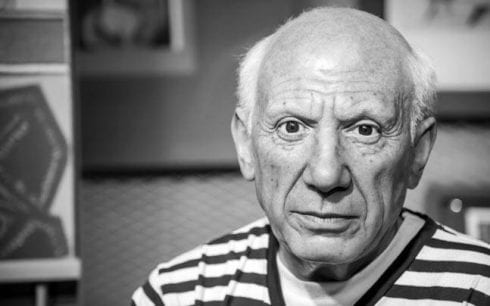
MALAGA’S most famous son, Pablo Ruiz Picasso, was born on October 25, 1881.
To mark his birthday this week, we thought we’d look back at the eight phases that constitute his evolution as an artist.
Before we begin, a quick ‘thumbnail’ of his life might be useful.
Picasso moved with his family to Galicia when he was nine years old. He doesn’t seem to have felt any affection for Andalucia, and he returned only rarely, for brief visits.
He was deeply affected by the death of his sister, from diphtheria, in 1895.
That same year the family left the north-west and resettled in Barcelona. This was much more to Picasso’s liking and he would always regard the Catalan capital as his home town.
With the dawn of the new century, the 18-year-old Picasso relocated to Paris, where all aspiring artists wanted to be. He needed to escape the influence of his father, whose artistic tastes were, he felt, decidedly ‘square’.
We can see the symbolism of this in his change of name.
His circle of acquaintances, up to now, had called him ‘Ruiz’ (in Spain you carry both your father’s and your mother’s surnames, but usually go by your father’s – unless, it seems, your mother’s is more interesting).
Taking advantage of this convention, he let it be known that he was now ‘Picasso’ rather than ‘Ruiz’.
The rise of Fascism in Spain angered Picasso, and he swore not to return to his native land while Franco was alive.
When he (Picasso) died in France in 1973, he was 91 years old. Franco still had two and a half years to live.
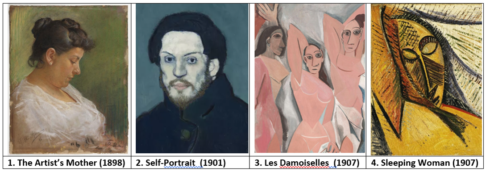
1. Juvenilia
Picasso once said that he painted like an adult when he was a child, and then spent years of his adulthood learning how to paint like a child.
His teenage works are very conventional – he clearly had skill, but hadn’t yet found his own voice.
2. Blue Period (1901-1904)
These paintings are gloomy and cold.
Critics suggest that the death of Conchita (his sister) and the suicide of his friend Carles Casagemas were weighing heavily on the artist.
His themes are almost obsessive – blind men and prostitutes.
3. Rose Period (1904-1906)
When Picasso fell in love with a woman named Fernande Olivier, his tone became more cheerful and positive.
She appears in many Rose Period canvases as a circus character. Picasso depicts himself as the clown, Harlequin.
4. African Period (1907-1909)
After seeing an exhibition of African tribal masks at the Trocadero, Picasso switched styles, and tried to imitate primitive art.
Even when he painted human faces, they took on mask-like aspects. He was moving away from realistic depiction.
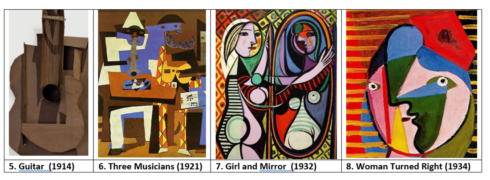
5. Cubism (1909-1919)
Though he was very much a loner, an artist who influenced others rather than followed trends, Cubism was a movement that he embraced enthusiastically.
He made friends with Georges Braque, and they discussed shape and form together. Indeed, it’s hard to tell their paintings of this period apart.
6. Collage (from 1912)
What sets Picasso apart from other artists is his lifelong willingness to evolve and adopt new ideas.
Around 1912, still working alongside Braque, he began gluing everyday scraps – newspaper, oilcloth, wallpaper – into his pictures.
The notion that an imaginative artist could incorporate random scraps into his creations, later celebrated as the objet trouve (the ‘found thing’) appealed to Picasso, and he started making collages.
7. Neo-Classicism (c.1917-1925)
After a trip to Italy in 1917, he had moved on yet again.
He now wanted to show that the great painters of the past had been limited by having to show reality.
Now cameras (both still and cinematic) could do that job, and the artist was free to (for example) play with ambiguity. A woman’s reflection in a mirror might look like a man.
8. Surrealism (mid-1920s-1930s)
The First World War and Sigmund Freud had an enormous effect on artists – and not only Pablo Picasso.
After the horror of the trenches, it was hard to see goodness in human nature. And Freud showed us that our dreams are not external visitations: they reveal the dark kinks in our own personalities.
Click here to read more Spain News from The Olive Press.