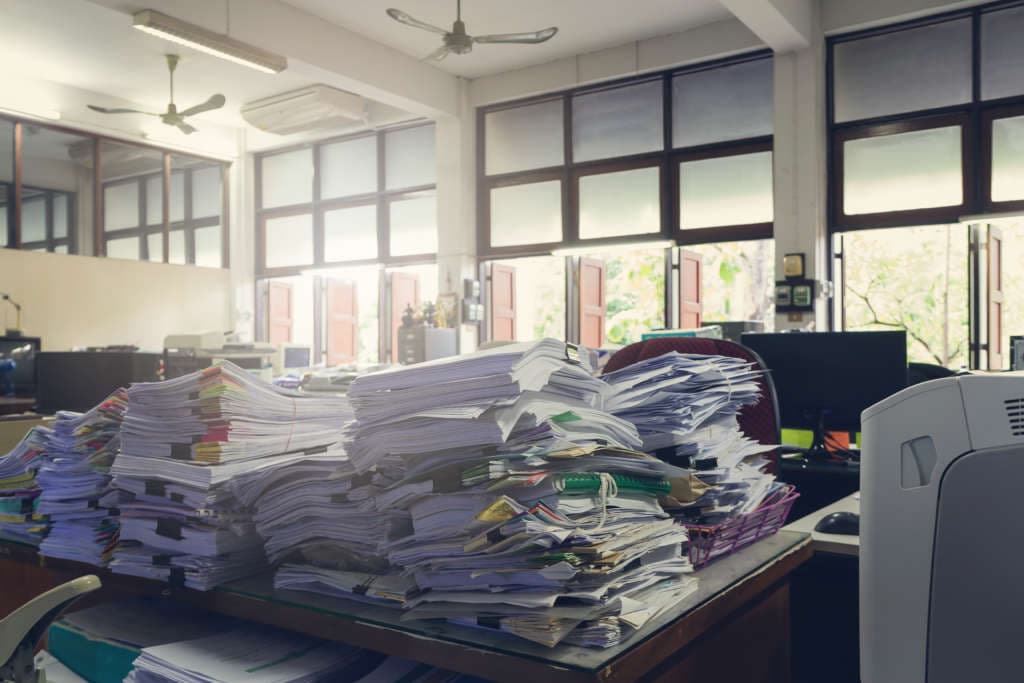
Government has spent decades improving how administrative work is processed. Agencies have invested in technology, systems and processes designed to make existing work faster, more efficient and less expensive.
But there is another question worth asking: Does the work need to enter the organization at all?
This is the concept of administratively unnecessary work (AUW): work that consumes government resources but could have been prevented before entering normal government workflows.
The goal is not to process AUW more efficiently. The goal is to prevent it from entering government workflows in the first place.
The State Department challenged business as usual. Using reported reductions in commercial mail volume at the State Department and applying estimated costs based on Postal Service estimates and conservative shipping costs, analysis estimates more than $5 million in operational savings.
The Diplomatic Pouch and Mail Division implemented an approach to identify non-mission-critical commercial mail at two operational sites (SA-32 and HST). SA-32 handles mail destined for embassies and consulates around the world. HST, the main office downtown, handles mail for domestic offices in Washington, D.C.
Both operations analyzed the mail entering their facilities and determined that a significant portion of non-mission-critical mail was AUW. Based on that determination, the sites worked with Waste-Free Mail (WFM), which enabled the State Department to communicate directly with the vendors producing the material and request that it be stopped at the source. This prevented unwanted commercial mail destined for embassies, consulates and D.C. buildings from ever being created.
I worked with the State Department offices at SA-32 and HST and the director of logistics throughout the implementation and evaluation. The State Department continues to use this approach to reduce unwanted commercial mail. In a little over two years, 1.41 million commercial mail pieces have been eliminated across the SA-32 and HST operations. The Logistics Department monitors and tracks mail-volume data, allowing the operational and sustainability impact to be measured and reported. The resulting data showed that reducing unwanted mail at the source reduces the downstream resources required for mail staff and office administrator handling, storage space, machine usage and disposal associated with AUW.
The significance is not simply the amount saved. The approach is fundamentally different from traditional mail management: Rather than making the processing of unwanted mail more efficient, it enables agencies to prevent AUW before government resources are committed to receiving, handling, distributing, storing and disposing of it.
The technology used at the State Department has also been tested during pilot programs at five U.S. Air Force installations: Davis-Monthan Air Force Base, Keesler Air Force Base, Maxwell Air Force Base, Sheppard Air Force Base and Patrick Space Force Base. All five installations achieved mail volume reductions, with documented reductions ranging up to 70%. WFM worked with the participating mail operations through the Air Force Installation and Mission Support Center (AFIMSC), San Antonio, Texas, during the pilots to evaluate the technology’s ability to reduce unwanted commercial mail entering the installations. These results suggest that the issue deserves to be considered more broadly than as a mail management problem.
The cost of unnecessary work
When unnecessary work enters a federal organization, it can create a chain of activities that require people, space and infrastructure.
In this case, employees receive, sort, distribute, process, store, potentially reship and eventually dispose of materials that never needed to enter the organization in the first place.
Although each task may appear small, collectively these activities consume government resources — and ultimately taxpayers pay for them.
This raises a broader question about how government defines efficiency.
If an agency becomes very efficient at processing unnecessary work, has it actually eliminated the underlying cost?
Or has it simply become better at processing something that should never have entered the agency?
The decision is not simply whether to process the work more efficiently. The question is whether the work should enter the government at all.
Why does AUW exist?
AUW often exists because the organization responsible for performing the work may not have the authority, incentive or visibility to eliminate it.
The people processing the work are typically measured on how efficiently they perform their assigned responsibilities — not on whether the work should exist in the first place. As a result, organizations can become highly efficient at processing work that may provide little or no value to the government.
When an efficiency opportunity affects employees, administrative personnel, operations, storage, facilities and disposal, it should be viewed as a government efficiency issue, rather than solely as the responsibility of the organization that processes the work.
The decision to eliminate that work often requires executive leadership because the benefits and consequences extend beyond any single organization.
Technology changes the game
Today, technology makes it possible to identify and prevent AUW before government resources are committed.
The objective is straightforward: Stop unnecessary work at the source rather than making government more efficient at handling it.
The big, audacious question
How much AUW is entering the federal government today, and how much of it could be prevented?
The federal government should conduct a governmentwide evaluation to determine whether preventing AUW should become a federal operational efficiency initiative.
The objective would be to identify work that consumes government resources but could be prevented before entering normal government workflows.
Such an evaluation is different from simply looking for cuts. It would first determine whether the work provides sufficient value to justify the government resources required to receive, process, store or dispose of it — and then ask whether that work could be prevented at its source.
This approach shifts the focus from simply doing work better to determining whether the work needs to be done at all.
Let’s determine what work does not need to be done at all — and prevent it before government resources are committed.
Michael Sanders is president of Intra-Mail Network and developer of the Waste-Free Mail app.
Copyright © 2026 Federal News Network. All rights reserved. This website is not intended for users located within the European Economic Area.