On a Thursday morning in October, Bridge Books is a sanctuary on Helen Joseph Street. The wooden bookshelves, small tables and a reading lounge invite you to stop. The book range is the hallmark of an alternative curatorial mind.
I quickly pick up a James Baldwin oldie, a Max du Preez semi-memoir and a book on feminism by Chimamanda Ngozi Adichie that I don’t have. I’m slightly early for an interview with Griffin Shea, who is briefing his staff, including interns from the Youth Employment Service.
Shea started Bridge Books in 2016 when he came to Joburg as a journalist and didn’t fancy adding to the well-stocked suburban literary scene. He Googled bookshops in the inner city and found gems he wanted to join. And so Bridge Books was born, first next door to the Rand Club and now in the revamped Barbican building, diagonally opposite the beautiful but defunct Rissik Street Post Office.
Connecting the city’s underground booksellers
A social entrepreneur, Shea is also founder of the non-profit Johannesburg Literary District (LitDistrict), which connects mainstream publishers to grassroots booksellers. While reading for a PhD, Shea examined the underground book economies of the city.
His next venture, part of his Création Africa project, is to create a book database South Africa does not have. But first, we chat about executive mayor Dada Morero’s so-called clean-up campaigns in the inner city (really attacks on the informal sector and on migrants) and their impact on booksellers.
“So we had, this time last year before G20, we had 71 booksellers in the neighbourhood. And I think we’ve lost about 15 or 20% of them,” says Shea.
Foot traffic is down.
“We also want [the city] to be clean and organised and safe... But sometimes I just feel [the campaign’s] done with such hostility towards small businesses,” says Shea.
“I was shocked to read the January labour statistics from Stats SA, and we lost a quarter of a million jobs just in the CBD.”
Book stock has been confiscated from sellers, he says, and the process to get your goods back is almost impossible.
“It’s easier to restock than to pay the R2,000 and spend weeks going through the process of whatever to get your things. I know one of them has now basically become a travelling salesman.”
How the ‘clean-up’ has hounded out booksellers
As with the retail shopping area around Small Street, the City’s so-called “clean-up” campaign has destroyed a trading economy that urban scholar Tanya Zack has valued at R10-billion in her book The Chaos Precinct.
“I’ve known a lot of them I’ve known for 12 years now, and [they have] put their children through school. They’ve got kids now; I’ve watched them finish matric, go to varsity, you know, they’re doing middle-class life.
“[Imagine], you have two square metres, maybe three square metres of space, and some crates, and you’ve managed to build a middle-class life from that.” Instead of being hounded, the multiplier effect of the retailers and sellers should be encouraged, Shea says.
“What would really help is if the streetlights worked, so they were safe at night, so that people could pack up easily; if the pavements were clean; if the storm drains were emptying so they don’t flood every time it rains.”
The raids are a setback but Shea is continuing to improve the sustainability of the small sellers and retailers that dot the city. They are hampered by logistics like access to credit, stock and catalogues.
Shea is working to fix those problems through his project called EasyBooks.
“We’re calling it EasyBooks, to make it easier to get books... In South Africa, we don’t have one database of every book that is available for sale.”
Creating easy access for independent booksellers
“Most of the world uses a language system called ONIX to communicate about books,” says Shea. “It’s basically like a giant Excel sheet that is in a standardised format. This year, we’ve built a database that now has half a million books in it, and we’re working for the rest of the year to get the smaller publishers loaded onto it.
“They could just pop a message through, like a WhatsApp, and get it back saying, yes it’s available, and you can get it through Bridge Books, for example. Then we’ll aggregate all those orders with our own orders, get the book for them and get it to them on the other end.”
The social justice impact is to create a more level playing field for independents without the networks and capital of the incumbents.
“We’ve got a little beta website now, where you can search these half-million books all at once. It’ll tell you the cost to the bookseller, the recommended retail price, how many copies are available, and where it can be ordered. If we can get this done here, it would be a good model to take to other places.
“If you’re a medium-sized bookstore, maybe you’re based in Kimberley, for example, and you don’t have access, then you can just pay a little monthly fee and get access to the data.”
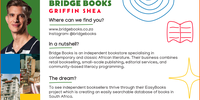
Bridge Books is one of 15 finalists in the Création Africa programme, which supports cultural entrepreneurs in Lesotho, Malawi and South Africa. The mentorship Shea received on the programme has helped him quickly scale.
“At Bridge Books,” says Shea, “we just don’t have access to the kind of mentorship, expertise, advice that we got through Création Africa.
“The reason we got so much progress done in just a few months is the people we met through Création Africa introduced me to a design school in Braamfontein who gave me three interns – who built a database in three months.” DM
Our writing about Création Africa is made possible in partnership with the French Institute of South Africa (Ifas). Création Africa is an initiative of The French Ministry of Europe and Foreign Affairs, the Embassy of France in South Africa, Lesotho and Malawi, and Ifas.