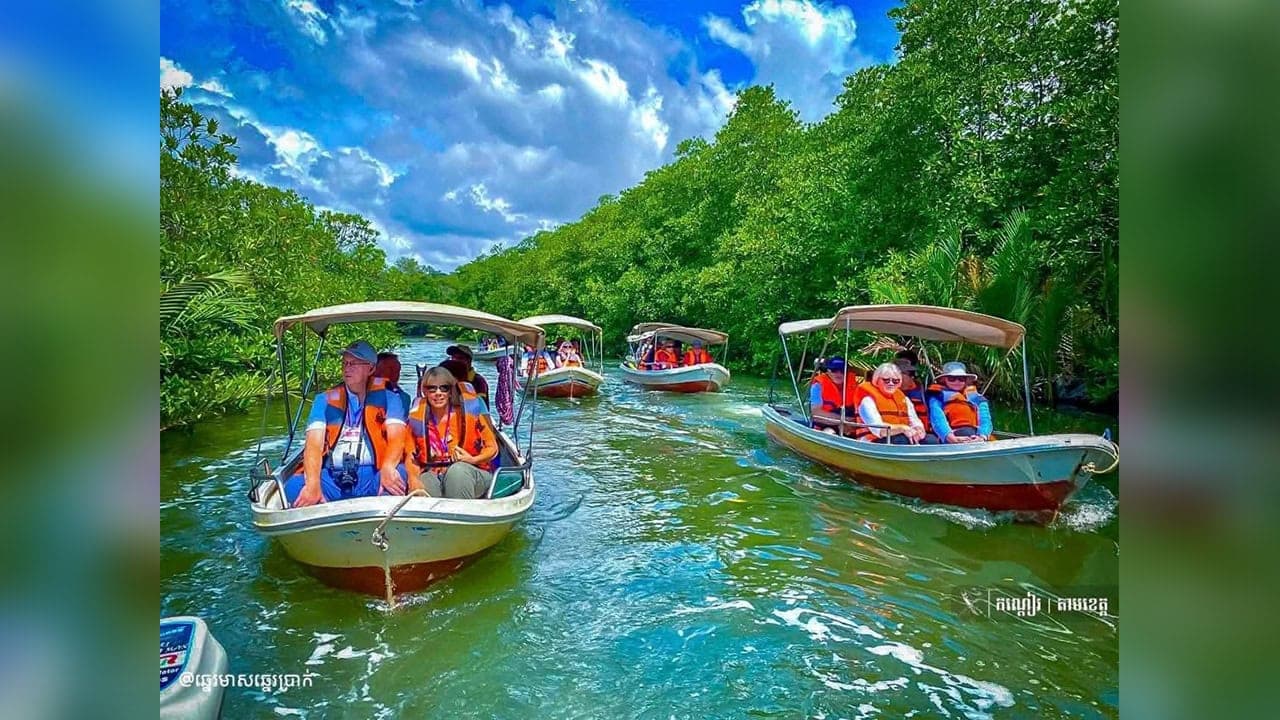
International tourist arrivals to Cambodia stood at about 2.46 million in the first nine months of the year, down 43.7 per cent from the almost 4.38 million recorded during the same period last year, according to Ministry of Tourism statistics.
The sharpest year-on-year drop was recorded in the second quarter, when arrivals fell 51.7 per cent to about 738,000 from the more than 1.52 million welcomed in the same period of 2025.
The figures highlight the challenges facing Cambodia’s tourism sector, with industry observers pointing to the damage caused to the Kingdom’s international reputation by online scam operations and the prolonged border conflict with Thailand as key factors behind the decline.
The causes of the falling numbers have sparked debate, with questions raised over whether the statistics accurately reflect leisure tourism, particularly because previous arrival figures have included people entering for gambling and other purposes. The closure of Cambodia-Thailand border crossings has also cut off a major source of visitors, including Thai nationals who previously travelled to casinos in Cambodian border areas.
Pacific Asia Travel Association Cambodia Chapter (PATA Cambodia) president Thourn Sinan believed the decline should be examined in the context of how international visitors were counted before and after the Covid-19 pandemic.
“Everyone knows the reasons why the number of visitors has dropped. But, as I recall, before Covid-19, people who came to casinos were not regarded as visitors. Later, however, they were counted as international visitors,” he said.
“When Thailand launched its war on Cambodia, the more than 800-kilometre Cambodia-Thailand border was closed, halting cross-border activity and causing a large portion of overall visitor numbers to decline,” he added.
Excluding people who travelled to Cambodia primarily to use casino services, Sinan estimated that the actual decline in tourism was at around 25 per cent.
He noted that international visitors were increasingly exploring destinations beyond Siem Reap province, including coastal areas such as Koh Rong and northeastern Cambodia.
“This is one of the reasons visitor numbers have declined in the Angkor area, as tourists choose to visit the northeastern provinces, the Mekong region, Tonle Sap and coastal areas,” he said.
Sinan noted that most ASEAN countries had experienced declines in visitor numbers, with Vietnam an exception, benefiting from air connectivity, which he described as the backbone of tourism.
For Cambodia, he identified two major challenges: the reputational damage caused by online scam operations and the border conflict with Thailand.
“The reputation hit from online scam operators who came from outside the country to commit crimes in Cambodia is the main cause,” he said.
Sinan acknowledged the government’s efforts to crack down on online scams and restore the country’s reputation, but said rebuilding international confidence would take time.
“I acknowledge the government’s strong action under its new mandate to strengthen law enforcement against these crimes, carry out reforms and restore the country’s reputation. But it takes time to restore it. If such crimes do not return, I believe our reputation will recover over time,” he said, while calling for those responsible to be brought to justice, with no exceptions.
In the first quarter of the year, Cambodia welcomed about 1.04 million international visitors, down 44.8 per cent from approximately 1.88 million a year earlier. Arrivals continued to fall in the third quarter, declining 29.7 per cent to about 712,000 from more than 1 million in the same period last year.
In the second quarter, arrivals stood at about 292,000 in April, down 48.3 per cent year-on-year, before falling to approximately 232,000 in May, a decline of 57.5 per cent. June recorded about 213,000 arrivals, down 48.5 per cent from the same month in 2025.
The third quarter recorded approximately 246,000 international arrivals in July, down 29.2 per cent year-on-year, followed by about 255,000 in August, a decline of 24.7 per cent. Arrivals fell further to approximately 211,000 in September, down 35.4 per cent from a year earlier.
Chhort Bunthang, a research fellow at the Royal Academy of Cambodia, also questioned whether the official figures fully reflected changes in leisure tourism, arguing that previous totals had included people entering the country for gambling, as well as large numbers of people involved in scam operations, prior to last year’s large-scale crackdown efforts.
Despite the government’s announcement that no major online scam centres remain, Bunthang warned that the damage to Cambodia’s international reputation could continue to deter foreign tourists who are concerned about their safety.
“As someone in academia, I urge that scientific research be conducted into the tourism sector to identify the real causes of the decline in foreign visitors and its wider effects. Such research should not be politicised. We need to examine the real issues, identify our strengths and weaknesses, and determine how we can address them,” he said.
He added that the research should explore ways to attract more visitors amid global tensions by examining why some countries continued to record growth despite the challenging international environment. He suggested studying the experiences of Vietnam and China for possible lessons for Cambodia.