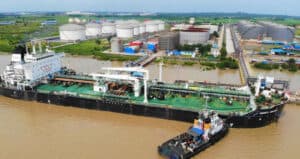
The Myanmar regime and companies linked to it have engaged in international trade fraud, using proxy firms and misclassifying aviation fuel as diesel to conceal imports of fuel used in airstrikes targeting civilians, according to an investigation released Monday by rights group Justice For Myanmar (JFM).
The findings are based on leaked documents from the regime’s Ministry of Commerce, confidential records from its Foreign Exchange Supervisory Committee (FESC), and an analysis of supply networks and market prices.
JFM said the FESC plays a critical role in approving imports of jet fuel that are intentionally and falsely declared as diesel, and in concealing the true buyers.
The FESC was established in 2022 to centralize and strictly regulate foreign currency conversions, imports and overseas transfers. It consists of six high-level regime officers, including Vice-President Nyo Saw, who has served as its chairperson since 2024.
Known to be an important figure in the management of the personal business empire of regime leader Min Aung Hlaing’s family, Nyo Saw is himself sanctioned by the EU and Canada.
The evidence indicates that six aviation fuel shipments arrived using these “evasive measures” between December 2024 and November 2025, JFM said.
During the same period, the regime stepped up airstrikes nationwide as it prepared for its sham election held in December 2025 and January 2026. The imports covered 843,000 barrels worth US$109.6 million and originated in or transited through Singapore and South Africa, the group said.
According to its findings, two Myanmar companies, Dynamic Wave and PP Petroleum Co. Ltd, were listed as importers in the contracts in order to hide the identity of the real buyer, National Energy Prime Aviation Services Co. Ltd (NEPAS).

Contracts naming Thai company Tawan-Oil Trading as the seller showed that Dynamic Wave served as a proxy importer for NEPAS in three shipments valued at $68.49 million and comprising 527,624 barrels.
Separately, Reuters reported on Monday that jet fuel imported under contracts identifying South Africa as the source was actually shipped from Iran. It said Tehran was the Myanmar military’s primary supplier of jet fuel between October 2024 and December 2025.
PP Petroleum imported another three shipments of aviation fuel misclassified as diesel, worth $41.06 million, according to contracts listing Singapore as the loading port. These were also for NEPAS, according to JFM.
NEPAS is a joint venture between regime-controlled Myanmar Petrochemical Enterprise and partner Asia Sun Group.
Asia Sun Group, a network of companies monopolizing the jet fuel supply chain, has established many shell companies in response to sanctions and public scrutiny. PP Petroleum is part of Asia Sun Group.
Some Asia Sun Group companies are sanctioned by the U.S., UK, EU, Canada and Australia—with sanctions dating back to 2022 and 2025—but NEPAS and MPE remain unsanctioned, JFM noted.
Based on its examination of regime documents and an analysis of market prices, JFM found that the regime deliberately mislabeled jet fuel as high-speed diesel to avoid scrutiny, bypass international regulations and minimize sanctions exposure risk.
Highlighting Thai supplier Tawan-Oil Trading and Singapore’s role as a loading hub, JFM called on both countries to investigate the Myanmar regime’s customs fraud and bar their territory, ports and banks from enabling jet fuel shipments.
The rights group demanded that South Africa block all fuel exports to Myanmar and investigate regime documents falsely listing the country as the fuel’s origin. It called on governments to stop granting “false legitimacy” to the regime.
JFM spokesperson Yadanar Maung said the regime’s use of trade fraud to facilitate jet fuel imports suggested that sanctions and public pressure “are biting,” but “clearly not enough.”
She urged governments to coordinate sanctions against the aviation fuel supply networks feeding the regime, and to investigate trade fraud by the regime and its partners to halt the “slaughter of civilians.”
The UNHCR, the UN’s refugee agency, said Myanmar military airstrikes remained the main cause of civilian deaths in the country, and called for an end to the transfer of arms, ammunition, jet fuel and dual-use equipment to the regime.
More than 6,200 civilians have been killed in over 14,000 regime airstrikes since the 2021 coup, according to the now-dissolved Human Rights Ministry of the National Unity Government.