Spread the word
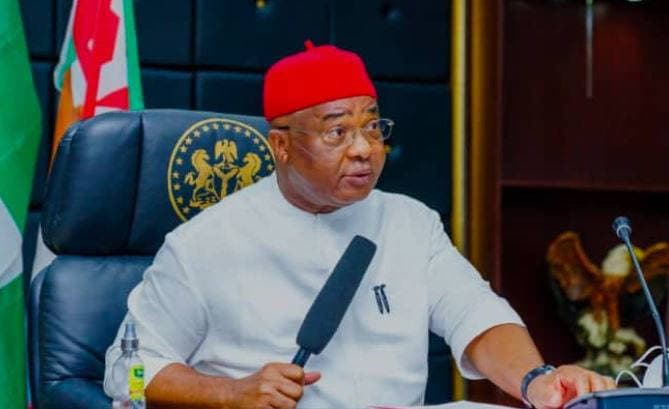
Imo State Governor Hope Uzodimma has proposed the establishment of a national media research centre in honour of the late founder of DAAR Communications Plc, Raymond Dokpesi, to strengthen journalism’s contribution to economic development and democratic governance.
Uzodimma made the proposal on Sunday while delivering the third annual Diamond Lecture in Abuja, organised by the Nigerian Institute of Public Relations (NIPR) and DAAR Communications Plc in memory of the late media entrepreneur.
The lecture, themed “Media, Democratic Consolidation and Development,” focused on the role of the media in strengthening democracy, promoting accountability and advancing national development.
The governor said the proposed centre would serve as a hub for research into how journalism could be harnessed to support economic growth and development through development journalism.
He also pledged to lead a campaign for the establishment of the centre, describing it as a lasting way to preserve Dokpesi’s legacy and strengthen the media industry.
“This memorial lecture is a good starting point. But we must go far above that. The best tribute we can pay to his memory is to protect that freedom and ensure that the journalism practised within it remains worthy of public trust,” Uzodimma said.
He added that friends and associates of the late broadcaster should take the lead in turning the proposal into reality.
“But I think that as his friends and associates we should take the lead by building a national media centre in his honour. The centre will be a hub for research on the media and how it can be properly channelled for economic development, or, put simply, for development journalism. I shall be prepared to lead in the campaign for the establishment of this centre,” he said.
Uzodimma calls for media freedom, accountability
The governor also stressed the importance of press freedom and responsible journalism in sustaining Nigeria’s democracy, saying the media must be able to scrutinise public officials without intimidation.
According to him, democratic institutions would function more effectively when journalists could investigate issues freely, governments accepted public scrutiny and accountability mechanisms responded to established facts.
“Our democracy will be better served when the media can pursue the truth without intimidation, when government accepts the discipline of scrutiny, and when the institutions of accountability respond to what is established,” he said.
Uzodimma maintained that the proposed centre would help strengthen the relationship between journalism, democratic governance and national development by supporting research into the media’s role in society.
The initiative, if established, would provide a platform for examining how media coverage and public communication could contribute to economic progress while preserving professional standards and public trust.
Dokpesi’s contribution to Nigerian broadcasting
Dokpesi, who died in May 2023 at the age of 71, was a media entrepreneur widely recognised for his role in the development of private broadcasting in Nigeria.
He founded DAAR Communications Plc, the media organisation behind RayPower FM and Africa Independent Television (AIT), following the deregulation of the country’s broadcasting industry in 1992.
RayPower began commercial broadcasting in Lagos on September 1, 1994, becoming Nigeria’s first private radio station and helping expand the country’s broadcasting landscape.
Two years later, on December 6, 1996, Dokpesi launched AIT, which provided an additional platform for news, entertainment, public affairs and locally produced television programmes.
Through the two outlets, he helped create opportunities for entertainers, music producers, journalists and programme makers who had faced limited access to established broadcasting platforms.
AIT became a significant outlet for Nigerian television productions, while RayPower contributed to the growth of contemporary music and entertainment broadcasting.
Dokpesi’s contribution to the industry extended beyond establishing media organisations, as his investments helped widen access to privately owned radio and television services.
His death was announced by his family on May 29, 2023. Reports at the time said he died in Abuja after collapsing while exercising on a treadmill as he recovered from an earlier illness.
The proposed national media research centre would seek to extend his legacy by supporting research, professional development and discussions on the contribution of journalism to accountability and national progress.
NIPR praises Dokpesi’s legacy
Speaking at the lecture, NIPR National President Ike Neliaku commended Dokpesi for his contributions to the media industry, particularly his commitment to press freedom.
Neliaku said the annual Diamond Lecture was designed to celebrate the late broadcaster’s achievements and preserve his legacy for future generations.
He also announced the forthcoming World Public Relations Forum, scheduled to take place in Abuja, saying the event would bring together participants from 126 countries.
The NIPR president said preparations for the international gathering had been concluded and the institute was ready to host participants from across the world.
Uzodimma’s proposal adds a new dimension to efforts to commemorate Dokpesi, with the proposed centre expected to focus on research into how journalism can support economic development, strengthen democratic institutions and promote accountability.
However, the proposal remains a pledge to campaign for the centre’s establishment; details of its funding, location, governance and commencement were not provided in the announcement.
Spread the word