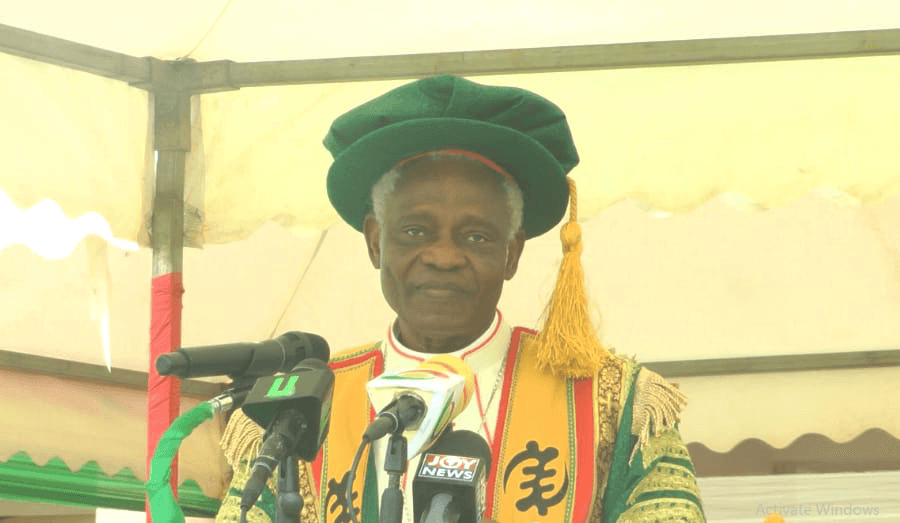
The Chancellor of the Catholic University of Ghana, Cardinal Peter Appiah Turkson, has urged students to embrace compassion and collective responsibility as they prepare for a world shaped by conflict, technological disruption and uncertainty.
He said university education must go beyond academic achievement to instil ethical values and prepare graduates to contribute meaningfully to society.
Cardinal Turkson was speaking at the university’s 25th Congregation and 38th Matriculation Ceremony at Fiapre, near Sunyani, on Saturday, October 24, 2026.
The university admitted about 1,810 students and graduated 2,806, comprising 668 postgraduate and 2,138 undergraduate students. It also celebrated its first PhD graduate, Dr Godfred Etse Klugah.

Drawing on the concept of a volatile, uncertain, complex and ambiguous world, commonly described as VUCA, Cardinal Turkson proposed a more human response to its challenges.
He encouraged students to replace volatility with vulnerability, uncertainty with unlearning, complexity with compassion, and ambiguity with answerability.
“The religious twist gives an ethical content to everything that seeks to transform the volatility, the uncertainty, the complexity and the ambiguity into something more human and more ethical,” he said.
He explained that recognising vulnerability should encourage people to seek and offer support rather than face life’s challenges alone.
“We are vulnerable, and because we’re vulnerable, we need to support each other with the common wisdom that we develop and acquire here,” he told the gathering.

Cardinal Turkson also urged students to remain open to learning by letting go of prejudices and habits that could hinder their development.
“To progress and to move on in life, we need to unlearn a lot of things. We need to let go of a lot of traits that we’ve come here with, and we need to forget and abandon lifestyles and prejudices with which we’ve come here,” he said.
He said compassion should guide academic and social relationships, fostering collaboration and mutual support.
Turning to artificial intelligence and emerging technologies, he cautioned against reducing human beings to figures and numbers at the expense of their inherent dignity.
He cited conflicts in Ukraine, Gaza and Sudan, alongside rapid technological and economic changes, as examples of the difficult environment young people must navigate.
On answerability, Cardinal Turkson said students must be willing to account for their choices.
“In providing answers for everything that we do, we show responsibility, we show maturity,” he said.
He described university education as building on lessons and values acquired at home, in school and across society. Like a manual for a new product, education should guide people in navigating life.

He congratulated the graduates and encouraged newly admitted students to make the most of their university experience.
The Bono Regional Minister, Joseph Addae Akwaboa, called on the university to strengthen practical learning, digital skills and industry partnerships to prepare students for the changing job market.
He said education and youth empowerment remained central to Ghana’s long-term development.
“The No Fee Stress Initiative is an important intervention aimed at easing the financial burden on eligible first-year students in public tertiary institutions,” he stated.
Mr Akwaboa also urged the university to use research and innovation to address youth unemployment, agricultural productivity, sanitation and public health challenges.
He assured the institution of the Bono Regional Coordinating Council’s commitment to partnerships that support regional development.