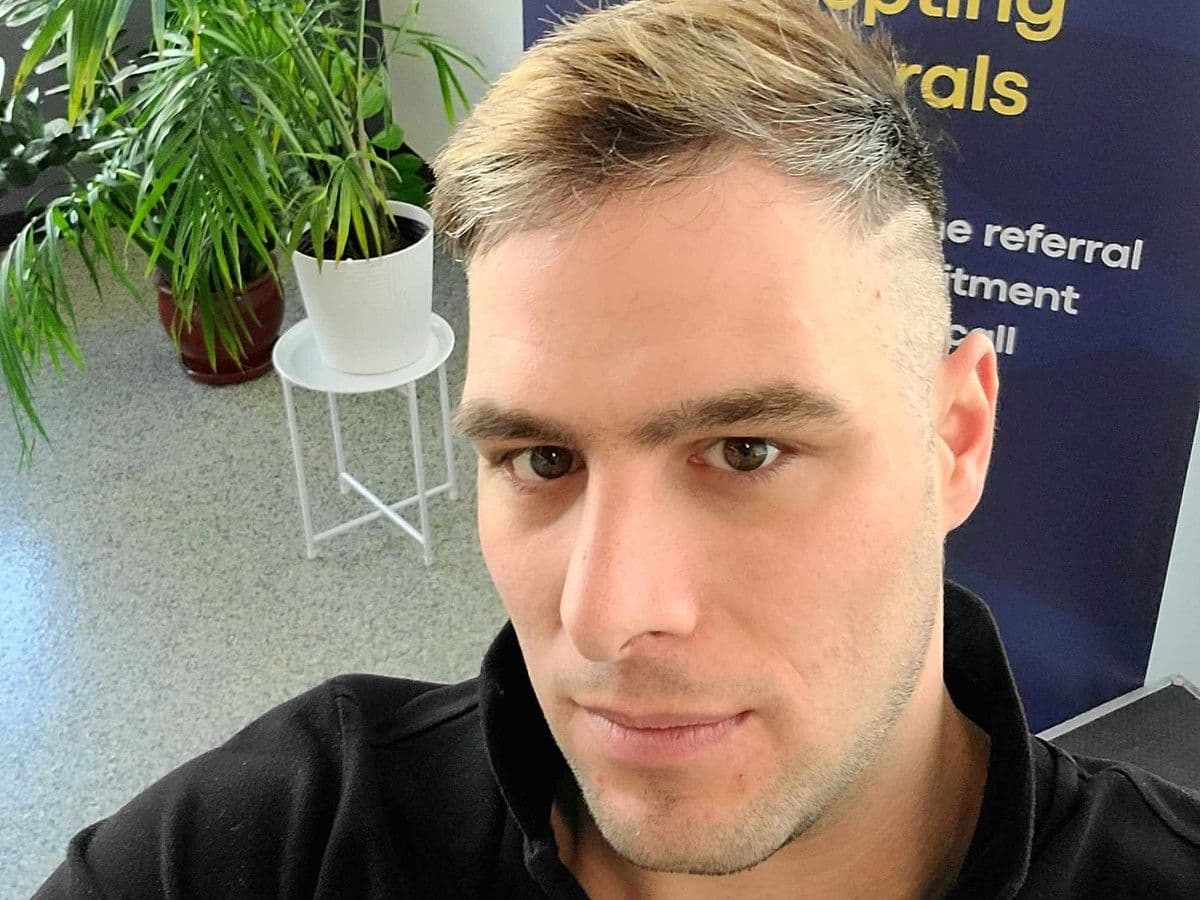
Right off the hop, Alex Kalashnikoff’s criminal history might not — at least to some — suggest him as a candidate for recovery.

Subscribe now to read the latest news in your city and across Canada.
- Exclusive articles by David Staples, Keith Gerein and others, Oilers news from Cult of Hockey, Ask EJ Anything features, the Noon News Roundup and Under the Dome newsletters.
- Unlimited online access to Edmonton Journal and 15 news sites with one account.
- Edmonton Journal ePaper, an electronic replica of the print edition to view on any device, share and comment on.
- Daily puzzles, including the New York Times Crossword.
- Support local journalism.
Create an account or sign in to continue with your reading experience.
- Access articles from across Canada with one account.
- Share your thoughts and join the conversation in the comments.
- Enjoy additional articles per month.
- Get email updates from your favourite authors.
Create an account or sign in to continue with your reading experience.
- Access articles from across Canada with one account
- Share your thoughts and join the conversation in the comments
- Enjoy additional articles per month
- Get email updates from your favourite authors
Sign In or Create an Account
Addicted since age 14, the former Edmonton resident was raised in a series of homes in northern Alberta — foster care, including stints an uncle or an aunt that “did the best they could.”
By his own admission, by 2023, he didn’t have enough to show for his decades. Incarcerated on and off for an array of offences, Kalashnikoff has a fairly lengthy criminal record — possession of stolen goods, threats, and assault.
It’s not hard to read between the lines on the rap sheet and see multiple addictions acted out in cities around Alberta — substances, alcohol, sex — and a criminal lifestyle feeding into it.

Get the latest headlines, breaking news and columns.
By signing up you consent to receive the above newsletter from Postmedia Network Inc.
A welcome email is on its way. If you don't see it, please check your junk folder.
The next issue of Headline News will soon be in your inbox.
We encountered an issue signing you up. Please try again
“I was obviously in addiction and needed help. I would say to myself, ‘I’m going to change.’ I’d tell my family members, ‘I’m going to change, I’m going to do all the right things.’
“I’d get out (of jail) thinking, wanting to change, but not knowing how to, and not knowing who I was without any other additional information or support. And then I’d be back to my usual self for another year, and I’d end up back in jail,” he recalled.
Lost in both time and space, he was drifting yet stuck.
“I would call my family and say, ‘Listen, how long’s it been?’
“They’d tell me, ‘It’s been a year, you’ve been gone again.’”
By Kalashnikoff’s own admission, he was “hopeless.”
“I was in a vicious cycle, hurting myself and everyone around me. I was just the last person to know that I was hurting myself and everyone around me,” he said.
Three years ago, his journey took a different trajectory. The addiction, criminal behaviour, and aimlessness all came to an abrupt halt.
There was a poster on the wall during his most recent jail stint, promoting ‘Therapeutic Living Units’: if he followed the program, they’d reintegrate him into society.
He took it as a challenge.
“I was like, ‘Okay, it looks like it’s better living over there, and maybe there’s perks to it, and I do want to change.’”
Or did he? Part of him was afraid of change, Kalashnikoff remembered.
The adventure — not an easy one — was just beginning.
The setting was homelike — no doors on cells. Furniture. TVs.
Under Recovery Alberta, “recovery centres” are getting stood up around the province.
In 2023, then-fledgling ROSC Solutions Group won a $70-million contract with the Alberta government to deliver and manage recovery services.

Through its subsidiary Beccarian Correctional Care, RSG operates Therapeutic Living Units. Classes dissected “criminal addictive thinking.”
“They teach you the things that you missed out on,” Kalashnikoff said.
“When you have to write down the things that you’ve done and talk to someone about it, it brings it right to your face. All those things that I didn’t want to see or want to hear or want to do, I just put it on the back plate. ‘Wasn’t my fault that I was in jail’ — but it really was.
“When you’re telling someone about what you did and how you got there, now you have to deal with who you are to move forward. Now you got to take responsibility for it, and that’s what they teach you, or else you’re going to be stuck.”
It was uncomfortable.
“I didn’t know how to live without criminal and addictive thinking, or females, drugs, women, everything, all of it put together; I had no idea how to live.”
Kalashnikoff lashed out with threats.
After five days, he was at risk of being kicked out.
“My behaviours were not proper behaviours to have as someone that’s trying to change their life,” he remembered.
But instead of getting kicked out, his accountability group chose mediation.
“You know, these are all the things that are coming up for you right now in this group of people. How are you going to address this? What can we do to support you?” they asked.
Kalashnikoff was stunned.
“I’ve never had that before in my life,” he remembered.
They saw him through owning his past, confronting painful realities of the things he blamed other people for.
“I could see that they’re not lying, and they’re actually doing better in life. And they’re actually people that were in the same places and situations that I was in that (now had) their licence, vehicle, jobs, daughters. They have all these things back in their lives, and they’re happy. And it made me think maybe, just maybe, if I follow them and listen to them and how they did it, maybe something like that can happen to me.”

Kalashnikoff took a little from each of 15 different modalities of recovery — including AA and NA — all tools in his recovery toolbelt, all things he wishes he knew growing up.
“These guys in the classes — the facilitators, the case managers, the counsellors, the support staff — they sat there and they cried with me. They didn’t laugh at me. When I was telling them the problems I went through in my life, they respected everything and they’d tell similar stories. In my addiction, I felt like I was the only one,” he said.
“You have to learn how to deal with things now, and how to cope … I used to just run away to a bottle, run away to whatever, a female, run away to anything. Now, they taught me, ‘Call a friend … They taught me to write my thoughts down.
“They taught me that I needed to do everything in micro-steps. Everything’s got to be steps and you got to follow your commitments. I followed that.
“It was the hardest thing I probably did in my whole life, but it got me to where I am today.”
Now Kalashnikoff has a job and his own place — and new leadership skills for helping others get on track and stay on track.
And he’s staying in touch.
“If there was never a TLU, I would still be stuck. I would be in a vicious cycle, doing my one year/three months in jail, every year,” he said.
“I’m not hanging out those some same places. I’m not in crack houses, bars, and strip clubs.
“I go to church, I’m hanging out with the boys (at the treatment centre), I’m hanging out at home with my girlfriend and son,” he said.
A high point was actually getting invited to a family wedding.
He talks with the brother he was estranged from.
The mother of his daughter reached out after a decade of silence.
(“I lived a destructive life and she did everything she could to protect her our daughter. So, I don’t blame her,” he said.)
Three years sober, he’s beating the snowball effects of addiction one day at a time. When offered a drink, he “plays the tape back” to recall what one single drink leads to, for him.
“One drink is going to lead to cocaine, it’s going to lead to meth, it’s going to lead to toxic relationships. I’m going to lose my house, I’m going to find a toxic relationship, and then poof, I’m back in jail in three to six months.”
Kalashnikoff shares his story with other inmates.
“A lot of the guys that I went to the TLUs with are striving, and they’ve changed.”
Bookmark our website and support our journalism:Don’t miss the news you need to know — add EdmontonJournal.com and EdmontonSun.com to your bookmarks and sign up for our newsletters here.
You can also support our journalism by becoming a digital subscriber. Subscribers gain unlimited access to The Edmonton Journal, Edmonton Sun, National Post and 13 other Canadian news sites. Support us by subscribing today: The Edmonton Journal | The Edmonton Sun.
Join the Conversation
This website uses cookies to personalize your content (including ads), and allows us to analyze our traffic. Read more about cookies here. By continuing to use our site, you agree to our Terms of Use and Privacy Policy.