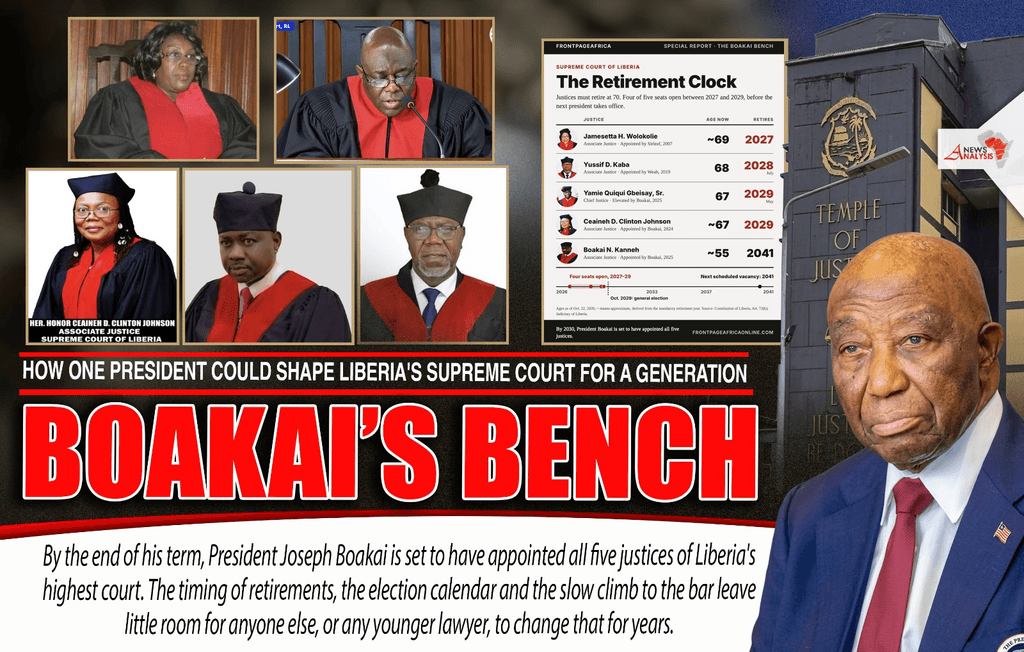
Monrovia – Few Liberian presidents have been in a position to remake the Supreme Court from top to bottom. President Joseph Nyuma Boakai is on course to do exactly that. If the justices retire as the Constitution requires, every seat on the five-member bench will have been filled by Mr. Boakai by the time Liberians vote in the October 2029 general elections, or shortly after.
By Rodney D. Sieh
The arithmetic is set by Article 72(b) of the 1986 Constitution, which requires the Chief Justice and Associate Justices to retire at 70. They may stay on only to finish cases they began hearing before that birthday. Justices are nominated by the President and confirmed by the Senate.
Three down, two to go
Mr. Boakai, who took office in January 2024, has already made three appointments.
In July 2024, the Senate unanimously confirmed Judge Ceaineh D. Clinton-Johnson, his nominee, to replace the late Associate Justice Joseph Nagbe. She was the first nominee confirmed under a new Senate rule requiring a two-thirds vote, or 20 senators, for tenured presidential nominees.
A year later, Chief Justice Sie-A-Nyene Yuoh reached the mandatory retirement age. Mr. Boakai nominated Associate Justice Yamie Quiqui Gbeisay, Sr. to succeed her. Mr. Gbeisay had joined the Court as an associate justice in October 2022, under former President George Weah. He was confirmed as Chief Justice in July 2025.
To fill Mr. Gbeisay’s former seat, the President nominated Cllr. Boakai N. Kanneh, chairman of the Law Reform Commission. Mr. Kanneh is a former deputy foreign minister for legal affairs and public defender, and has taught at the Louis Arthur Grimes School of Law. He is also the brother of Gbarpolu County Senator Botoe Kanneh, a family tie that has drawn political attention.
The retirement calendar
The remaining seats will open on a predictable schedule:
• 2027: Associate Justice Jamesetta Howard Wolokolie, the longest-serving member of the bench, appointed in 2007 under President Ellen Johnson Sirleaf.
• 2028: Associate Justice Yussif D. Kaba, born July 19, 1958, appointed under President Weah in 2019.
• 2029: Chief Justice Yarmin Quiqui Gbeisay, born May 3, 1959, turns 70 in May 2029, five months before the election.
• 2029: Associate Justice Clinton-Johnson, a Boakai appointee, is also due to retire in 2029.
• 2041: Associate Justice Kanneh, the youngest member of the Court.
By 2028, the last two justices appointed by earlier presidents, Ms. Wolokolie and Mr. Kaba, will have left. Mr. Boakai will then fill the Chief Justice’s seat and Ms. Clinton-Johnson’s seat in 2029, in the middle of an election year. If all of these appointments are made and confirmed, the full bench will be his.
Why it matters
In most democracies, the makeup of the highest court is decided gradually, by several presidents. That spread is one of the quiet protections of judicial independence. No single administration owns the bench, and justices are less likely to be seen as one leader’s choices.
Liberia’s fixed retirement age makes turnover predictable, but it can also cluster vacancies. That is what is happening now. A Court made up entirely of one president’s nominees is not illegal or improper by itself. Whether it becomes a problem depends on who is chosen and how they rule.
Concerns have already been raised. When Mr. Gbeisay was nominated as Chief Justice in 2025, a veteran lawyer told allAfrica that three Supreme Court appointments in less than two years signaled growing executive influence over the judiciary. The lawyer also questioned Mr. Gbeisay’s firmness, pointing to his lone dissent in the Court’s December 6, 2024 ruling on the House speakership crisis.
That crisis shows why the Court’s independence matters. In November 2024, a majority bloc of lawmakers declared the Speaker’s seat vacant and elected Rep. Richard Koon outside a formal session. Speaker J. Fonati Koffa refused to step down. The Executive began recognizing Mr. Koon after a Ministry of Justice opinion in favor of the bloc. In April 2025, the Supreme Court declared Mr. Koffa the constitutional Speaker, but he resigned weeks later and Mr. Koon took the gavel.
The tension has not gone away. This week the Court reserved its ruling in former Rep. Yekeh Kolubah’s appeal against his April 2026 expulsion. The House voted to expel him a day after Justice Kaba ordered it to halt the proceedings. These cases put the Court at the center of disputes between the Legislature, the Executive and individual lawmakers. A future bench will decide many more.
The 2029 election
The timing of the final vacancies raises its own questions. Two seats are due to open in 2029, the year Liberians choose a president. A bench appointed entirely by the sitting president could be asked to rule on election disputes, including challenges involving that president or his party. Liberia’s Supreme Court is the final arbiter of electoral disputes. Its rulings in 2017 and 2023 helped settle contested results peacefully.
The Senate’s two-thirds confirmation rule gives senators a real check. Nominees now need broad support, not just a governing majority. How the Senate uses that power in 2028 and 2029, in the heat of a campaign, will be closely watched.
There is also a longer-term effect. Justices appointed in their fifties will serve into the 2040s. The next president, whether it is Mr. Boakai in a second term or someone else, may inherit a bench with few scheduled vacancies. Mr. Kanneh alone is set to serve until 2041. Unless justices die, resign, or are removed through impeachment, a new president could serve a full six-year term without appointing anyone.
Is there room for young lawyers?
The Constitution sets a low floor. Under Article 68 and Section 2.4 of the Judiciary Law, a justice must be a Liberian citizen for at least 10 years, at least 30 years old, a Counsellor-at-Law of the Supreme Court Bar, and engaged in active practice of law for at least seven years before appointment.
In practice, the path is long. A Liberian lawyer usually earns an undergraduate degree before law school, then a law degree, typically from the Louis Arthur Grimes School of Law. After passing the bar, the graduate is admitted as an Attorney-at-Law. Only after years of active practice can an attorney petition the Supreme Court to be admitted as a Counsellor-at-Law. The Court has cited a five-year practice requirement for that petition. Candidates are then examined by committees of senior lawyers.
Can someone be a Counsellor-at-Law at 30? On paper, yes, but only with an unusually early start. A lawyer who finishes a first degree at 21, completes law school by 24 and is admitted to the bar at 25 could, after five years of practice, petition at about 30. Most Liberian lawyers reach that point in their mid-thirties or later.
Because of the seven-year practice requirement, the earliest realistic age for appointment to the Supreme Court is the early-to-mid thirties. No Liberian president has come close. Liberia’s justices have generally been appointed in their fifties or sixties, after long careers as judges, government lawyers or senior practitioners. Mr. Kanneh, the youngest on the current bench, will serve until 2041, which suggests he was appointed in his early fifties.
So for lawyers aged 30 to 45, the honest answer is: not soon. With the bench likely to be filled by 2029, the next wave of scheduled vacancies may not come until the late 2030s and 2040s. Today’s young counsellors who build strong careers as judges, scholars or advocates may be the leading candidates then. A president could choose to appoint a younger justice sooner, but that would break with long practice, and the Senate would have to agree.
A test of institutions, not just appointments
Mr. Boakai did not create this calendar; the Constitution and the birthdates of sitting justices did. How he uses it is a choice. He can pick nominees known for independence and legal skill, from a range of backgrounds and regions, and give the Senate time for real scrutiny. Or the appointments can be seen as political rewards. The first path would strengthen a Court that Liberians and Liberia’s international partners increasingly rely on to settle political disputes.
For a country that rebuilt its institutions after 14 years of civil war, the Supreme Court is one of its most important achievements. The next five appointments, more than any single ruling, will decide whether the Court stays a check on power or becomes an extension of it.