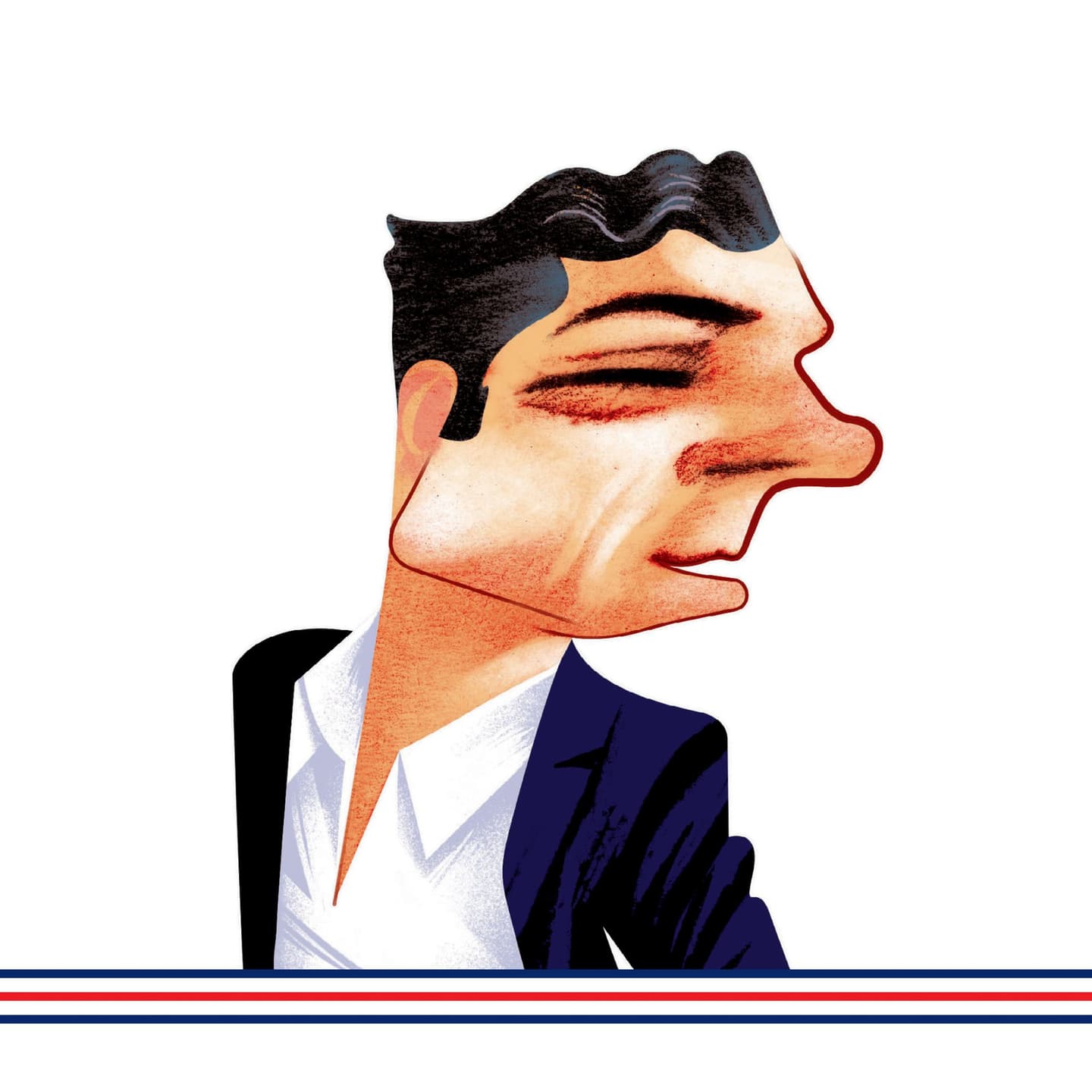
MIDTERMS 2026
In the age of vertical video, political messaging lands in bite-size clips. No Democrat is thriving in this new world quite like the young senator from Georgia. Maybe 2028 has already started.
Jon Ossoff Instagram
Behind a podium onstage at the second Georgia Senate debate, Senator Jon Ossoff made an appeal to a very specific audience. “I want everybody who’s clipping this debate for television news across Georgia and online tonight to roll that tape,” he said as he ridiculed his opponent, Mike Collins, for appearing to reverse his previously stated stance on abortion.
Ossoff knows his audience. Over the course of his campaign for reelection to the Senate in the battleground state of Georgia, the 39-year-old Democrat has vaulted to national stardom thanks in no small part to the power of short-form video. His pervasive presence on social feeds everywhere from Berkeley to Boston is a consequence of the clip-centered nature of his campaign, which churns out atomized video from his rallies and debates, and it has established Ossoff in the common liberal imagination as a great Democratic hope of 2028.
If 2024 was the podcast election, wherein Donald Trump’s return to power was fueled by his appearances with and support from garrulous commentators who built up vast audiences by talking about energy drinks and who constructed the pyramids, then these midterms have undoubtedly been the short-form video elections. Political stars are born by virtue of their campaign’s ability to produce clips designed to go viral, earn media attention, and rake in donations from voters who’ve learned to love the candidate through their feeds. Ossoff’s campaign has proved particularly adept in this regard: Its media strategy has cemented his reputation as one of the party’s most effective messengers on the stump, helped to raise an astonishing $110 million during this election campaign, and thrust his name to the forefront of the 2028 conversation.
For many Democrats, their love-at-first-sight encounter with Ossoff likely involved looking down at a video shot through a lens looking up at him. His rallies are cinematic productions. There are multiple camera shots, and one in particular stands out: the camera tilted upward at the candidate, the soft glow of the lighting accentuating his jawline, his eyes looking out beyond the crowd. This is called the hero shot, and it’s become a trademark of his media strategy, a visual grammar now synonymous with the young senator from Georgia and reminiscent of that of a young senator from Illinois. It helps that, like Barack Obama, Ossoff is tall and handsome, his shirtsleeves perma-rolled to the elbows as a kind of sartorial cue that this is a serious man getting down to business.
The rallies are for a Georgia audience, the voters Ossoff needs in order to do the immediate job of winning reelection in November. His campaign is determined to maintain the perception that this race is a local one, with the senator hyperfixated on the concerns of his constituents and uninterested in either national ambitions or the chatter among prospectors in Washington.
Yet Ossoff’s media strategy of filling social feeds with digestible hits from his rallies is inevitably a national one. And it’s been swell for fundraising. He raised $33 million in the third quarter, adding to his gargantuan total election-cycle haul of well over $100 million. His campaign says nearly 97% of the third-quarter contributions were small-dollar commitments of less than $100. (For comparison: Collins, his opponent, has raised $9.2 million in total this cycle.)
Sound bites have been a part of American politics for centuries, since before Abraham Lincoln told Republicans at the Illinois State Capitol that “a house divided against itself cannot stand.” What’s new is the format and how it has seeped into every crevice of American life, conquering our collective attention. “We’re in a clip-based economy,” says Keith Edwards, a progressive political commentator who oversaw content strategy on Ossoff’s 2021 runoff campaign. “Clavicular is a clear example of that. He really came out of nowhere just from the clips that surfaced online.”
Only a small fraction of America regularly watches the streams hosted by Twitch personalities like Clavicular and Hasan Piker, but our feeds are inundated with content from these figures, churned out by so-called clippers who are often paid to blast the videos out into the world for engagement revenue.
“[Ossoff] understands this in a way that [Donald] Trump used to. I think Trump just doesn’t have it in him anymore,” says Edwards. “Sure, it’s a speech. But really, the rally is a clip-making factory. When I go live on Tuesdays,” he adds, referring to his own stream on YouTube and Twitch, “maybe 4,000 people are watching concurrently, but the cut-downs and the clips that we make from it generate millions of views. So it’s just about being really focused with your time and understanding that what happens in that room is a production process to generate as many clips as possible.”
Ossoff is well suited to these shifts in media consumption. When he first ran for Senate in 2020, recalls Hussien Salama, the lead video producer for the campaign during the runoff election in early 2021, his campaign embraced TikTok in an effort to appeal to younger voters at a time when many politicians were keen to avoid the platform over its ties to China. Ossoff, then in his early 30s, was more natural in front of the camera than other candidates Salama would go on to work with, and he had a close relationship with his video team. But the candidate started paying real attention to social strategy after a video compilation of his stump speeches assailing his then opponent, David Perdue, went viral on TikTok. “That success and hearing from students, young voters on the ground being like, ‘We love your TikTok,’ made him engage much further,” Salama says.
Before getting into politics, Ossoff was a documentary producer, and his work often investigated public corruption. This helps to explain his preternatural ability to weave broader indictments of Trump’s administration into a persuasive narrative. There are characters, like “Prince Don and Prince Eric,” who are making foreign business deals while their father makes American foreign policy. Or Natalie Harp, Trump’s peculiar executive assistant whom Ossoff mentioned at a rally in August: “He doesn’t want to do the job. He wants to build his ballroom and travel with Natalie on their apparently defenseless flying palace gifted by the emir of Qatar.”

Ossoff's political persona has evolved—and exploded—since his first congressional run in 2017, though questions remain about his retail politicking.
Joe Raedle/Getty ImagesThe curious existence of Natalie Harp had been covered before by reporters in Washington. But it wasn’t until Ossoff made that passing mention—and clips of the remark drew millions of views—that she was thrust into the spotlight. The moment elevated Ossoff on the national stage as Trump and the White House went on the counterattack and late-night shows ruthlessly mocked Harp’s idiosyncrasies.
Ossoff’s rhetoric is crisp and prosecutorial, blending the mettle voters say they want from Democrats facing down the White House with the kind of intellectual critique that distinguishes him from Democrats who have sought to respond to Trump’s crass demagoguery with cringe sloganeering. “Donald Trump was in Dalton yesterday, oblivious to the collapse of his presidency,” Ossoff said at a rally in Cobb County this past weekend. “A crowd smaller than this one endured two hours of senile babbling while the price of oil hit its five-month high.” A video of Ossoff’s merciless interrogation of Jay Clayton during his confirmation hearing to serve as director of national intelligence has been viewed nearly 5 million times on YouTube. Chris Hayes, the MS NOW host, has said he now jokingly refers to Ossoff as the “Lisan al-Gaib” in his team’s Slack chat.
“He pays attention,” says Salama. “There are some candidates who I work with who don’t watch their things or aren’t aware of what their social does. Jon cares about how he’s being presented to the world.”
Ossoff’s campaign has been selective about the kind of media—and scrutiny—it allows for the candidate. The campaign has spent months declining my requests for an interview, and Ossoff has not sat for a profile with a news outlet this election cycle. One producer of a popular podcast with a national audience, speaking on condition of anonymity, complained that they spent a year and a half trying to convince Ossoff to appear on the show. In the end they were only able to corner the senator for a quick interview in the halls of Congress.
This strategy allows the campaign to exercise tight control over messaging, says Adrienne Elrod, the veteran Democratic strategist: “Everyone’s talking about him. It is working. And it’s not just because he’s talented; it’s because his team knows how to control the message and the framing and the content in a way that is digestible and energizing to Democrats, independents, and, frankly, some Republicans.”
“A lot of candidates are going to adopt that philosophy,” Elrod adds. “Come to our YouTube page, come to our Instagram page. We will control the content. We will not let a third-party journalist do it.”
What the Ossoff campaign has focused on is a particular flavor of short form. Most of his viral videos are clipped from scripted campaign speeches. He generally steers clear of long-form podcasts embraced by politicians like Gavin Newsom, who hosts his own, and James Talarico, the Texas Senate candidate who rose to prominence thanks in part to a sit-down with Joe Rogan. His operation does not pump out the kind of semiscripted videos that made Zohran Mamdani a star. And the impromptu quick hits with iPhone-camera-wielding reporters on Capitol Hill—the ones that Alexandria Ocasio-Cortez has perfected with a smile, a flick of her hair, and a game answer to whatever nonsense TMZ DC has cooked up this time—have proven more daunting terrain for the Georgia senator.
In a recent clip, Ossoff was confronted over his support for the Laken Riley Act, a vote that has drawn the ire of progressives over its consequences for immigration enforcement. The senator gave a curt answer before hastily escaping the shot. He said he had to go to a committee meeting.
“Like all politicians, Tony has seven or eight kinds of smile,” Martin Amis once wrote of Tony Blair. Jon Ossoff has none.
Across the endless stream of content bearing Ossoff’s face, blaring over news feeds and televisions, one rarely sees his teeth. What the Democratic strategists and donors who have interacted with Ossoff behind the scenes worry about is whether the candidate can excel at the off-the-cuff retail politics traditionally required to mount a bid for the presidency. “He’s a robot,” says one top Democratic strategist who has interacted with Ossoff. “He can do the speeches. But he can’t do the retail politics at all.” This concern has been simmering behind the scenes of Democratic Party politics since Ossoff’s explosion onto the national stage over the summer, and it was pushed into public conversation by David Axelrod, the former Obama campaign strategist, in an interview on Pod Save America earlier this month.
“I think that he is a star,” Axelrod said, reacting to Ossoff’s first debate with Collins. “You would teach off of this debate… I thought they were gonna have to remove Collins on a stretcher.” But: “I haven’t seen him smile. I’ve never seen him smile. He’s always very severe. So there are other elements of campaigning that I would like to see.” (Ossoff did crack a smile during one exchange over the summer, after a TMZ reporter asked him about people’s belief that he has “BDE.”)

Ossoff has cultivated a trademark seriousness in his campaigning.
Bloomberg/Getty Images“That was not my experience with him at all,” says Edwards when I ask about these concerns. “I have clips from the 2020 campaign on my phone, of him dancing, having fun with voters. Let’s just step back for a moment. It’s a very serious time. I think he’s actually one of the few people who is adequately defining the moment, and that’s why he’s resonating, because it is such a dangerous and corrupt moment.”
In this theory of the Ossoff case, his resting stone face serves a potent political purpose: proving to Democratic voters that he’s serious about their concerns. “He is serious because we’re dealing with some very serious issues right now, including a leadership vacuum in the executive branch of government,” says Elrod. “He is meeting that moment in a very serious way.”
This is an attitude that was first adopted by Ossoff during the 2020 campaign, when he had to convince voters—particularly the older Black Democrats of Georgia—that he was a real candidate in spite of his youth. “There is a particular requirement to signal that this guy knows what he’s talking about,” says Salama. “This guy is not here to screw around.”
Six years later, Ossoff has come to offer something Democrats have been craving: a candidate who is fluent in the messaging of the moment and gives them hope for a world after Trump. In former president Joe Biden, Democrats may have seen steadiness as an adequate antidote to the chaos, but they did not see much beyond that. In Ossoff, weary liberals have someone who speaks like Obama. His crowds seem to achieve the decibels of an Obama rally. Even his campaign logo, a navy “O” with three red stripes jutting out of it, looks an awful lot like Obama’s iconic 2008 insignia.
Ossoff has insisted that he will not run for president in the next cycle, putting his well-worn seriousness to work on questions around his own ambitions. “I have no interest in running for president in 2028—and, to be very frank, with just 16 days until the polls close, I want to urge everybody out there to remain focused on the task at hand,” he told Al Sharpton in a recent interview on MS NOW. “The Trump administration is out of control. They’ve lied us into war, they’ve sent prices skyrocketing.”
It was all Ossoff: sober, prepared, disciplined, punchy. In the short-form era, it’s also the kind of clip that will haunt Ossoff should he change his mind for 2028. Or not.
“I’m old enough to remember when Bill Clinton ran around, running for reelection in 1990, saying he wouldn’t run in ’92,” says Paul Begala, Clinton’s longtime strategist. “I’m old enough to remember when Barack Obama, in 2006, told Tim Russert and the whole country, ‘I’m not going to run in ’08.’ And he did. I’m very glad they broke those promises. I suspect they meant them in the moment. I’m sure Ossoff means it in the moment.”
Erika Kirk Doesn't Really Want to Talk Politics. So How's She Going to Lead Turning Point USA?
A Deep Dive Into How Larry Ellison Built His Influence
Making the Elizabeth Holmes Doc Fried Nathan Fielder’s and Lance Oppenheim’s Brains
“History Will Judge”: Fox News Anchor Bret Baier on Donald Trump and Pete Hegseth’s War With the Press
Inside Lane Kiffin’s Trash-Talking, “Joey Freshwater” Era With Nick Saban at Alabama
From the Archive: Inside Elizabeth Holmes’s Chilling Final Months at Theranos

Aidan McLaughlin is the Washington correspondent for Vanity Fair, covering politics and power in the nation's capital. You can follow him on X. ... Read More
News
Gavin Newsom Sure Sounds Like He's Running
As the governor looks beyond California, he opens up about his political ambitions, his vision for the country, and why he's chosen Bill Clinton as his 2028 spirit animal.
By Joe Hagan
Politics
“History Will Judge”: Bret Baier on Donald Trump
On a night out at his “clubhouse” in Washington, the Fox News anchor weighs in on Trump’s war with the media, his old colleague Pete Hegseth, and how history will judge our increasingly wild national climate.
By Aidan McLaughlin
Politics
The White House Claims Trump’s New Ads Are “Clearly Not Political,” Says Aide
The pre-midterm commercials are “reminding Americans to love their country,” a White House official insists to Vanity Fair, even as both Republican and Democrat lawmakers balk.
By Savannah Walsh
Politics
Party at Stephen Miller’s House!
From her house on a military base, Katie Miller treats Washington’s most powerful to cakes, farm animals, and sake-squirting hibachi chefs.
By Aidan McLaughlin
News
Susie Wiles Isn’t Going Anywhere
A veteran West Wing chronicler says the White House chief of staff is in for the long haul.
By Chris Whipple
Books
How Jill Biden Concealed the President’s Rapid Deterioration
In an exclusive excerpt from The East Wing: Power, Intrigue, and the Untold Story of America’s First Ladies, go inside the former first lady’s turbulent White House tenure—from that disastrous presidential debate to Hunter Biden’s trial.
By Azadeh Moaveni
Politics
The Crown Prince of the French Far Right Is Losing His Throne
Jordan Bardella is something like the French Charlie Kirk, a right-wing prodigy who many believe could someday be president. Now he stands accused of antisemitism, but it's the return of his mentor Marine Le Pen from political exile that's ruining all his big plans.
By Olivier Bouchara
Business
Meet The New Establishment 2026
Power Brokers. Heroes. Heretics. Outlaws—Meet the leaders of the Artificial age.
By Vanity Fair
Movies
Tom Cruise’s Toughest Stunt Yet: Campaigning for an Oscar Without Looking Like He Wants One
Timothée Chalamet and Bradley Cooper learned the cost of looking thirsty. Tom Cruise will have to pull off a tricky balancing act for his Digger campaign.
By Rebecca Ford
Theater
Jeremy O. Harris on the Democrats, and His Message for New York City Mayor Zohran Mamdani
“The bitchiest level is that in spaces where it matters, as in spaces with money, people think I won the Tony,” the playwright and cultural critic tells Vanity Fair’s Mark Guiducci in the new episode of VF’s long-form interview series Fair Game.
By Savannah Walsh
News
The Widow’s Peak
A year after Charlie Kirk’s killing, his widow talks to VF about the fight over TPUSA and the conspiracy theories surrounding her. But there’s one thing she doesn't really want to discuss.
By Clara Molot