Updated October 27, 2026

Illustration: Quartz
Formula 1 teams operate on budgets that make racing look like a sport reserved for the very wealthy and factory-backed drivers. That picture leaves out the broad layer of motorsport that takes place every weekend at local tracks, drag strips and paved parking lots. This grassroots tier runs on member clubs, rental equipment and volunteer labor. It is open to adults with no racing background.
In the U.S., organizations such as the Sports Car Club of America, single-make clubs and independent tracks host events for people who hold ordinary jobs during the week. Comparable club networks run grassroots events in the U.K., Europe, Australia and elsewhere. Many of these events let a beginner arrive with the car they already own. Some require no car at all.
This guide covers 10 affordable ways to get into motorsports, each a separate entry point rather than a rung on a single ladder. Some put a daily driver on a cone course or a closed road circuit. Others spread the effort and expense across a team that shares one car in an endurance race. Sim racing moves practice into the home, with setups that range from a game controller to a wheel and pedals. Volunteering as a corner worker puts a person beside the track without needing a car. Racing schools and clubs offer a structured path toward a competition license.
The skills overlap more than the formats suggest. Car control built in a rental kart carries over to a road course. The flag signals a marshal displays are the same ones a driver must read from the cockpit. Motorcycle riders follow a parallel path, from street-bike track days to club racing.
Affordability here describes structure, not price tags. Most routes keep spending down through rented equipment, shared vehicles, restricted modifications or donated time. The list is a selection, not a ranking. The right starting point depends on a reader's location, vehicle and goals. Rules on safety gear, vehicle inspection and licensing vary by organizer, track and vehicle speed. Anyone signing up should read the current rulebook for the specific event before arriving.
Rental karting and kart league racing for adult beginners

Illustration: Quartz
Rental karting is one of the most direct ways for an adult to start racing without buying a vehicle, tools or safety gear. Indoor and outdoor tracks supply the kart and usually the helmet. A first session requires little more than signing a waiver and sitting through a safety briefing.
Karting has long served as the first rung of the sport. Formula 1 champions including Lewis Hamilton and Max Verstappen began their careers in karts as children. The same basic skills apply to an adult who starts later. A rental track is where many newcomers first learn them.
A typical arrive-and-drive session follows a simple pattern. After the briefing, drivers head out for a session limited to a set number of minutes or laps. Many tracks fit karts with transponders that record every lap. Drivers often get a printout or digital readout of their lap times afterward. That gives them a clear measure of improvement from one visit to the next.
Indoor tracks tend to use electric or gasoline-powered karts on tight, technical layouts. Outdoor tracks are often longer and faster, with more room to practice braking and passing. Kart types, speeds and age or height limits differ from venue to venue. Check a track's own rules before booking.
Karting teaches the fundamentals of vehicle control in a compressed form. A kart has no suspension and no driver aids. It responds immediately to every steering, throttle and brake input. Drivers learn to find the racing line, pick braking points, carry speed through corners and judge when a pass is possible.
Many rental tracks run adult leagues for drivers who want structured competition. Leagues typically award points across a season of race nights, with drivers grouped by pace or experience. Some tracks also hold endurance events in rental karts. In those races, several drivers share one kart and swap seats during pit stops.
The next step for drivers who want more is owning a kart and joining a local karting club. Club racing takes place on sprint tracks built for karts. Classes are divided by engine type, kart type and combined driver and kart weight. The Briggs & Stratton LO206 class is a common choice for newcomers. Its sealed engine limits modification. Owning a kart brings new responsibilities, including transport, maintenance and personal safety gear. It also opens up a full calendar of club races.
Autocross with the SCCA in your own street car

Illustration: Quartz
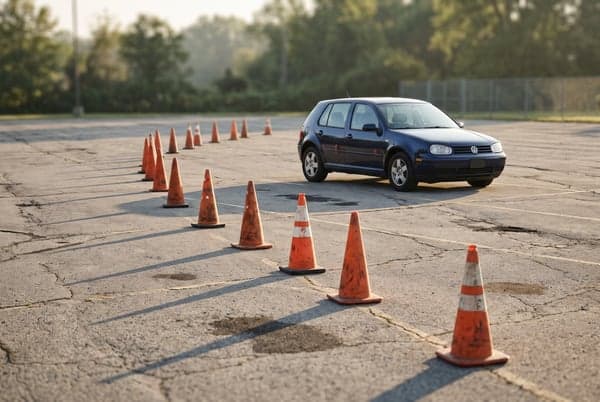
Autocross lets adults compete in the car they already drive every day. Drivers take timed runs, one at a time, through a course marked out with traffic cones on a large paved lot. The lowest time in each class, after penalties, wins.
The Sports Car Club of America calls its autocross program Solo. Local SCCA regions host events throughout the season, and many independent car clubs run their own. Courses are usually set up in parking lots, on airport aprons or on other broad stretches of pavement. The layout changes from event to event, so no driver arrives already knowing the course.
The format keeps the barrier to entry low. Only one car is on course at a time, so there is no wheel-to-wheel contact with other drivers. Speeds stay well below those of a road course because the tight layout rarely allows long straights. Course designers leave open space around the layout, so the main thing a driver can hit is a cone. That combination is why a stock, street-legal car can take part without a roll cage or racing seats.
A typical event day starts with registration and a technical inspection. Inspectors generally look for a secure battery, tight wheel lug nuts, sound brakes and a cabin cleared of loose items. Helmet requirements also apply. Standards vary by organizer, and the event's posted rules are the place to confirm them.
Before the first run, drivers walk the course on foot. The walk is the only chance to learn the sequence of cones, and many drivers do it more than once. Runs then follow in groups called heats. Each driver typically gets several attempts, and the best single run usually counts.
Penalties shape the results. Under SCCA Solo rules, each cone knocked down or out of its box adds two seconds to a run. Missing a gate or taking a wrong turn counts as off course, and that run earns no valid time.
Club events depend on the entrants themselves. When a driver's heat is not running, that driver is usually assigned a work shift. Common jobs include resetting cones on course, running timing equipment and staffing the start line.
Cars compete in classes grouped by model and by how heavily they have been modified. Beginners often enter a novice category, and many local regions pair newcomers with an experienced driver who rides along. The trade-off of using a daily driver is added wear on its tires and brakes.
HPDE track days on a closed road course

Illustration: Quartz
High-performance driving education, known as HPDE, lets drivers take a street car onto a real racing circuit without competing against anyone. Beginners usually ride with an instructor in the passenger seat. That makes HPDE a structured way to learn a road course in a car that is already sitting in the driveway.
The format is built around instruction rather than results. There is no starting grid, no podium and, at most events, no official timing. Organizers present HPDE as education, not competition. Race-style driving against other cars breaks the rules at these events.
Several car clubs run HPDE programs across the U.S. The Porsche Club of America and the BMW Car Club of America both hold driver education events through their local chapters. Some chapters accept cars from other manufacturers, though policies differ by event. The National Auto Sport Association, known as NASA, also runs HPDE alongside its racing program. Independent track-day companies fill out the calendar at many circuits.
Drivers are sorted into run groups by experience. Novices share the track with other novices, and more advanced groups go out in separate sessions. Passing in beginner groups is tightly controlled. It is usually allowed only on designated straights. The car ahead must first give a point-by signal out the window. Advanced groups may have more open passing rules, depending on the organizer.
A typical day mixes driving sessions with classroom time. Between sessions, beginners attend briefings on the track layout, session procedures and what to do if a car leaves the pavement. Instructors then debrief students on what happened on track. Each session works as a lesson rather than a string of laps.
Car preparation starts before arrival. Most organizers require a technical inspection covering brakes, tires, wheel bearings, fluid leaks and a secure battery. They also ask drivers to remove loose items from the cabin. Helmet standards, inspection forms and rules for convertibles vary by organizer. The current requirements for the specific event are worth reading before registering.
Track driving puts more wear on brake pads, brake fluid and tires than daily commuting does. Many personal auto insurance policies exclude on-track driving, and some insurers sell separate HPDE coverage. Drivers should check their own policy before taking a car onto the circuit.
Sim racing at home with iRacing, Assetto Corsa or Gran Turismo

Illustration: Quartz
Sim racing lets adults learn real circuits, car control and wheel-to-wheel racecraft from home. Practice happens on a computer or games console, with no real tires or fuel to replace.
iRacing is a subscription-based online racing service for PC. Its circuits are laser-scanned. That process captures the bumps, curbs and elevation changes of the real tracks in close detail.
Each iRacing driver carries two numbers. A safety rating reflects how cleanly they drive, and an iRating reflects how competitive they are. Matchmaking uses these numbers to group drivers of similar ability. Licenses start at the Rookie level and move up as a driver keeps racing cleanly. The structure rewards avoiding contact alongside raw speed.
Assetto Corsa comes from Kunos Simulazioni, a studio in Italy. The original game has a large modding community that adds cars and circuits from around the world. Its follow-up, Assetto Corsa Competizione, is built around GT3 cars and the GT World Challenge series.
Gran Turismo is Polyphony Digital's series for Sony $SONY's PlayStation consoles. It is designed to be played with a standard controller. Gran Turismo 7 includes license tests that teach braking, cornering and car control through short exercises.
The franchise also has a real-world track record. GT Academy, a program run by Nissan and PlayStation, recruited players and trained them as racing drivers. One graduate, Jann Mardenborough, went on to compete in the 24 Hours of Le Mans.
Wheel and pedal sets come from makers such as Logitech, Thrustmaster and Fanatec. Force feedback sends resistance through the wheel to show what the front tires are doing. Direct-drive wheels mount the rim straight onto the motor shaft for more detailed feedback. Load-cell brake pedals measure how hard the driver presses rather than how far the pedal travels. A real car's brake responds to pressure in a similar way.
The most direct transfer to real driving is track knowledge. A driver can learn braking points, turn-in markers and gear choices for a circuit before arriving for a track day or race.
A simulator still leaves gaps. It cannot reproduce the lateral forces a driver feels through the seat in a fast corner. A crash ends with a reset rather than a damaged car.
Volunteering as a corner worker or race marshal

Illustration: Quartz
Volunteering as a corner worker or marshal puts a newcomer beside a live racetrack without needing a car, a competition license or a racing helmet. Amateur road racing depends on volunteers to staff its flag stations, and clubs such as the Sports Car Club of America (SCCA) recruit them for their events.
Corner workers stand at stations spaced around a circuit. Each station usually sits behind a barrier with a clear view of one stretch of track. The crew's job is to watch the cars and signal drivers with flags.
A waving yellow flag warns of danger ahead and tells drivers not to pass. A red flag stops the session entirely. Other flags warn of a slick or debris-covered surface, a slow vehicle ahead or the end of the session.
Stations also report to race control by radio. When a car spins, stalls or hits a barrier, the nearest corner crew is often the first to see it. Workers describe the incident, help clear debris and assist in getting a stopped car off the circuit. That work shows how quickly track conditions change and how officials decide whether to slow or halt a race.
Flagging is only one of several jobs. The SCCA organizes its volunteer specialties into areas such as flagging and communications, timing and scoring, registration, grid and technical inspection. Timing and scoring workers record lap times and finishing positions. Grid workers line cars up before each session. Tech inspectors check that cars meet the rulebook.
Clubs typically train new workers at the event by pairing them with experienced crew. Requirements such as minimum age, clothing and liability waivers vary by organizer. Newcomers should check with the organizing club before signing up for a weekend.
The same volunteer model exists outside U.S. club racing. In the U.K., marshals staff events ranging from club meetings to the British Grand Prix at Silverstone. The British Motorsport Marshals Club supports and trains volunteers there.
The paddock access that comes with the job also puts volunteers in regular contact with drivers, crew members and officials. Those contacts can lead to a crew role, a ride-along or practical advice on choosing a first race car.
Budget endurance racing in the 24 Hours of Lemons

Illustration: Quartz
The 24 Hours of Lemons lets adult beginners race wheel-to-wheel on a real road course by splitting one inexpensive car among a team of drivers. Sharing the car, the work and the bills keeps this form of endurance racing within reach of people without a professional budget.
The series is built around a strict limit on what a team may spend on the car itself. Organizers keep that limit low on purpose. It pushes entrants toward old, high-mileage vehicles that might otherwise be headed for a scrapyard. Safety equipment does not count against the limit. Teams can buy proper protective parts without eating into the car budget.
A typical team includes several drivers who take turns behind the wheel in stints during a long race. Despite the name, many Lemons events are not one continuous 24-hour session. They are often spread across a weekend, with racing on both days. Pit stops for fuel and driver changes become part of the strategy. A car that keeps running can finish ahead of a faster one that breaks down.
The culture is deliberately tongue-in-cheek. Teams build themed cars and often wear costumes to match. Race officials, known as judges, hand out humorous penalties for rough driving or creative rule-bending. The series' signature award, the Index of Effluency, goes to the team that achieves the most with the car least likely to succeed. It does not go to the team that covers the most laps.
The low-budget theme stops at safety. Cars must pass a technical inspection before they can run. The rules call for equipment such as a roll cage, a racing harness and fire safety gear, along with helmets and fire-resistant clothing for drivers. Exact standards change over time. Anyone building a car or joining a team should read the current rulebook before spending money.
Building a car is not the only way in. Some established teams sell open seats for a race, an arrangement often called arrive-and-drive. A driver pays to share a car that is already prepared and inspected. Similar team-based series include the ChampCar Endurance Series and the World Racing League. Each sets its own rules for cars and drivers.
Spec Miata and other spec racing classes

Illustration: Quartz
Spec racing classes such as Spec Miata limit what competitors can change on their cars. The result is a closely matched field in which driver skill counts for more than car preparation. Spec Miata is built around the Mazda Miata and runs in Sports Car Club of America (SCCA) road racing.
The idea behind any spec class is a tight, published rulebook. Engine, suspension, tires and bodywork are restricted to a defined set of parts and settings. A competitor cannot gain speed with a custom engine or exotic components. Those parts are not legal in the class. The rules aim to keep cars at similar performance levels and to head off an arms race between entrants.
The Miata became the basis for a spec class for practical reasons. It is a small, light, rear-wheel-drive roadster, and Mazda built it in large numbers. Early-generation cars are common on the used market. Replacement parts are widely available. That matters in a sport where cars wear out and sometimes get damaged. A large aftermarket of suppliers and race shops has also grown up around the car.
Spec Miata is not tied to a single organizer. The National Auto Sport Association (NASA) also runs a Spec Miata class. Its rules differ from the SCCA's in places. A driver who plans to race with both groups needs to read both rulebooks before preparing a car.
The spec approach extends well beyond Mazda. NASA runs Spec E30, a class for the BMW E30 3 Series. The SCCA runs Spec Racer Ford $F, which uses a purpose-built race car rather than a converted road car. Each class follows the same principle of restricted modifications and matched equipment.
Some drivers buy a car that a previous owner has already built to class rules instead of converting one themselves. Either way, the car must pass the sanctioning body's technical inspection before it can race.
Spec racing is wheel-to-wheel competition, not a timed run or a non-competitive track session. Entering a race requires a competition license from the sanctioning body. The car needs safety equipment such as a roll cage and racing harnesses. The driver needs a helmet and fire-resistant clothing. Specific standards change over time and differ between organizers. Drivers should check the current SCCA General Competition Rules or the NASA rulebook before buying any equipment.
Test and tune nights at a local drag strip

Illustration: Quartz
Test and tune nights let drivers take an ordinary street car to a drag strip and make timed, straight-line passes without entering a formal competition. Many local strips hold these open sessions. They give a daily driver access to a purpose-built track with professional timing equipment.
Two cars usually line up side by side at the start of a straight strip. The strip is typically a quarter mile (1,320 feet) or an eighth mile (660 feet) long. Each driver launches when the lights change and runs to the finish. There are no corners and no passing zones. Each car stays in its own lane for the whole run.
Before any car reaches the start line, it goes through technical inspection. Track staff typically look for fluid leaks, a secure battery and loose items inside the cabin. Requirements for helmets, safety gear and car equipment vary by strip. They also tighten as a car gets quicker. Many U.S. tracks follow the National Hot Rod Association rulebook. Drivers should check the track's current rules and the NHRA's before arriving.
The start is controlled by a column of lights known as the Christmas tree. Drivers roll forward until small bulbs at the top show they are pre-staged and then staged. Amber lights then flash, either one after another or all at once, depending on the format. Green follows. Leaving before green triggers a red light, which counts as a foul start.
Each run produces a timeslip, a printed or digital record of the pass. Reaction time measures how quickly the driver responds after the tree signals the start. Elapsed time, or ET, measures how long the car takes to cover the distance to the finish line. The slip also lists split times, such as the 60-foot time. It records the car's speed at the end of the run as well.
Those numbers turn every pass into feedback. A slow reaction time points to the driver. A weak 60-foot time usually points to traction or launch technique. Comparing slips across a night shows whether a change made the car quicker.
Test and tune also serves as a bridge to bracket racing, a common form of grassroots drag competition. In bracket racing, each driver submits a predicted ET, called a dial-in. The slower car gets a head start based on the difference between the two dial-ins. Running quicker than the dial-in is called breaking out, and it usually costs the win. Consistency matters more than raw speed.
That handicap structure lets very different cars compete on even terms, from family sedans to modified muscle cars. Drivers who learn to repeat their times on test and tune nights are practicing the core skill bracket racing rewards.
Motorcycle track days and WERA or CCS club racing

Illustration: Quartz
Riders can take a street-legal motorcycle onto a closed racetrack at a track day, then move into wheel-to-wheel competition with club racing organizations such as WERA and CCS. This route lets a rider start on a bike they already own instead of buying a dedicated race machine.
A motorcycle track day is an open lapping session, not a race. Organizers sort riders into groups by experience, commonly labeled novice, intermediate and advanced. Novice groups often limit where and how riders may pass. Many organizers also assign coaches or control riders to beginners. That structure keeps a first-time rider on track with others moving at a similar pace.
Preparing a street bike for the track usually takes modest work. Many organizers ask riders to tape over headlights, taillights, turn signals and mirrors. The tape keeps broken glass or plastic from scattering across the circuit after a fall. Some organizers ask riders to remove mirrors entirely. A number of organizers bar glycol-based antifreeze in the cooling system. A coolant leak of that kind leaves a slick film on the pavement. Tire condition and brake pad wear are typically checked at a tech inspection before the first session.
Protective gear is mandatory. Riders need a full-face helmet, a leather suit, gloves and boots. A two-piece suit generally must zip together at the waist. Some organizers require a back protector, while others only recommend one. Exact standards differ from one organizer to the next. Riders should read the current gear rules of the specific organizer before arriving.
WERA, the Western Eastern Roadracers Association, and CCS, the Championship Cup Series, run amateur road racing at circuits around the U.S. Both sanction classes divided by engine size and level of modification. Lightweight classes give riders of small-displacement sport bikes, such as the Kawasaki Ninja 400 and Yamaha R3, a place to compete. Those smaller machines make less power than large superbikes. They are a common choice for newer racers.
Moving from track days to racing requires a competition license, and each organization sets its own requirements. Race bikes also face stricter technical rules than track day machines. Club racing rulebooks commonly call for safety wire on drain plugs, oil filler caps and other fasteners whose failure could spill fluid on the track. The details vary by organization and class. Riders should check the current rulebook for the series they plan to enter before preparing a bike.
Racing schools and club membership as a path to a competition license

Illustration: Quartz
A racing school or a sanctioning club such as the Sports Car Club of America (SCCA) offers a structured route from casual track time to wheel-to-wheel racing. Schools teach the skills. Club membership connects drivers to events and to the competition license that racing requires.
Wheel-to-wheel road racing is different from a track day or a timed event. Drivers compete for position in close company, and a mistake can involve other cars. For that reason, organizers do not let a newcomer enter a race on enthusiasm alone. Most sanctioning bodies require a competition license, and each one sets its own conditions for earning it.
The SCCA organizes its members into regions across the U.S. Those regional chapters run much of the club's local activity. The National Auto Sport Association, known as NASA, is another U.S. organization that runs both driver education and wheel-to-wheel racing. In the U.K., Motorsport UK is the governing body that issues competition licenses.
Racing schools give beginners a way to learn without owning a race car. Many schools supply the car, the track time and the instructors as part of the course. A student can learn before buying, preparing, storing and towing a dedicated race car. That also gives a driver the chance to find out whether racing suits them before making a larger commitment.
Courses generally mix classroom sessions with on-track exercises. Classroom topics often cover vehicle dynamics, such as how a car's weight shifts under braking and cornering. On track, students practice race-specific situations that a track day does not cover. These include rolling or standing starts, running side by side with another car and holding a position under pressure. Instructors often review data or in-car video with students between sessions.
Some clubs run their own licensing schools for members who want to move into racing. These events concentrate on race procedures and safety. They are designed to show that a driver can handle traffic predictably before competing.
Membership carries practical benefits beyond licensing. It puts a driver on the club's event calendar, and entering a club's events typically requires being a member. Regional chapters are also where newcomers meet experienced racers. Those contacts can lead to co-driving arrangements, shared cars and used race equipment for sale.
Licensing requirements differ between organizations and countries, and clubs can revise them between seasons. Before paying for a course, a prospective racer should read the current licensing rules of the specific club they plan to race with. That check confirms whether the school counts toward the license. It also shows which safety equipment the driver will need.