
Through the hour-long chat with BT, Nyrika Holkar easily shifts from one topic to another with poise and calm. It could be a question on Godrej Enterprises Group’s diversified businesses or how she views technology and digital or how she keeps her team motivated. As Executive Director of the entity that runs diverse businesses such as consumer (home appliances, furniture and fittings, locks and security), aerospace, commercial appliances, advanced engineering, intralogistics and real estate, Holkar is the custodian of an enviable legacy, one that she must make future ready. She has been a key part of the growth story of a group that has stood for quality across generations.
The large meeting room in her office in Mumbai’s Vikhroli is simple but functional. A peep outside reveals a spacious open office that is quietly buzzing with activity. Academically, she first earned an undergraduate degree in philosophy and economics from Colorado College, doubling it with a master’s in law from University College in London. The move into the family business (her mother, Smita and Jamshyd Godrej are siblings) came after a six-year stint with AZB & Partners. In an interview with Krishna Gopalan, Holkar elaborates on the business today and her vision for tomorrow. Edited excerpts:
Q: You have a rich legacy with the Godrej brand name. Do you view that as a strategic advantage in a dynamic business environment?
A: We have been around for 129 years. The natural inclination would be to preserve everything or to change everything. Neither of the two is very helpful. One must identify the elements that are enduring and specific aspects that need to be changed. The Godrej brand enjoys tremendous trust, but we must build on that and ensure it is renewed in every generation. If we look at today’s younger consumers, we need to understand they are choosing us because we are a brand that delivers on their aspirations. The fact is nobody will choose us for nostalgia.
Q: Godrej is a diversified group. How much of a challenge is to preserve the rich past and yet get it right on the more contemporary businesses?
A: In consumer businesses, while quality and trust are something the brand stands for and these remain key drivers of purchase. For us, the opportunity is to make the brand more design forward and tech enabled, and to get the price value equation right so that we can give consumers a strong value proposition. It also means that the proposition needs be communicated effectively. For example, a thing like steel kitchens that are ideally suited for the hard use of Indian kitchens and can withstand high humidity, pests, and corrosion is important to communicate to customers.
However, in the industrial businesses, the challenge is different. Quality and trust remain the most critical factors for a repeat purchase but again, design becomes the differentiator. As we move from build-to-print to build-to-spec, we have to build a different set of capabilities and we have to be able to integrate software and electronics with mechanical fabrication.
Q: Technology is at the core of your businesses. Where are you on the journey to becoming a more tech-led organisation?
A: The insight from our consumer interactions is that we are not perceived as being design-forward. So, we decided to use AI to understand trends from different sectors, like the automotive industry, OTTs, and hospitality, to translate trends for home furniture and decor. In this way, technology can be an enabler to help us serve the customer better.
Today, technology has helped us distill insights faster, compared to a few years ago, when our systems were more analog. Earlier, teams operated more on intuition and experience whereas today we can operate on insights at scale. It is about the ‘art of the possible,’ not the art of the impossible.
Amethyst, our AI platform, has allowed us to experiment in a safe and closed environment. We believe experimentation must be disciplined and that we must institutionalise learnings in situations where we may not have been successful in our pursuit. I strongly believe that good ideas can come from anywhere in the organisation and that we must create a culture where everyone feels like their ideas are appreciated and valued. A lot of our innovation programmes and digital enablement are based on active learning projects which are implemented in the businesses.
Cross functional teams come together from across the organisation, and what I find interesting about this approach is that diversity of perspectives help each of us to question our own assumptions and biases and come to a better and more holistic outcome.
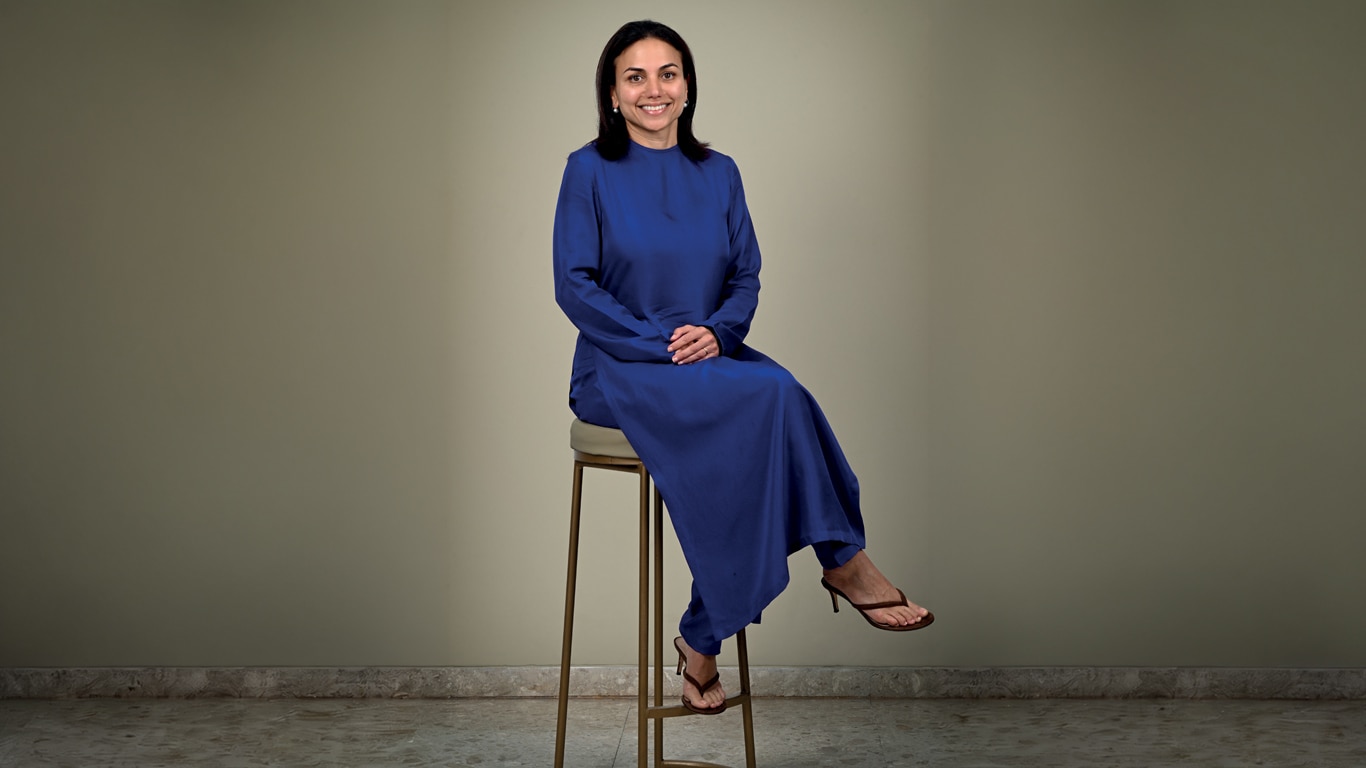
The Godrej brand enjoys tremendous trust. If we look at today’s younger consumers, we need to understand they are choosing us because we are a brand that delivers on their aspirations.
-Nyrika Holkar,ES, Godrej Enterprises Group
Q: Are you doing a lot of that today?
A: Yes, and our diversity of businesses becomes a strength if one can do cross-learnings between them. For example, material exploration and aerospace can have some value for appliance components. In my view, cross-deployment, whether it’s on the shopfloor or on go-to-market or the product, is where our strength is.
Q: How has the process of picking a new business foray changed or matured over time?
A: I’ll take two examples. One can be around an adjacency. In our locks business, for instance, we have a very strong distribution network for mechanical and digital looks. We looked at how this channel synergy can help us enter a new business.
We looked at this whole idea of architectural hardware that goes through the same channel. It’s a different product and it made sense to bring it through an adjacency through some synergy in terms of channel or customer.
There are many bets we have taken. Today, storage of energy is an area where we have put innovation money. So, we have incubated a business of battery chemistry that is more earth abundant.
This is not for consumer electronics but more for large-scale industrial energy use cases.
Here, blue-sky thinking is around what the needs of the country will be when we are thinking of moving towards Viksit Bharat. We can, in some sense, provide capability, expertise and patient capital to bring it to market.
@krishnagopalan