President Lee Jae-myung said on the 26th that South Korea cannot avoid joining the Comprehensive and Progressive Agreement for Trans-Pacific Partnership, or CPTPP, saying, "We cannot refrain from doing what must be done simply because someone objects and resists fiercely." The remarks were seen as underscoring that accession is inevitable over the long term, even as the government has put off joining this year.
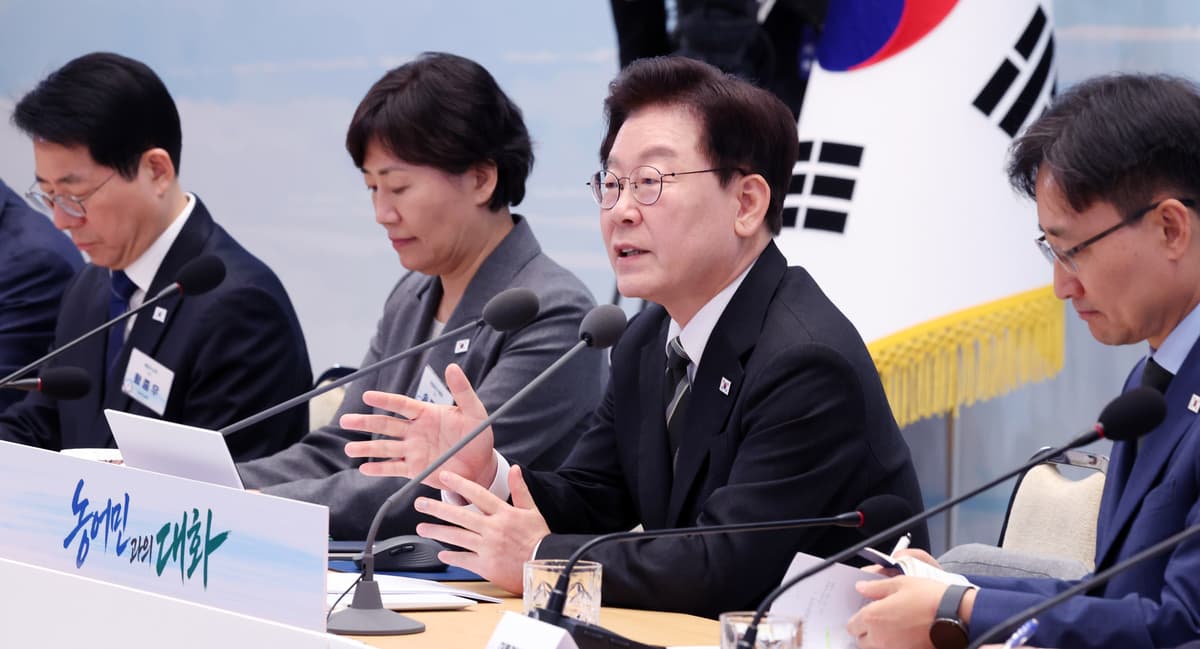
Speaking at a dialogue with farmers and fishers held at the Blue House state guest house, Lee argued for the need to join the pact. "South Korea is what we call an open trading nation, a country that depends on exports and trade, so expanding the global export market — what we call our economic territory — is very important," he said.
He added that applying for membership would not guarantee approval and that a final agreement would be difficult to reach within his term. "In the end, there is a very high chance this will end with nothing but criticism and no results," he said. "Even so, for the sake of the country as a whole, it has to be done, even with some criticism, so that we can move on to the next stage." He also said, "We cannot live on semiconductors alone, but neither can we live on agriculture alone. Everything must coexist in harmony."

At the same time, he proposed compensating losses in the farming and fishing sectors through measures such as an export levy. The idea is to collect a portion of the profits from industries and companies that benefit from trade liberalization and use the money to compensate industries that suffer losses.
"If you benefit on the basis of someone else's sacrifice, you should bear at least a minimum burden," Lee said. "Someone will profit from a new agreement, won't they? A certain portion of those profits should be set aside to make up for the losses."
He also laid out a plan to use government funds to fill the target amount for a rural-urban cooperation fund that previous administrations had promised but failed to deliver. Lee said the fund, originally meant to reach 1 trillion won ($700 million), had collected only a little more than 300 billion won, and he repeatedly stressed that the government would contribute the roughly 700 billion won shortfall.
He also signaled a willingness to expand spending on farm household income support. "Direct support for farming households needs to increase. A basic income for farming and fishing villages is one such method," Lee said. "Raising public-interest direct payments is also a clear task for the government. I think you can look forward to this one." He expressed partial agreement with a request to raise the agriculture ministry's share of the total national budget to 5% from the current 2.8%.
On the government's plan to conduct a full survey of farmland, Lee said, "To carry out farmland policy, you have to know the state of the farmland, but a survey that is required by law has not been done for 70 years." He added that the aim was "to find out whether people who registered as farmers and bought farmland are actually not farming and using the land for something else," and said, "This is now a main cause of rising home prices near the Seoul metropolitan area."
He explained that Agriculture, Food and Rural Affairs Minister Song Mi-ryung had proposed the survey to him, saying, "There is something required by law that has not been done for decades, so while we are at it, let's conduct a full survey." Lee said, "This is not intended to take away farmland or impose penalties."