

Here in our Universe, there are a series of fundamental forces that all appear to operate independently of one another. There’s gravity, which is an attractive force between all objects with mass and/or energy, governed by Einstein’s general relativity and the curvature of spacetime. There’s electromagnetism, where any particle with an electric charge or an electric or magnetic field is affected by other charges and electromagnetic fields in the environment. There’s the weak nuclear force, which enables particles to change species and to decay from a heavier species into a lighter one. And there’s the strong nuclear force, which holds atomic nuclei together and binds quarks (and antiquarks) together into hadrons.
We aren’t sure whether gravity is an inherently quantum force or not, but the other three forces — electromagnetism, the weak nuclear force, and the strong nuclear force — all have quantum field theories that describe them. Although it took decades to ultimately make sense of these three forces, we now know that at least two of them are interrelated: the electromagnetic and weak nuclear force. These are not two completely independent forces, but rather are two “broken” manifestations of a more fundamental, unified force that exists under high-energy conditions: the electroweak force.
It makes sense to wonder whether, at still higher energies, the strong nuclear force doesn’t unify with the electroweak force as well: the big idea of grand unification, or of grand unified theories as they’re sometimes known. We don’t know the answer to whether nature ultimately unifies or not, and if so, under what conditions, at which energy scale, or under what framework. But it’s a fascinating idea that continues to generate theoretical interest, and continues to drive the search for experimental signatures. Here’s what we’re seeking.

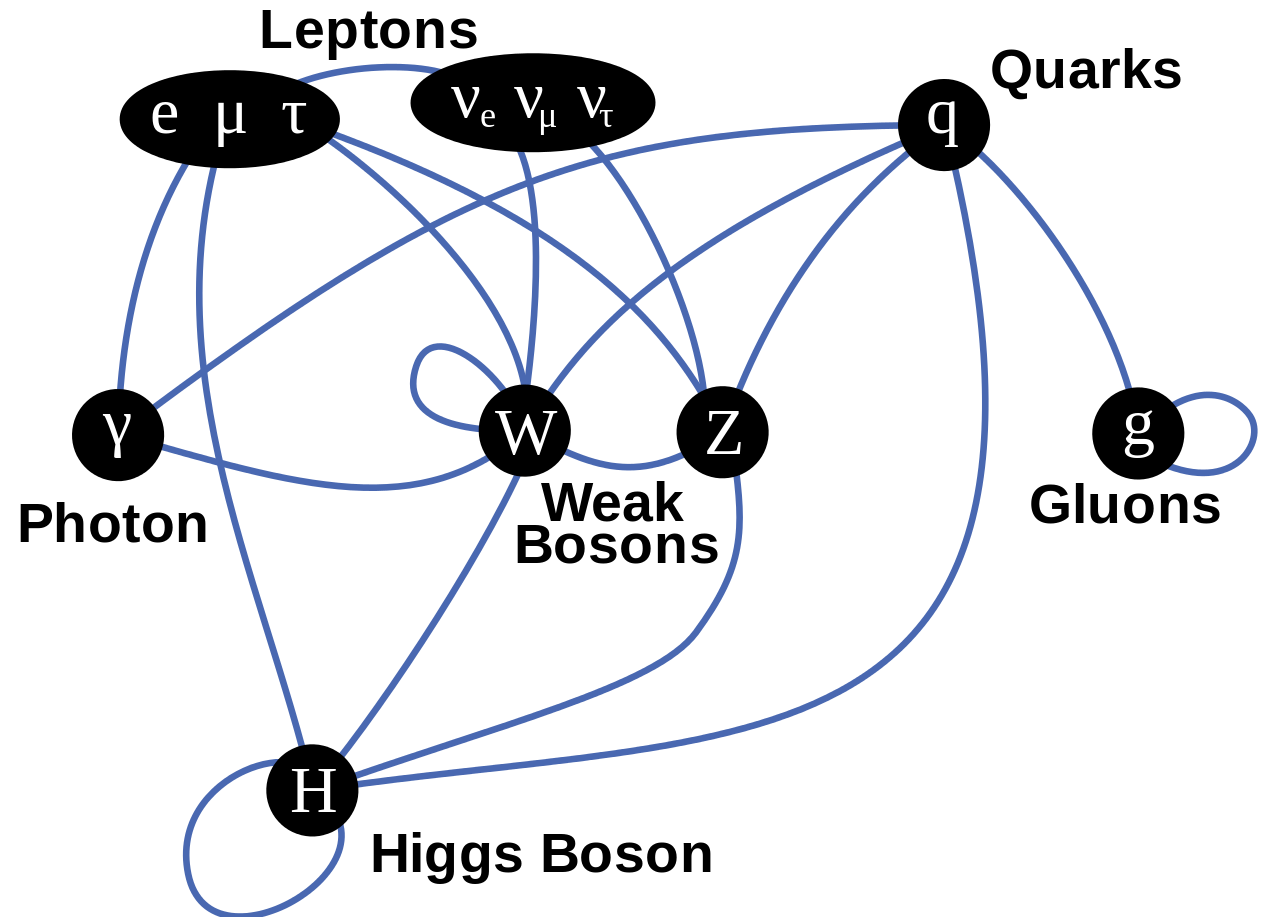
If you’ve ever seen the Standard Model of elementary particles, you could easily be forgiven for thinking that:
- the photon governs the electromagnetic force, which works exclusively on particles with an electric charge,
- the W-and-Z bosons govern the weak nuclear force, and work exclusively on particles with some form of weak charge,
- and that the gluons govern the strong nuclear force, and work exclusively on particles with some sort of color charge: the quarks, antiquarks, and other gluons.
This oversimplified picture is one that we often paint, and it’s mostly true. For most applications, it’s a close enough approximation to being true — a good enough model — that we simply run with it and don’t worry about the tiny caveats where we need to be a little more subtle.
But in fundamental physics, those subtle details are often where the next vital breakthroughs are hiding. For the weak interaction, there isn’t just “some form of weak charge,” but a more complicated structure. In the Standard Model, quarks experience all three of these interactions, the charged leptons experience only the electromagnetic and weak interactions, and the uncharged leptons (neutrinos) experience only the weak interactions at all. Looking into this further led scientists to uncover a surprising phenomenon: electroweak unification, the first successful unification of forces in our understanding of physics since Maxwell unified electricity and magnetism.
The key idea came in the early 1960s. In the strong interactions, there was an idea that had been around for a while known as isospin: where there’s a flavor symmetry related to what we now think of as the “up-ness” or “down-ness” of a particle. For example, a proton, having two up and one down quark, has a more “up” isospin than its counterpart, the neutron, with one up and two down quarks, which instead has a more “down” isospin.
The equivalent of that idea for the weak interactions is known as weak isospin, where the (left-chiral) particles with positive electric charge have positive weak isospin (positrons, up quarks, down antiquarks, etc.), and the ones with negative electric charge have negative weak isospin (electrons, up antiquarks, down quarks, etc.). The neutrinos, which are uncharged, since they’re all left-handed (left-chiral fermions), have positive weak isospin, and the antineutrinos, which are also uncharged, have negative weak isospin.
Weak isospin used to be thought of as the equivalent of “weak charge,” but something was missing. The original idea was that there were only the W-bosons mediating the weak interactions, and that all of the particles were left-chiral only. However, this would lead to a scenario where particles were massless and the symmetry known as CP, where replacing particles with the mirror-image versions of their antiparticles, would be exact. This instead led to a more complex version of the theory, where:
- there was a neutral Z-boson in addition to the electrically charged W-bosons,
- the charged fermions that we observed — the quarks and the charged leptons — were superpositions of both left-chiral and right-chiral particles (allowing particles to have mass),
- and that in addition to “weak charge” or weak isospin, which itself is not conserved, there’s another quantum number that relates electric charge to weak isospin known as weak hypercharge (which is also not conserved), and only a specific combination of weak isospin and weak hypercharge is conserved.
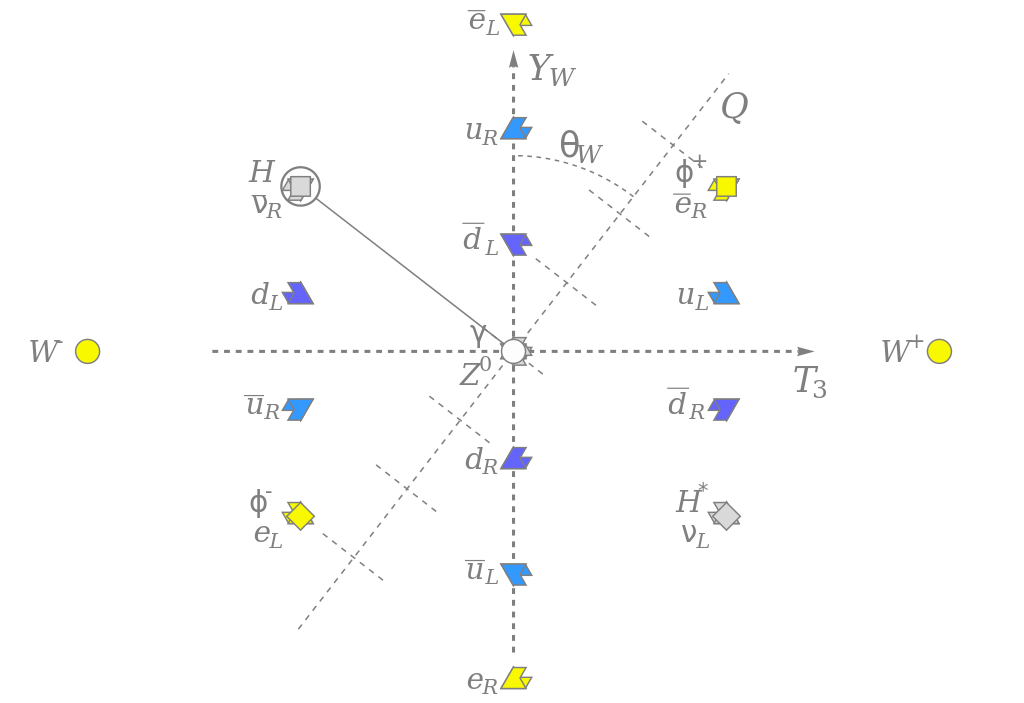
Because there’s an intimate relation between weak isospin, weak hypercharge, and electric charge — and also between the W-and-Z bosons and the photon, which arises as part of the same mechanism that leads to the Higgs boson — we learned that the electromagnetic force and the weak force are not two separate, unrelated forces, but rather are part of a single, unified “electroweak” force. When you see the group theory that underlies the Standard Model written out as SU(3) ⊗ SU(2) ⊗ U(1), it’s tempting to think of the SU(3) part as the strong interactions, the SU(2) part as the weak interactions, and the U(1) part as the electromagnetic interactions.
But that can’t be true.
Instead, part of the SU(2) component describes the electromagnetic interactions, and part of the U(1) component describes the weak interactions. Instead, we need these two groups to work together, and so SU(2) ⊗ U(1) behaves as the electroweak interactions. That’s the (math-free version of the) story behind electroweak unification.
Now, we have another fundamentally quantum force: the strong interactions. In the regular Standard Model, there is no mixing between the SU(3) (strong force) component and the SU(2) ⊗ U(1) (electroweak force) component at all. But if we consider a few pieces of evidence, there certainly are quite a few things that we don’t know how to make sense of today that would make sense if — at some level, at some energy, and under some grander framework — this “superforce” unification actually occurred.
For starters, if you learn the mathematics of group theory, you’ll learn that there are several types of groups, with
- unitary groups,
- special unitary groups,
- orthogonal groups,
- special orthogonal groups,
- symplectic groups,
- and exceptional groups
numbering among them. (The Standard Model, made of SU(3) ⊗ SU(2) ⊗ U(1), is made of two special unitary and one unitary group.)
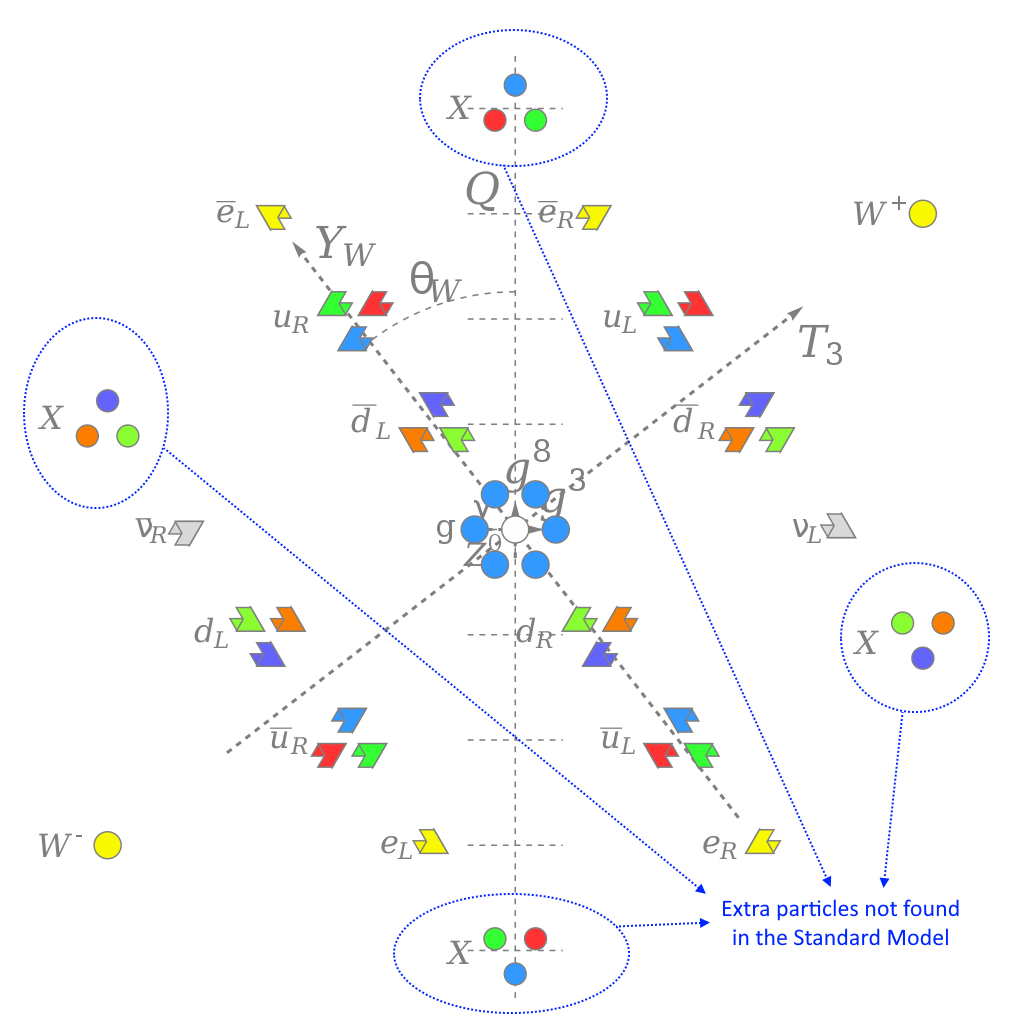
It turns out that if you scale up to a larger group of a variety of types, including SU(5) or larger for special unitary groups, SO(10) or larger for special orthogonal groups, or most of the exceptional groups, you wind up finding that not only is the entire Standard Model living inside of these groups, but they have a whole bunch of interesting properties that the Standard Model, alone, doesn’t have. For one, they predict the existence of new, heavy particles at a new scale: the GUT (or grand unified theory) scale, and those particles enable a whole slew of things we’ve never seen before.

1.) Proton decay. If grand unification is true, then the proton is not a stable particle like it is in the Standard Model. Given enough time, due to the new baryon-number-violating interactions that grand unification would introduce, the proton would eventually decay. Because it would have to conserve electric charge and decay into something lighter than the proton itself, the two main pathways would include:
- a neutral meson, like a pion or a kaon, along with a positively charged light lepton, like a positron or an anti-muon,
- or a positively charged meson, like a pion or a kaon, along with an antineutrino,
since if you’re going to violate baryon number in this context, you have to violate lepton number as well by an equal amount.
It was, in fact, this aspect of grand unified theories that led to the development of Kamiokande: what has now grown into the world’s largest tank-based neutrino detector after being upgraded to super-Kamiokande and, now, is in the process of an upgrade to hyper-Kamiokande. In the location of Kamioka mine in Japan, it wasn’t originally a “neutrino detector experiment,” which is what the “nde” in Kamiokande now stands for, but a nucleon decay experiment: a tank build to search for proton decay. Of course, in 1987, a nearby supernova created a neutrino signature in the original Kamiokande detector, and the subsequent field of neutrino astronomy has won several Nobel Prizes in physics, including this year’s. While the simplest model for grand unification, SU(5), predicts a proton lifetime of 10³⁰ years, current experimental limit set the lifetime to be no less than 10³⁴ years. If we can up that limit by another three orders of magnitude, we’ll potentially be able to rule out SO(10) unification as well.

2.) A viable mechanism for creating a matter-antimatter asymmetry. It’s no secret that there’s more matter than antimatter in the Universe. But one thing we don’t yet know is how we came to get a Universe that has more matter than antimatter. In general, we presume that something happened early on in the very young Universe, post-Big Bang, to create more matter than antimatter from an initially symmetric state. We also know that based on Standard Model physics alone, we cannot generate the asymmetry we presently observe; there must be new physics involved at some level to create it.
Grand unification creates a viable framework for doing precisely this. By predicting the existence of new, superheavy bosons that couple to both quarks and leptons — in a framework that allows the aforementioned CP-symmetry to be violated — we can, in the early Universe:
- create large numbers of these two new bosons, X and Y, plus their antiparticles,
- have those X’s and Y’s (and anti-X’s and anti-Y’s) decay to a mix of quarks and leptons,
- in a fashion that favors quarks over antiquarks and leptons over antileptons,
- yielding a Universe with a big enough matter-antimatter asymmetry to match observations, including the observed baryon-to-photon ratio.
If grand unification is correct, it could be the solution to one of the biggest unsolved problems in all of modern theoretical physics.
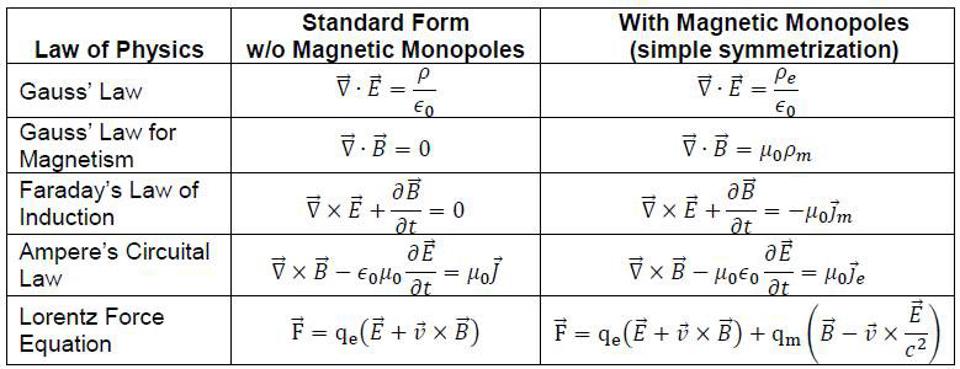
Credit: Ed Murdock
3.) For larger grand unification schemes, like SO(10), the Universe becomes fully left-right symmetric. We know, under the Standard Model of particle physics, that the Universe is fundamentally not symmetric in a number of important ways.
- We have electric charges, but not magnetic ones.
- We have chiral Fermions, where the “left-handed” components couple to nature in a different fashion (for instance, only to the W-boson and never to the Z-boson) than the “right-handed” components (which only couple to the Z, and never to the W).
- And furthermore, there are no “right-handed” neutrinos (or “left-handed” antineutrinos) at all.
In most grand unified theories, all of these differences disappear. Grand unification generically predicts the existence of magnetic monopoles, which would make Maxwell’s equations symmetric between electricity and magnetism. This could be a potential explanation behind why electric charge is quantized in the Universe.
If you bring in right-handed neutrinos, which grand unification does, you can come up with a simple mechanism to explain the very small but non-zero values of neutrino masses in the Universe.
And in a left-right symmetric Universe, parity (or mirror symmetry) is explicitly conserved, meaning that our parity-violating Universe would arrive as a consequence of spontaneous symmetry breaking: a feature that would disappear above the unification scale.
Things would be very interesting indeed, in a large number of ways, if grand unification holds true for our Universe. And while we have no proof, there’s an interesting piece of very, very circumstantial evidence that might point in that direction.

In physics, each force has a coupling constant associated with it: a constant that describes the strength of that force. Today, the electromagnetic coupling constant is small: about 1/137. The weak coupling constant is also small, but not quite that small: more like 1/30. The strong coupling constant is much larger: more like 1/9.
However, all of these coupling constants scale with energy.
- At higher energies, the electromagnetic coupling constant gets stronger.
- At higher energies, the weak coupling constant evolves in a way that brings it closer to the electromagnetic coupling constant.
- And at greater energies, the strong coupling constant gets weaker, decreasing and bringing it closer to both of the other coupling constants as energy scales up.
If you go up to very high energies — energies comparable to the theoretical grand unification scale — those coupling constants all almost meet at a point. They miss each other, but only by a little bit. Remember: the difference between today’s modern energy scales, at roughly the milli-electron-volt level, and the grand unification scale, up around 10¹⁵ giga-electron-volts, spans 27 orders of magnitude.

Even in the absence of folding in any extra new particles or interactions or couplings, the fact that they only miss each other by less than three orders of magnitude, as shown above on a logarithmic scale, represents a remarkable fine-tuning problem: a puzzle on naturalness grounds. The running of these constants, even if they do run together perfectly, doesn’t prove the existence of grand unification. However, if the coupling constants do meet, it sure would be a strange coincidence if they all intersected at a point and just kept evolving at both higher and lower energies; mathematically, this is an exceptionally rare occurrence if you choose the parameters of your three curves at random.
And yet, the proton remains stable, there’s no evidence for magnetic monopoles, and efforts to detect neutrinoless double beta decay — which would be a consequence of the Majorana neutrinos predicted by grand unification — have all only yielded null results. Despite the promise of the idea of grand unification, we have only constraints on these scenarios. That doesn’t mean that unification isn’t important at some level, or that it doesn’t describe our Universe. But until we have a stronger hint that goes beyond the mere circumstantial, we have to make sure that we keep this idea firmly classified in the realm of the speculative. As fascinating as it may be, there’s simply no evidence we can point to that indicates that there’s any more unification in our Universe than electroweak theory predicts.
This article Do the three quantum forces all unify together? is featured on Big Think.