
Spread the word
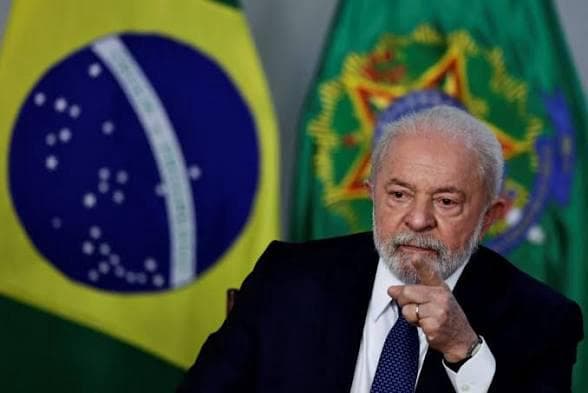
Brazilian President Luiz Inácio Lula da Silva has secured an unprecedented fourth, non-consecutive presidential term after defeating opposition candidate Flávio Bolsonaro in a closely contested runoff election, overcoming an early setback in the first round to retain control of Latin America’s largest economy.
Official results announced by Brazil’s Superior Electoral Court (TSE) showed that Lula, 80, of the Workers’ Party (PT), polled 64,256,232 votes, representing 51.79 per cent of valid ballots, while Flávio Bolsonaro, 45, of the Liberal Party (PL), received 59,826,041 votes, or 48.21 per cent. Blueprint reports
The result gave Lula a lead of approximately 4.43 million votes, ending a fiercely contested campaign shaped by economic concerns, public security, corruption allegations, political polarisation and competing visions for Brazil’s future.
However, Flávio Bolsonaro rejected the outcome and announced plans to seek the annulment of the election, raising the prospect of a legal dispute following an already controversial voting process.
The election marks another major chapter in Brazil’s prolonged political contest between Lula’s left-wing political movement and the conservative movement associated with former president Jair Bolsonaro.
Lula stages comeback after losing first round
Lula’s victory followed a challenging first round on October 4, when Flávio Bolsonaro finished ahead of the incumbent president, securing 47.03 per cent of valid votes against Lula’s 45.16 per cent, according to reported results.
Neither candidate obtained the majority required to win outright, forcing a runoff between the two leading contenders.
Flávio’s first-round performance exceeded the expectations of several opinion polls and strengthened the opposition’s campaign for a change of government.
The senator, who is the eldest son of former president Jair Bolsonaro, sought to build on conservative support by focusing on the cost of living, taxation, corruption concerns and public security.
Lula, meanwhile, reorganised his campaign after the first round, appealing to younger voters and mobilising supporters around democratic values, social inclusion and his administration’s record.
The incumbent also presented the election as a choice between continuing his government’s social and economic policies and returning to a political direction associated with the previous administration.
The runoff ultimately reversed the first-round outcome, making the election a significant political comeback for Lula and an important setback for the Bolsonaro family’s attempt to return to the presidency.
Who is Lula, and what does a fourth term mean?
Lula, a former trade union leader who helped establish the Workers’ Party, first became president in 2003 and served two consecutive terms until 2011.
He returned to office in January 2023 after defeating Jair Bolsonaro in the 2022 presidential election.
His political career has been marked by efforts to reduce poverty, expand social welfare programmes and improve the living conditions of lower-income Brazilians. His supporters credit his earlier administrations with improving access to social assistance and employment opportunities.
However, his political record has also been shaped by corruption controversies, economic policy disagreements and persistent divisions within Brazilian society.
Lula was convicted in corruption-related cases and spent 580 days in prison before Brazil’s Supreme Court annulled the convictions, allowing him to return to electoral politics.
His latest victory will give him another opportunity to pursue his economic and social agenda, although the narrow margin suggests that a substantial section of the electorate remains opposed to his leadership.
According to the electoral court, his new mandate is scheduled to begin on January 5, 2027.
At 80, Lula is also among the oldest leaders in the region, with his new term expected to place renewed attention on economic management, governance and the long-term direction of the Workers’ Party.
Flávio Bolsonaro rejects defeat, threatens legal challenge
Flávio Bolsonaro’s refusal to concede defeat introduced a new layer of uncertainty after the announcement of the final results.
The senator said he would seek to have the election annulled, questioning the circumstances surrounding the last-minute extension of voting hours.
The development follows the political and legal difficulties facing his father, Jair Bolsonaro, who is serving a 27-year prison sentence over his conviction in a case involving an attempted coup following his defeat in the 2022 election.
Flávio emerged as a leading figure in the conservative camp during the 2026 campaign, seeking to consolidate support among voters who opposed Lula’s economic policies and political leadership.
His campaign also drew on the support base associated with his father, whose presidency left a lasting imprint on Brazil’s right-wing political movement.
The demand for annulment, however, does not itself invalidate the result. Any challenge must be considered through the country’s established legal and electoral procedures.
The electoral court announced Lula as the winner after the count was completed, while the legal implications of Flávio’s proposed challenge remained a matter for the relevant authorities.
Two-hour voting extension sparks controversy
The final hours of voting were marked by confusion after Brazil’s Supreme Court Justice Cristiano Zanin ordered a two-hour extension at polling stations that were still open.
Voting had originally been scheduled to end at 5 p.m. local time but was extended until 7 p.m. following complaints about transportation disruptions in several cities and heavy rainfall in parts of the country.
Lula’s campaign raised concerns that reduced public transportation services had prevented some voters from reaching polling stations, particularly in major urban centres such as São Paulo and Salvador.
Flávio Bolsonaro also requested an extension in some regions, citing severe weather conditions in southern Brazil, where his support was comparatively strong.
The court’s decision, however, came so close to the scheduled closing time that some polling stations had already shut down their electronic voting machines.
Authorities clarified that only polling stations that remained open were covered by the extension; those that had already closed were not reopened.
The decision also forced electoral officials to suspend the publication of preliminary results temporarily while voting continued. Counting resumed after the extended deadline.
The controversy provided the basis for Flávio’s subsequent rejection of the outcome, although the announcement of a legal challenge did not establish that the election result was invalid.
Transport disruptions raise questions about voter access
Transportation difficulties became one of the most contentious issues of the election.
In Salvador, municipal officials reported that at least 75 public buses had been prevented from leaving garages amid disputes linked to electoral advertising regulations.
The incident prompted concerns about the ability of voters who depended on public transportation to reach polling stations.
Bahia’s regional electoral court ordered the arrest of Salvador’s Secretary of Mobility, Pablo Souza, in connection with the reduction in bus services, which the court said could constitute an electoral offence.
Lula’s campaign argued that the transportation problems required intervention to protect citizens’ right to vote.
The controversy also highlighted the practical difficulties electoral authorities face when transportation, weather conditions and last-minute judicial decisions intersect during a national election.
In its post-election assessment, the TSE acknowledged the operational challenges caused by the extension, noting that thousands of voting machines had already been closed and that the change required adjustments to the processing of election returns.
The court nevertheless proceeded with the count and announced the final result.
Voter turnout and electoral figures
Brazil’s 2026 presidential runoff attracted substantial participation, with more than 158 million registered voters eligible to cast ballots.
According to the TSE, approximately 128.2 million voters participated in the second round, while abstention stood at about 19.2 per cent, lower than the 21.08 per cent recorded in the first round.
The electoral authority reported that 499,248 electronic voting machines were used during the runoff, with 1,551, representing approximately 0.31 per cent, requiring replacement.
The figures provide an indication of the scale of the election and the logistical demands involved in conducting a nationwide presidential vote in one of the world’s largest democracies.
The TSE also reported a substantial volume of election-related litigation, reflecting the legal disputes and competing claims that accompanied the campaign.
The outcome was announced after the electoral authority completed its counting process, confirming Lula’s lead over his challenger.
Economic pressures and political divisions remain
Beyond the controversy surrounding the vote, the election exposed continuing divisions over Brazil’s economic direction.
Lula’s supporters defended his record on social welfare and assistance to lower-income households, arguing that his experience and policies offered continuity.
Opposition voters, meanwhile, expressed concerns about rising living costs, taxes, corruption and public security, issues that featured prominently throughout the campaign.
The narrow margin between the candidates underscores the challenge facing the next administration as it seeks to govern a country whose electorate remains divided over economic priorities and political leadership.
Lula will also have to navigate relations with Brazil’s political opposition, maintain investor confidence and address public expectations over jobs, inflation, security and social development.
His victory comes at a time when several Latin American countries have experienced political shifts towards conservative candidates, making the Brazilian result a notable development in the region’s changing political landscape.
Implications for Brazil and international relations
Brazil’s presidential election carries implications beyond its borders because of the country’s economic size, influence in South America and role in international discussions on trade, climate change and global governance.
Lula has consistently emphasised national sovereignty and Brazil’s desire to maintain an independent foreign policy.
His re-election is expected to preserve the broad direction of his administration’s international engagement, although the precise course of future relations will depend on developments in Brazil and abroad.
The result also means that the conservative movement associated with Jair Bolsonaro will remain outside the presidency, despite Flávio’s strong first-round performance and substantial support in the runoff.
For Lula, the immediate challenge is to translate his electoral victory into effective governance while addressing the concerns of voters who backed his opponent.
For Flávio Bolsonaro, the proposed legal challenge and the continued mobilisation of conservative supporters will shape the opposition’s next steps.
Ultimately, Lula’s victory gives him a fourth non-consecutive presidential mandate, but the close result and the dispute over voting procedures show that Brazil’s political contest remains far from settled.
Spread the word