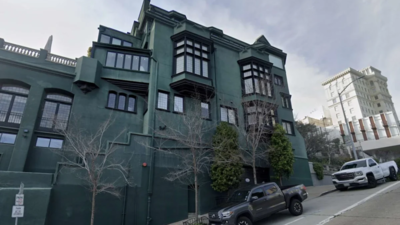
A historic mansion in San Francisco’s Russian Hill neighbourhood, once associated with a wealthy businessman’s romantic scandal and later linked to an opium den, a theatre, a reported brothel and a World War II officers’ club, has returned to the property market with an asking price of $25 million.
Known as the Verdier Mansion, the six-level residence at 1001 Vallejo Street spans 9,545 square feet and is being offered for sale after two decades under its current owners.According to SFGATE, the mansion was designed in 1906 by architect Houghton Sawyer for Robert G. Hanford, a businessman who made his fortune through mining and railways. The property’s current listing on confirms the $25 million asking price and the home’s 9,545-square-foot area.
However, real-estate databases list 1907 as its construction year, while historic-district records date the mansion to 1905-1906.
A mansion built around a controversial romance
The house was commissioned by Hanford for Gabrielle Guittard Cavalsky, a member of the family behind Guittard Chocolate. A 2006 historical feature by SFGATE, drawing on research by an earlier listing agent, recounted the couple’s relationship as a dramatic romance involving two married people.
Hanford reportedly described his feelings for Cavalsky as a once-in-a-lifetime passion in a letter to his wife. The relationship eventually ended in divorce, but the mansion remained a reminder of the affair.
Its grand living room, which was designed to accommodate musical performances, reportedly hosted gatherings where Cavalsky sang while musicians accompanied her.The property changed hands over the following years. In 1919, it was purchased by Paul Verdier, associated with San Francisco’s City of Paris department store, and the residence subsequently became known as the Verdier Mansion.
The National Park Service’s historic-district nomination identifies the building as the Hanford-Verdier Mansion and credits Sawyer as its architect.
From artists’ gatherings to a reported brothel
The mansion’s later history was considerably less conventional than its beginnings as a private residence. According to SFGATE’s historical account, the property passed through periods of neglect and changing use after the Verdier family moved out. The building reportedly became an opium den after squatters entered it.
Its ballroom also hosted artists’ gatherings, including events described as Artists Balls, while an earlier period saw the house used as a bohemian meeting place for literary and artistic circles.One of its most notorious reported associations was with Sally Stanford, a well-known San Francisco madam. Historical accounts cited by SFGATE describe the mansion as having been used for prostitution, drinking and gambling during Stanford’s time there.
These accounts form part of the property’s reported history rather than a complete, independently documented record of every use of the building.During World War II, the mansion reportedly served as an officers’ club, where military personnel could socialise and be entertained. The SFGATE feature also said that John F. Kennedy was believed to have visited the property 17 times. That detail remains a reported historical claim and should not be treated as independently established fact.The mansion later went through further ownership changes. In the early 1950s, it was sold at auction to Catherine Doliani, who was reported to have divided the building into apartments. Its changing uses reflected a period when the grand residence was no longer functioning solely as the private home for which it had been designed.
Restoration returned the mansion to its former grandeur
The property underwent a major restoration in 1992, when physician Thomas Grotz and his wife, Lena, worked to restore its grandeur and update its interiors.
The earlier SFGATE report described additions including a spiral staircase, a modern kitchen and luxury finishes.Economist Myron Scholes, who received the Nobel Memorial Prize in Economic Sciences in 1997, later owned the mansion. He and his wife, Jan Blaustein, bought it in 1998, according to the historical report. The property was subsequently purchased by John and Donna Skeen in 2006 for $12 million. The current listing marks its return to the market after 20 years with the couple.
Six levels, gardens and sweeping city views
The current listing describes the mansion as a six-bedroom residence spread across six levels, with six full bathrooms and two powder rooms. It occupies an approximately 8,285-square-foot lot near the Vallejo Street steps in Russian Hill, an established San Francisco neighbourhood known for its steep streets and city views.The home includes an elevator connecting its floors, a temperature-controlled wine cellar, gardens, terraces and an interior courtyard.
Its principal rooms feature period woodwork and detailed finishes, while the property’s elevated position offers views of the city skyline and landmarks including the Bay Bridge and Coit Tower.A long garage that can accommodate five or six vehicles is another notable feature of the property, according to the listing. The combination of historic architecture, extensive interior space and outdoor areas makes the mansion unusual in a city where large private homes are relatively scarce.The $25 million asking price places the Verdier Mansion among San Francisco’s high-end residential listings. Whether it sells at that price remains to be seen, but its appeal rests on more than its size and location: the house carries a century-long history that moves from a wealthy businessman’s romantic scandal to artists’ gatherings, reported illicit activity, wartime use and a modern restoration.For a prospective buyer, the property offers a restored historic residence. For San Francisco, it remains a reminder of how a single building can reflect the changing social life of a neighbourhood across generations.