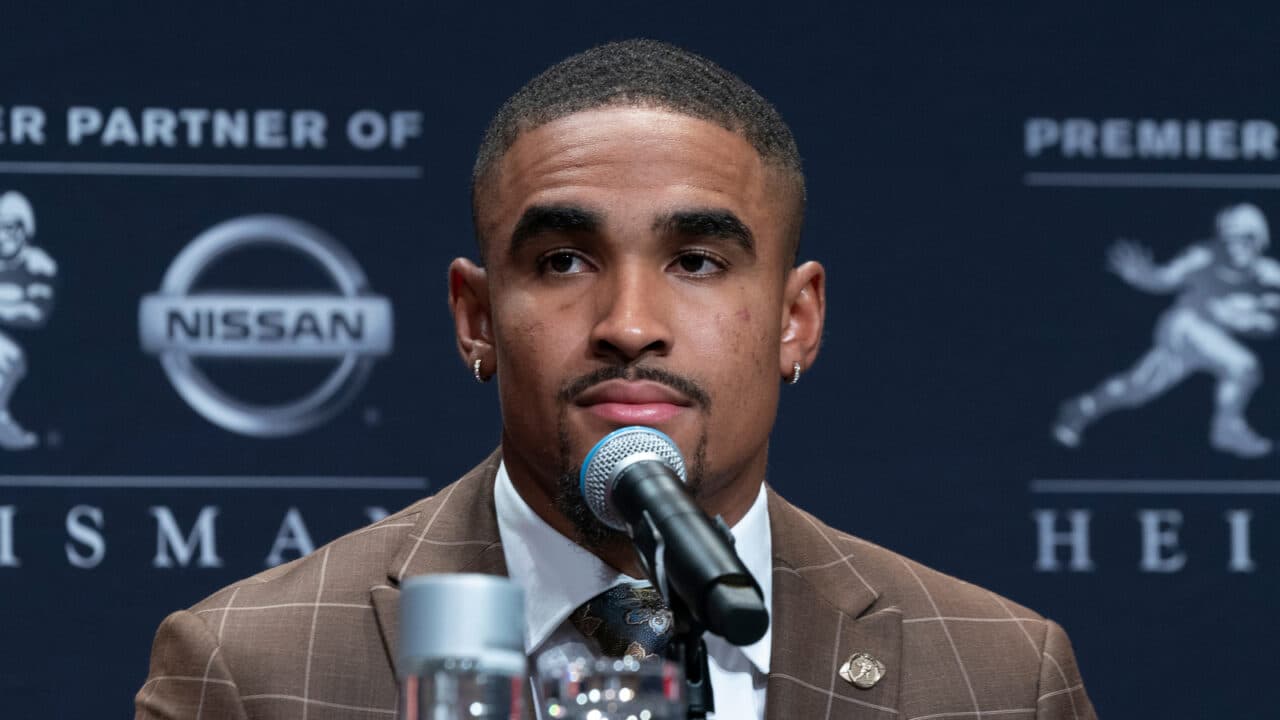
Jalen Hurts’ 2026 season took a serious turn after doctors diagnosed the Philadelphia Eagles quarterback with deep vein thrombosis and blood clots in both lungs. The diagnosis is expected to sideline him for the remainder of the season. His recovery is the priority, but the circumstances have also intensified scrutiny of how the NFL treats its players.
Hurts initially received a diagnosis of a superficial blood clot in his left calf before playing against the Jacksonville Jaguars in London on Oct. 11. Follow-up testing later revealed the more serious condition, prompting questions about the decisions surrounding his availability. The Eagles and Hurts’ agent said his prognosis was very good.
At the same time, a broader discussion about race and criticism of quarterbacks has resurfaced. An opinion essay published by Salon on Oct. 21 argued that Hurts’ experience reflects a double standard in how Black athletes are judged. That argument raises difficult questions, although it does not establish that race influenced the medical decisions in his case.
Hurts’ health crisis has drawn fresh scrutiny
The Eagles announced on Oct. 15 that Hurts would miss their game against Carolina after a follow-up ultrasound showed movement in the clot. On Oct. 19, the team and his agent confirmed the diagnosis of deep vein thrombosis and bilateral pulmonary emboli.
The statement said Hurts was clinically stable, would receive blood-thinner treatment and was expected to make a full recovery. Because he cannot participate in contact activities during treatment, his return to football depends on medical clearance.
The sequence has prompted questions about why Hurts played in London after the initial clot was discovered. NFL Commissioner Roger Goodell said on Oct. 21 that the league welcomed a review requested by the players’ union. That process concerns medical handling, not a publicly established finding of racial discrimination.
Hurts has long faced questions about his public image
Hurts is known for his controlled public demeanor and limited willingness to offer personal details to reporters. Some fans see that reserve as discipline, while others may interpret it as distance. Those reactions are subjective, but they shape how athletes become public characters.
In a 2022 interview with The Philadelphia Inquirer, Hurts was asked whether Black quarterbacks still faced extra scrutiny. He responded, “I think there’s levels to that, and I’ll just leave it at that,” acknowledging the subject without making a sweeping accusation.
Hurts has also said that his character reflects how he was raised. His approach does not require him to perform a particular personality for reporters or audiences. Yet the expectations placed on a quarterback can extend beyond his decisions on the field to his tone, expressions and willingness to share.
Race has shaped the history of the quarterback position
For much of professional football’s history, Black players faced barriers to playing quarterback, a position associated with leadership, intelligence and decision-making. The NFL has changed substantially, but greater representation does not automatically eliminate older assumptions about who looks or sounds like a traditional leader.

That history matters when analysts describe quarterbacks. A player’s running ability can be a genuine strength, but emphasizing athleticism while overlooking preparation, anticipation or reading defenses can leave an incomplete picture of his skill set. The same standard should apply to every quarterback.
Hurts is a dual-threat quarterback whose game includes passing, running and leadership responsibilities. His style should be evaluated through performance and context, rather than assumptions tied to race. The issue is not whether criticism is allowed; it is whether comparable performances receive comparable explanations.
Research has found differences in quarterback coverage
A 2024 study in the Journal of Broadcasting & Electronic Media analyzed approximately 200 hours of NFL broadcasts from 64 games in the first four weeks of the 2023 season. Researchers found several differences in how announcers described quarterbacks of different racial backgrounds.
Among the study’s findings, quarterbacks of color were more likely than white quarterbacks to have success attributed to running ability. White quarterbacks were more likely to have failures explained by inexperience. The researchers also found differences in other types of commentary, although most categories showed no significant difference.
The findings do not prove that every broadcaster is biased or that every criticism of Hurts is racially motivated. They do, however, provide evidence that the language surrounding quarterbacks can follow different patterns. Consistent evaluation requires examining those patterns rather than assuming the playing field is automatically equal.
Hurts’ career challenges narrow ideas about quarterback talent
Hurts has built a record that cannot be reduced to a single trait. He led Philadelphia to a Super Bowl victory in February 2025 and earned Super Bowl MVP honors, establishing himself as a championship quarterback whose contributions extend beyond rushing or athleticism.
His success also shows why labels can be limiting. Mobility is one part of his game, not a substitute for passing, preparation or decision-making. Analysts can question his performance in specific games, but those judgments should be grounded in film, statistics and the same standards used for other quarterbacks.
The broader point is not that Hurts should be protected from scrutiny. Professional athletes are paid to perform under pressure and are open to criticism. Fairness means that criticism should be specific, consistent and based on what a player actually does, rather than assumptions about what his personality or background supposedly reveals.

The medical questions deserve evidence, not assumptions
The decisions surrounding Hurts’ blood clots deserve careful review because they involve player safety. The Eagles said their medical staff and doctors in London reviewed the initial ultrasound and concluded that he could safely play, with a follow-up examination recommended. A later scan revealed movement in the clot.
Hurts was ruled out against Carolina on Oct. 15 and placed on injured reserve on Oct. 17. On Oct. 19, the Eagles and his agent announced that further testing had revealed deep vein thrombosis and bilateral pulmonary emboli. They said he was clinically stable, would be treated with blood thinners and could not participate in contact activities during treatment. They also said they expected him to make a full recovery.
It would be premature to claim that race caused Hurts to take the field or affected the care he received. A fair assessment should examine the medical protocols, communications, available test results and requested review. Race belongs in the broader discussion about athlete treatment and quarterback coverage, but it should not replace evidence about this specific case.
The standard should be consistent for every quarterback
Race is most useful to the conversation when it prompts careful comparisons. Do commentators describe similar mistakes differently? Do they credit preparation and decision-making equally? Do public figures receive the same room to be quiet, frustrated or private without having their character defined by those choices?
Those questions can be applied to broadcasts, press conferences, coaching decisions and fan discussions. They do not require that every difference be assumed to be discrimination. They require people to notice patterns, check them against evidence and remain willing to correct judgments that rely on stereotypes.
Hurts’ immediate concern is his health, and his stated medical outlook is positive. The NFL’s review should focus on the facts of his care, while the wider conversation about race should be guided by research and consistent standards. Both deserve seriousness without turning an unresolved question into a predetermined verdict.
Fun fact: Despite becoming an NFL star, Hurts continued his education and earned a master’s degree in human relations from the University of Oklahoma in 2023.
TL;DR
- Jalen Hurts was diagnosed with deep vein thrombosis and blood clots in both lungs after playing in London on Oct. 11.
- The Eagles and his agent said he was clinically stable and expected to make a full recovery, but blood-thinner treatment prevents him from participating in contact football.
- The NFL welcomed a review of the situation after the NFL Players Association requested an investigation into his medical care.
- Research has found differences in how quarterbacks of color and White quarterbacks are described, including how their successes and failures are explained.
- Those findings support continued scrutiny of media language, but they do not prove that racial bias influenced the medical decisions in Hurts’ case.
This article was made with AI assistance and human editing.
Read More From This Brand: