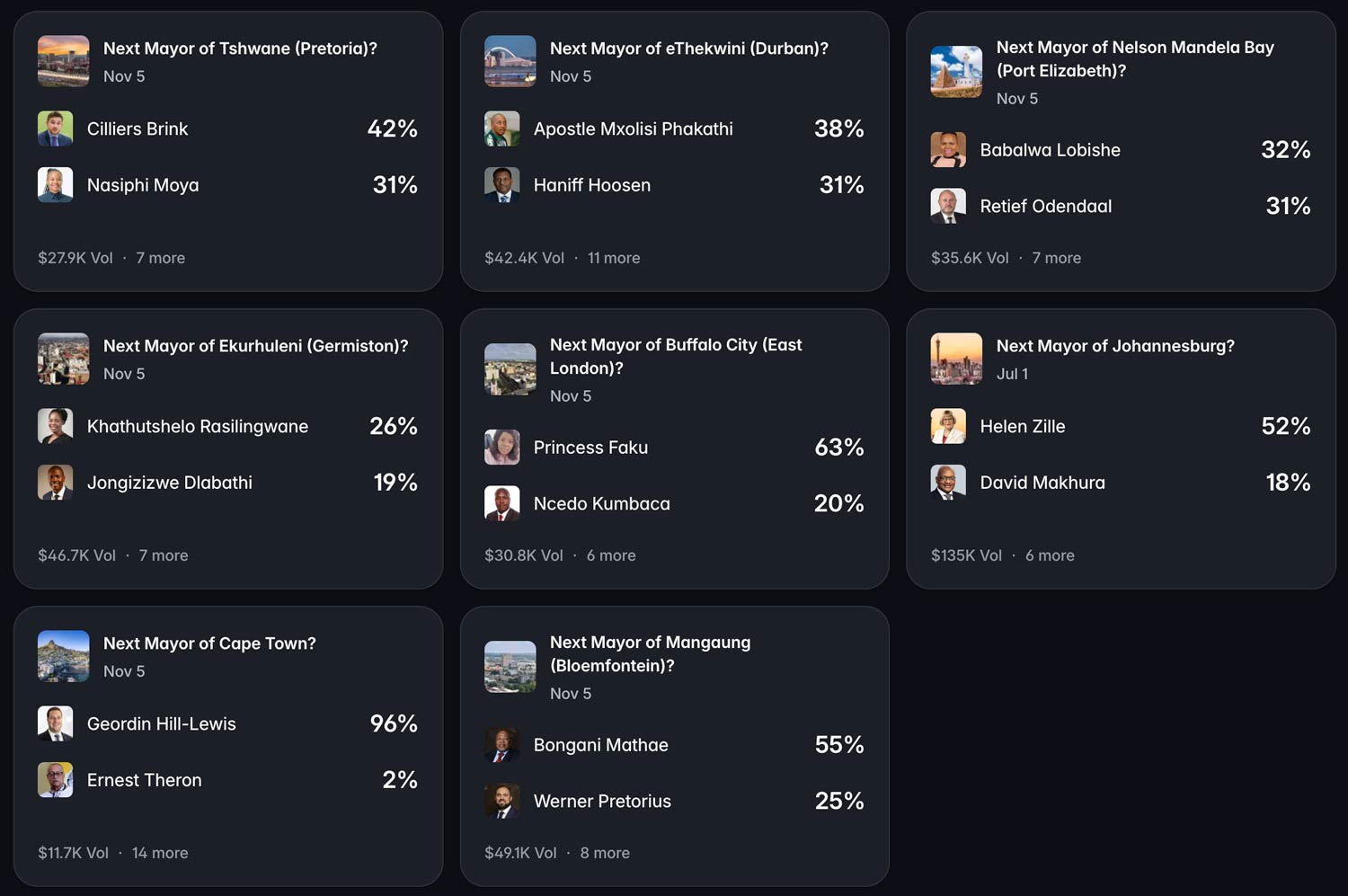
With a week to go before South Africa’s 4 November local government elections, punters on Polymarket give the DA’s Geordin Hill-Lewis a 96% chance of being Cape Town’s next mayor and Helen Zille a 52% chance of taking Johannesburg.
Polymarket, which describes itself as the world’s largest prediction market, is taking bets on who will lead all eight of the country’s metros. No South African regulator oversees it, and the country’s licensed bookmakers want it shut out.
In Nelson Mandela Bay, Babalwa Lobishe was on 32% and Retief Odendaal on 31% at the time of writing on 27 October. In Tshwane, Cilliers Brink led Nasiphi Moya by 42% to 31%, and in eThekwini Mxolisi Phakathi led Haniff Hoosen by 38% to 31%. Ekurhuleni is the most open, with Khathutshelo Rasilingwane ahead on just 26%. The market is more certain about Buffalo City, where Princess Faku is on 63%, and Mangaung, where Bongani Mathae is on 55%.
How it works
Polymarket doesn’t set odds or take the other side of bets, as a bookmaker would. It runs an order book – the same matching system a stock exchange uses – in which users buy and sell contracts from one another.
Each candidate has a “yes” and a “no” contract, priced between US$0 and $1. When the market settles, each winning contract pays out $1 and losing contracts pay nothing. That means the price doubles as the market’s estimate of the probability: a Zille “yes” contract trading at 52c implies a 52% chance that she becomes mayor. Someone who buys at that price and is proved right makes 48c a contract.
Trades are settled in pUSD, Polymarket’s own token, which according to the company’s documentation is backed one-for-one by USDC, a stablecoin pegged to the US dollar. Contracts are recorded on Polygon, a public blockchain, so every trade can be checked. Users can fund accounts with cryptocurrency or through intermediaries such as Coinbase and MoonPay, which may charge their own fees.
Polymarket charges a “taker” fee on political markets, charged to traders who accept an existing offer rather than post their own. The fee is highest when a contract trades near 50c, at about 2% of the value of the trade.
Outcomes are settled through UMA, a separate blockchain-based system. Someone proposes the result and puts up a deposit. If nobody challenges it within a set period, the result stands; disputed results go to UMA’s own resolution process.
Thin markets
Trading volume across the eight metro markets totalled about $379 000 at the time of writing. Johannesburg accounted for $135 000 of that and Cape Town for only $11 700. Volume counts the value of every trade, so money that changes hands several times is counted several times.
Markets this thin are easier to move. Bloomberg reported in July that election markets on Polymarket and its US rival Kalshi can be distorted at surprisingly low cost. It pointed to California’s governor race, in which Polymarket briefly priced one candidate at 96% while polls had him at about 4%.
South Africans also don’t elect mayors directly. They vote for ward councillors and parties, and each new council elects its mayor at its first sitting, which must take place within 14 days of the council being declared elected. With many councils expected to be hung, coalition negotiations – which are hard for any market to price – will decide several metros. Polymarket’s rules for the Johannesburg contract settle it on the first person elected mayor by the city council, and leave it open until the end of June 2027.
South Africa is not on Polymarket’s list of restricted jurisdictions. Users in the US, the UK, France, Australia and neighbouring Zimbabwe, among others, can close existing positions but not open new ones.
South African gambling law allows online betting only through totalisators and bookmakers licensed by provincial gambling boards. It makes no specific provision for prediction markets.
Manipulation fears
In July, News24 reported that more than R700 000 had been wagered on Polymarket’s Johannesburg mayoral market. That prompted the South African Bookmakers’ Association (Saba) to publish a policy position paper on 27 July calling for prediction markets to be brought under the country’s gambling laws.
The association warned that South Africa has no system to detect manipulation of political prediction markets, and that offshore operators escape the responsible-gambling, self-exclusion and tax obligations that apply to local bookmakers.
It also argued that offshore platforms take gambling revenue, and the tax that comes with it, out of the country. Until there is a dedicated legal framework, Saba wants prediction markets treated as part of the illegal offshore gambling market. — (c) 2026 NewsCentral Media


