
Global oil benchmarks retreated from their highest levels in nearly six months in early Asian trade on Monday (Oct. 26, 2026).
UAE’s Murban crude, however, bucked the trend and climbed above $118 a barrel.
Below are the numbers (as of 10:50 am Beijing time), as per OilPrice.com:
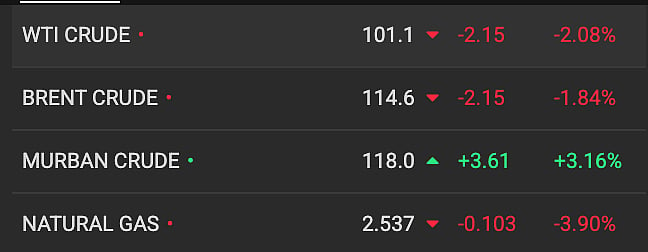
Brent’s decline of $2.15 puts it back near where it traded in the middle of last week. Murban now sits about $3.40 above Brent, which reverses a brief pause.
On Friday, Murban rose nearly 4% to $114.40, matching Brent and erasing the discount it had recently traded at.
Why Brent/WTI prices dipped
Brent and US crude fell on Monday, retreating from near six-month highs reached late last week, even though continuing attacks on Saudi Arabia kept supply concerns in focus.
Both benchmarks had settled nearly $3 a barrel higher on Friday as Houthi attacks intensified energy supply concerns.
Brent gained 6% over the week. After a rally like that, some profit-taking is a common explanation.
The trigger for Monday's movement was not immediately clear.
The weekend backdrop
The Houthis said on Saturday they attacked Saudi oil facilities and airports, including an Aramco facility in Yanbu, the Rabigh refinery and King Khalid International Airport in Riyadh.
Saudi Arabia has not confirmed the reports. The Saudi-led coalition said it intercepted two ballistic missiles fired toward Yanbu and Taif.
On Sunday, the coalition said it intercepted more Houthi drones and missiles aimed at Riyadh, Khamis Mushait and the southern region.
Yanbu matters because it is the Red Sea outlet of the 7-million-barrel-a-day pipeline that replaced Saudi Arabia’s Hormuz exports.
No hit on oil infrastructure has been independently confirmed.
On Sunday, US Central Command chief Adm. Brad Cooper flew over the Strait of Hormuz as CentCom said US forces had helped partners export more than 1.5 billion barrels since the summer.
Why Murban stands out
Murban Crude loads at Fujairah, outside the Strait of Hormuz, and traded at record premiums during the 2026 Gulf crisis. In mid-September it traded above $127 a barrel while Brent was above $107.
A likely reason is that barrels that can avoid Hormuz are scarce and attract a premium whenever bypass routes look at risk.
Murban is the flagship light sour crude oil grade of the Abu Dhabi National Oil Company (ADNOC) and the single largest export stream from the United Arab Emirates (UAE).
Murban has an API Gravity of approximately 39.9° to 40°, making it a light (low-density) crude similar to US WTI and Brent, as per BrentChart.com.
Its sulfur content is roughly 0.7% to 0.8% by weight, which technically classifies it as "sour", though its sulfur level is much lower than standard Middle Eastern grades.
In terms of refining yield, Murban yields high volumes of gasoline, naphtha, and middle distillates, though it requires hydrotreating capacity to process into ultra-low-sulfur fuels.
Natural gas
Natural gas fell 3.9% to 2.537. The screenshot doesn’t show the contract or unit, and I didn’t find a reported driver for the move, so I’m treating it as a separate story from the oil rally.
What to watch
The Federal Reserve decides on rates on Wednesday.
Any Saudi confirmation or denial of damage at Yanbu, Rabigh or the East-West Pipeline.
Whether Murban holds its premium over Brent.