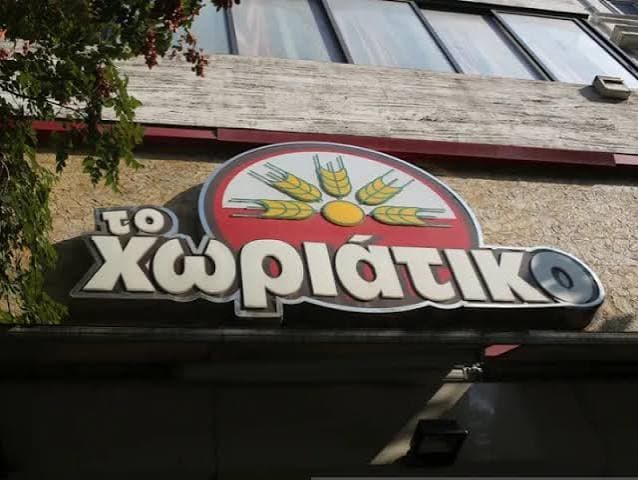
520 companies, several “straw men”, a labyrinthine network, and estimated at least 100 million euros in tax evasion. The owner of bakery chain “Horiatiko”, Angelos Giannakopoulos, and another 58 persons have been arrested since yesterday, Sunday.
After Pizza Fan chain raids and arrests last week, the raids and arrests in Choriatiko is the second case of alleged government attempts to clear the wide-spread corruption in the local “business” world.
According to state broadcaster ERT, authorities’ investigation is not limited to the bakeries of “Hhoriatiko” chain but encompasses the entire business portfolio of the owner Giannakopoulos. In addition to the bakeries, he reportedly owns nightclubs and has interests in entertainment establishments along the coastal strip. The “Horiatiko” chain is just one of the businesses under scrutiny.
The network utilized “straw men” (proxies) and shell companies to conceal actual control and hinder the tracing of financial flows.
The investigation focuses on fictitious transactions, as well as the failure to remit Value Added Tax and social security contributions, actions that have negatively impacted public coffers and employee social security coverage.
Tax evasion by the “Hhoriatiko” bakery chain appears to exceed €100 million, involving a complex, labyrinthine network of a total of 520 companies including next to the bakeries also night entertainment facilities and night- & strip-clubs.
Dozens arrests since Sunday
Initially authorities arrested the 57-year-old businessman Angelos Giannakopoulos in Ioannina, Epirus, western Greece.
He had reportedly violated terms of a previous conviction and was not allowed to leave the country. He was arrested when he returned from Dubai and was heading to Albania allegedly in order to return to the Emirate.
Parallel to his arrest, also the 80-year-old chief accountant in charged of the overview of the network financial operations was also handcuffed.
The network allegedly involved dozens of individuals—including managers, business owners, and accountants. Among them, a 90-year-old “straw man” as well as a well-known former unionist of the Public Power Company/PPC/DEH, so state broadcaster ERT TV.
The investigation and raids were conducted by the Organized Crime Prosecution Directorate (DAOE) in collaboration with the Independent Authority for Public Revenue (AADE).
Thorough investigations and raids have been reportedly conducted in outlets in Athens, Mykonos, Rhodes and Zakynthos.
According to case details, 56 arrests have been made, with the investigation centering on alleged tax violations, as well as the failure to remit VAT and social security contributions.
The network under scrutiny includes, among others, companies linked to the “Hhoriatiko,” “Attikoi Fournoi,” and “Bread Factory” bakery chains.
Approximately 200 retail outlets are reportedly connected—directly or indirectly—to Giannakopoulos, through either overt or covert business ties.
A central element of the investigation is the alleged use of shell companies and “straw men”, that is individuals who are formally listed as owners or managers, but who do not necessarily exercise actual control over the businesses.
In this way, ownership and management can appear fragmented across many different companies, each with its own separate managers, addresses, and accounts.
Owner’s criminal past
It is not the first time, the owner of Horiatiko comes to negative spotlight.In 2010, he was arrested in connection with a human trafficking ring. In the years that followed, business activities allegedly linked to him became the focus of extortion attempts, as well as armed attacks and bombings and links to the Greek Mafia, daily ethnos.gr and other media recalled on Monday.
Although he was convicted in 2010, the execution of his sentence was suspended, and he was released on bail subject to restrictive conditions. The “trafficking ring” was uncovered when Interpol, the Security Police, and the National Intelligence Service (EYP) dismantled a criminal organization that coerced women—primarily from Eastern European countries who had entered Greece on tourist visas—into working as dancers and sex workers at strip clubs owned by him.
According to reports, the proceeds from these activities were allegedly laundered through his chain of bakeries.
On November 28, 2025, he was arrested by Traffic Police for dangerous driving; he had been driving a luxury Lamborghini at a speed of 216 km/h on Vouliagmenis Avenue in Argyroupoli suburb of Athens..
The use of straw men, if proven, complicates the process of assigning liability and tracing the flow of funds; while the nominal managers may formally assume corporate obligations, the actual control is exercised by other individuals.
Bakeries as money laundering vehicles
The scrutiny directed at bakery chains is linked to the specific nature of the sector: a high volume of low-value transactions, daily sales, and products intended for immediate consumption.
These characteristics can make it difficult to verify actual turnover—though this does not imply that such practices are representative of the entire industry.
Potential schemes for tax evasion or money laundering may involve the issuance of fictitious invoices, the reporting of fabricated expenses, or the artificial inflation of turnover. In the first scenario, the over-invoicing—or outright fabrication—of raw material and service purchases can be used to reduce reported profits and, consequently, the tax burden. In the second, illicit proceeds may be disguised as revenue from legitimate sales, thereby acquiring a veneer of legal origin.
The involvement of supplier companies and intermediaries can further complicate investigations, as transactions must be cross-referenced against supporting documentation, bank records, actual product quantities, and production data.
The scope of the investigation extends beyond mere tax-related issues. The potential failure to pay social security contributions directly affects employees, as it may impact their insurance coverage and pension rights, while also depriving public funds of resources, libre.gr stressed.
PS Many Greeks on social media claim that there were rumors about money laundering through the bakeries chains mentioned above. So, “why the arrests now?”, they wonder.
“It’s the upcoming elections, and the government’s inability and unwillingness to clean corruption within the party,” the usual mean Greeks respond.