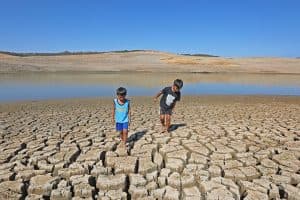
THE PHILIPPINES faces one of the highest risks of disruptions to agricultural production and hydropower generation in Southeast Asia due to a severe El Niño, leaving the country vulnerable to price shocks, Fitch Solutions unit BMI said.
In a report released on Monday, BMI said the Philippines is among the countries to be most affected by El Niño, which significantly increases the proportion of agricultural land exposed to severe drought.
“In past El Niños, the share of cropland exposed to high-intensity drought rose by 11-12 percentage points (ppts) on average across these regions, with… the Philippines… among the hardest hit,” it said.
The state weather bureau Philippine Atmospheric, Geophysical and Astronomical Services Administration last week said that a strong to very strong El Niño is active in the Tropical Pacific.
It is expected to peak before the year ends and last until the first quarter of 2027.
El Niño typically causes severe dry conditions to parts of the country, which could strain the agriculture sector and the overall economy as it threatens water supply and energy production.
With rice as the country’s staple grain, El Niño-related disruptions often spill over to food inflation as rice supplies take a hit and prices surge.
“Food inflation is the key economic transmission channel,” the Fitch unit said. “Local food inflation (in emerging markets) has historically been 1.8-2.5 ppts higher within a year of an extreme drought, and El Niño makes such droughts significantly more likely in exposed regions.”
Food inflation in the Philippines has been elevated even before the full impact of a severe El Niño has materialized.
In September, inflation for the heavily weighted food and nonalcoholic beverages index quickened to 6.7% from 4.6% in August, marking the fastest pace since 7% in October 2023.
Bangko Sentral ng Pilipinas (BSP) Governor Eli M. Remolona, Jr. earlier said that the El Niño remains their top inflation concern, noting that a severe episode will be “pretty bad for prices.”
Headline inflation has been above the BSP’s 3% target for seven consecutive months, hitting a peak of 7.2% in September to average 5.4% year to date. The BSP has noted that this could accelerate further in the coming months as the “Godzilla” El Niño takes shape.
In its report, BMI said it expects full-year inflation to settle at 5.9% in 2026 and 5% in 2027. These are below the BSP’s forecasts of 6.1% for 2026 and 6% in 2027.
BMI noted that the Philippines entered this year with lower rice stocks, equivalent to 15% of annual domestic consumption and exports, down from around 20% during the 2023-2024 El Niño episode.
The Philippines is among the Southeast Asian countries which BMI flagged with lower rice stocks going into the current El Niño episode, including Thailand with 19% (from around 20%) and Vietnam with 8% (from over 10%).
“Rice stocks have fallen below 2023 levels in Thailand, Vietnam and the Philippines, leaving the Philippines, which imports around a third of its rice, most exposed to higher prices,” BMI said.
The Philippines imports 30%-35% of its rice consumption, exposing it to higher import costs as its source countries also face potential supply disruptions. Vietnam remained the Philippines’ top supplier of rice.
National rice inventory fell by 8% year on year to 1.91 million metric tons (MT) in September from 2.07 million MT.
Last month, rice inflation accelerated to an over two-year high of 20.3% from 19.4% in August amid tighter domestic supply and rising transportation costs.
The Department of Agriculture has also said that the El Niño has so far caused P8.57 billion in agricultural damage across the country. Based on the agency’s worst-case scenario, dry spells could affect 4.6 million local farmers and fisherfolk and slash palay (unmilled rice) output by 1 million MT.
On the other hand, BMI also noted that the Philippines experiences a large increase in drought risk across its hydropower capacity during El Niño periods.
However, because hydropower only accounts for less than 20% of the country’s total electricity generation, BMI expects the impact to manifest through peak-power constraints rather than broader system-wide power shortages.
CLIMATE RISKS
Meanwhile, the BSP chief noted that climate risk is a lived reality for the Philippines, which confronts both severe typhoons and potential drought.
“In the Philippines, the past two months alone saw unusual successive tropical cyclones. The southwest monsoon caused massive damage to our farms and roads,” Mr. Remolona said during the Green Swan Conference held in Manila on Oct. 19.
“And we are now preparing for the opposite shock: what we call the ‘Godzilla’ El Niño with the risk of severe drought,” he added.
Such natural disasters, Mr. Remolona noted, pose threats to inflation, financial stability, and economic growth.
“What begins as a climate event can quickly become an inflation problem, a financial stability concern, and a threat to sustained growth,” he said.
“Our task goes beyond measuring exposures. We need to prepare for the worst. We need resilient infrastructure, insurance that absorbs losses, and financing that supports adaptation,” he added.
The Green Swan Conference is a joint initiative led by the Bank for International Settlements (BIS) and the Network for Greening the Financial System (NGFS).
Its fifth edition hosted by the BSP was co-organized with BIS, NGFS, Banca d’Italia, gathering central bankers, climate scientists, and finance and business leaders from Europe, Asia and the Pacific, the Middle East, and the Americas. — Katherine K. Chan