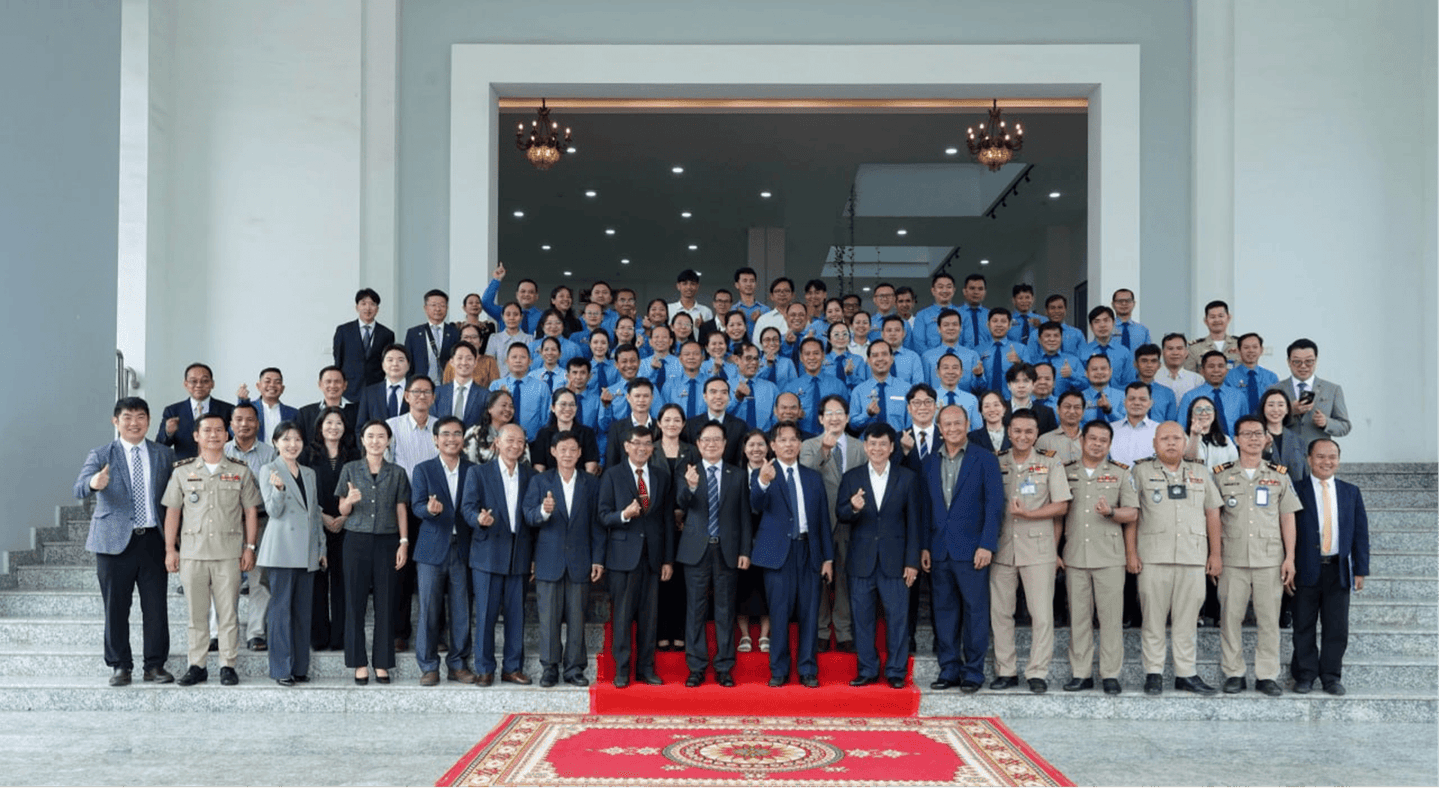
As Cambodia and South Korea approach next year’s 30th anniversary of restored diplomatic relations, their partnership reflects significant progress in politics, trade, investment, agriculture, tourism, education, environmental protection and human resource development. Among these achievements, cooperation in higher education and research has made a meaningful contribution to strengthening knowledge, institutional capacity and friendship between the two nations.
Over the years, the Royal Academy of Cambodia (RAC) has developed partnerships with leading Korean institutions, including the National Research Council for Economics, Humanities and Social Sciences (NRC), KDI School of Public Policy and Management, Korea Environment Institute (KEI), Korea Legislation Research Institute (KLRI), Korea Institute of Child Care and Education (KICCE), Korea Institute for International Economic Policy (KIEP) and Korean Educational Development Institute (KEDI).
Its academic connections also include Seoul National University (SNU), Pusan National University (PNU) in Busan, Changwon National University, Korea Foundation for Advanced Studies (KFAS) and Chey Institute for Advanced Studies.
One notable achievement has been academic exchange.
Through the International Scholar Exchange Fellowship (ISEF) programme, the RAC’s Asia Research Center facilitated research opportunities for 34 Cambodian scholars between 2003 and 2022. Generally lasting six months to one year, these exchanges strengthened research skills, broadened academic perspectives and established professional relationships with Korean scholars and institutions.
Research and publication have also played important roles. Between 2005 and 2023, the centre implemented 155 domestic research projects and organised 59 international conferences and seminars. From 2005 to 2018, it produced 40 research publications and supported more than seven books and collected works. These achievements reflect the centre’s broader institutional cooperation, including support from Korean partners.
More recently, through cooperation with the NRC and KDI School, the RAC facilitated capacity-building opportunities for more than 100 Cambodian participants between 2023 and 2026.
Training covered agriculture, tourism, water resource management, environmental protection, public policy research, technical and vocational education and training, and online scam prevention. Such programmes have contributed to strengthening professional skills and institutional capacity in Cambodia.
Educational cooperation has also extended to language and culture. The RAC has sent Khmer language instructors to Pusan National University in Busan, helping Korean students understand Cambodia’s language and cultural heritage. Meanwhile, Cambodian officials and researchers have benefited from graduate study opportunities at KDI School, gaining knowledge relevant to Cambodia’s development.
Environmental cooperation offers another practical example. On September 3, the RAC and SNU issued a Joint Declaration to Promote Phnom Penh Rain Day in support of UN Sustainable Development Goal 6.1 on access to safe and affordable drinking water. Their cooperation has also included a proposed five-year initiative to expand rainwater harvesting facilities to 1,000 Cambodian schools, demonstrating how scientific partnerships can address community needs.
Another milestone came on August 28, when the RAC was recognised as a member of the Association of Academies and Societies of Sciences in Asia (AASSA). With its secretariat hosted by the Korean Academy of Science and Technology (KAST), AASSA offers opportunities to strengthen regional scientific networks and academic cooperation across Asia.
Although these achievements may appear modest compared with major investments and infrastructure projects, their long-term significance should not be underestimated. Just as a small needle can stitch together many pieces of fabric into a single whole, cooperation in education and research, however modest in scale, can help connect knowledge, experience and friendship between the two nations.
Looking ahead, the RAC leadership has proposed establishing a Korean Research Centre within the academy. The proposed centre would have two principal missions. First, it would study Korean society, culture, politics, economics and development experiences to identify lessons adaptable to Cambodia’s circumstances, rather than simply reproducing Korea’s development model.
Second, it would provide Korean language and cultural training, particularly for Cambodian workers preparing for employment in South Korea. Such training could include workplace practices, social norms and relevant laws, helping workers adapt more effectively and avoid unnecessary difficulties.
The proposal remains at the conceptual stage and would require further cooperation with Korean institutions and the embassy of the Republic of Korea in Cambodia.
As the two countries prepare to commemorate three decades of restored diplomatic relations in 2027, the anniversary should serve not only as an occasion to celebrate past achievements but also as an opportunity to deepen future cooperation. For the RAC, continued partnerships in education, research, environmental protection and human resource development can provide lasting benefits while strengthening mutual understanding and friendship between Cambodia and South Korea.
Dr. Khek Vireak is director of the Asia Research Center, Royal Academy of Cambodia. The views and opinions expressed are his own.