
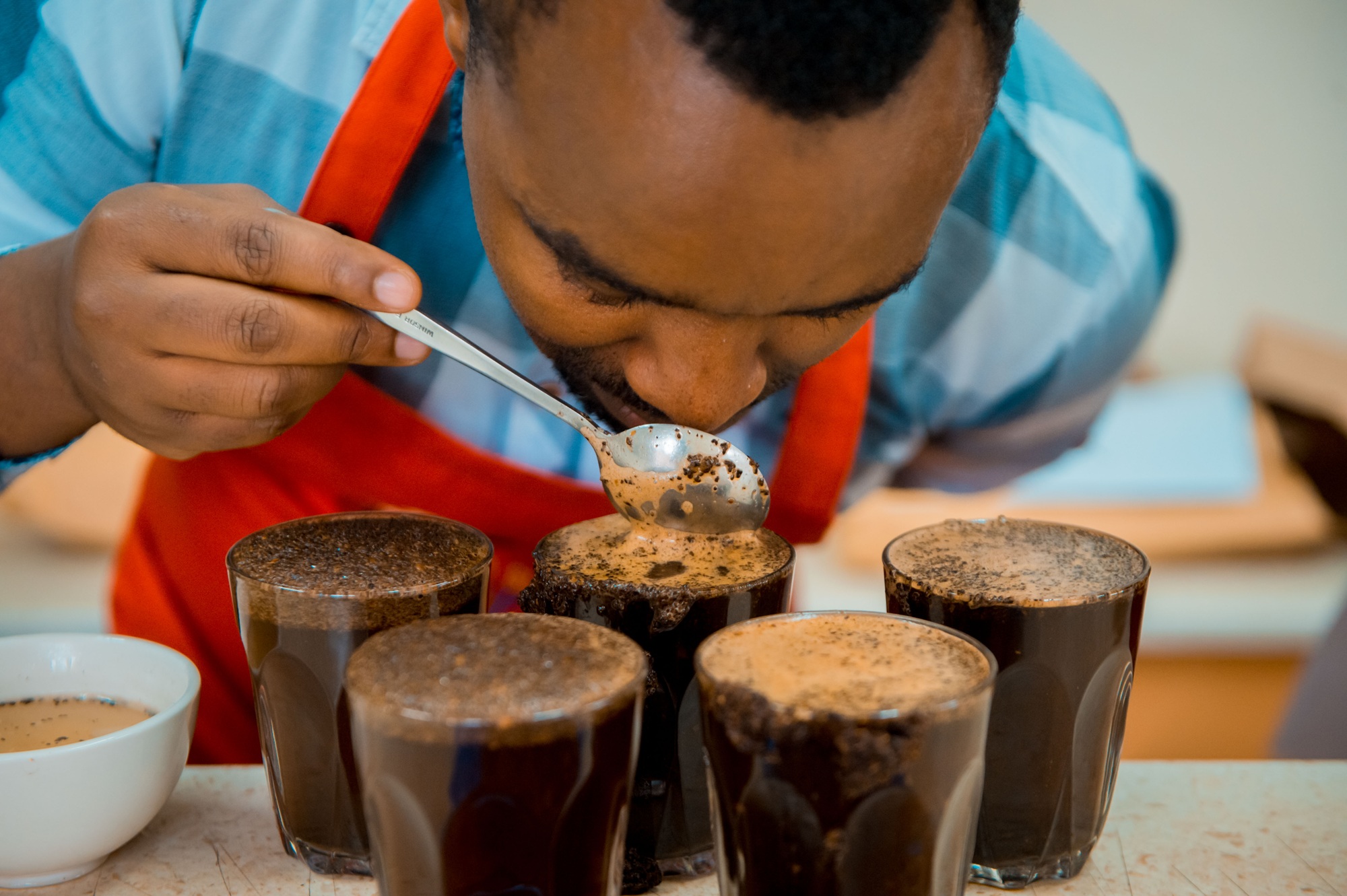
A Coffee Cupping session in Rwanda
On October 21st, a kilogram of coffee from K-Organics in Huye District sold for a record $452, about Rwf 670,000, at the Best of Rwanda auction. Behind that price lies a lesson about transformation and about leadership.
In the 1990s, Rwanda almost exclusively produced low-grade, semi-washed commodity coffee that fetched poor prices on the international market. Today, Rwanda’s specialty coffee commands international recognition and premium prices. That shift took more than better farming.
Export reforms, private investment, washing stations, cooperatives, quality standards, and relationships with international buyers reshaped the entire value chain, especially under the stewardship of the National Agricultural Export Development Board (NAEB). K-Organics shows how these pieces connect. Its anaerobic natural lot scored 90.74 points in the Best of Rwanda competition, a result that rests on careful production, specialized processing, rigorous quality assessment, and access to global buyers.
What changed was the system connecting farmers to consumers, not only how coffee is grown. That is an example of systems thinking in practice, and it also asks who benefits from the value created. In a LinkedIn post, Dr Agnes Kalibata, former UN Special Envoy for the 2021 Food Systems Summit and former President of AGRA and Rwanda’s former Minister of Agriculture, welcomed the result while urging that farmers receive fair rewards. The National Agricultural Export Development Board (NAEB) says farmers who supply cherries to processors are allocated 75 per cent of Best of Rwanda auction revenues. The task now is to extend such premium market benefits to more producers.
I learned this lesson the hard way. A little over a decade ago, I took part in introducing greenhouse tomatoes and coloured sweet peppers in Rwanda. At the time, greenhouses were mainly used to grow roses for export, while the coloured peppers sold in high-end hotels and in markets such as New Frulep and Germany Butchery were largely imported from neighbouring countries. The technology and the agronomic practices were promising. Yet the project nearly collapsed because we had not thought enough about the market system that production depended on.
The turning point came when my team and I went to buyers, consumers, and other stakeholders to understand what was going wrong. Improving production alone was not enough. Demand, buyer requirements, distribution, and the commercial interests of each actor needed equal attention. By redesigning those relationships, we built a more viable model that worked for farmers, the technology provider, and the project funder.
That experience changed how I understand agricultural development. A technically successful intervention or project can still fail when the wider system does not work. It also contributed to my decision to write the book, From Agriculture to Food Systems: A Practical Introduction to Food Systems Thinking for Africa’s Agriculture Professionals.
Rwanda is now building on this thinking.
The Fifth Strategic Plan for Agriculture Transformation (PSTA 5), launched in December 2024, places resilient and sustainable food systems at the centre of agricultural development. The Rwanda Food Innovation Ecosystem Strategy 2026 to 2035 reinforces this through the Rwanda Food Innovation Partnership, which aims to connect researchers, innovators, investors, regulators and businesses to commercialize and scale new ideas.
Frameworks like these are necessary, but they do not act on their own. Someone must turn them into collective action. That is where food systems leadership becomes essential. It means understanding interconnected challenges, weighing competing interests, building trust, and coordinating across institutional boundaries.
Take malnutrition in a district.
The Ministry of Agriculture and Animal Resources cannot solve it alone. Agriculture must support nutritious food production, health services must address diets, and environmental authorities must protect the resources production depends on. Trade and infrastructure institutions must help communities access nutritious food affordably. Finance must support coordinated investment, and district authorities, businesses and communities must be involved. Without coordination, each institution may meet its own targets while malnutrition persists.
It requires a whole-of-government approach as envisioned by Rwanda’s actual policy direction under the Fifth Strategic Plan for Agriculture Transformation (PSTA5), which explicitly promotes coordinated action across sectors.
As a Fellow of the African Food Fellowship, an initiative of Wageningen University and Research, I have seen the value of building leadership skills alongside professionals from other disciplines within Rwanda’s agriculture sector, both from public and private institutions. The Fellowship prepares leaders to tackle complex food systems challenges while practicing collaborative and adaptive leadership.
Three priorities should guide Rwanda’s next phase.
First, measure success beyond production, because farmer incomes, profitability, nutrition, affordability, and environmental sustainability matter alongside yields. Second, design investments around interconnected needs, with finance, markets, infrastructure, and commercial incentives considered from the start. Third, invest deliberately in food systems leadership, so that professionals can collaborate, make difficult choices, and lead change across institutions.
Rwanda’s coffee story shows what coordinated agricultural development can achieve. PSTA 5 and the Rwanda Food Innovation Partnership offer a chance to extend those lessons to other value chains.
Rwanda has embraced food systems thinking in its strategies. Now it must invest equally in producing more leaders who practice food systems thinking to make these strategies work. This can be done in partnership with like-minded organizations like the African Food Fellowship and AGRA’s Centre for African Leaders in Agriculture
Kelvin Odoobo is a food systems practitioner and agritech entrepreneur based in Kigali, founder of Shambapro, and author of From Agriculture to Food Systems.
Visited 1 times, 1 visit(s) today