
The first-ever global assessment of these vibrant underwater ecosystems paints a grim picture: Climate change projections put 96 percent of shallow-water reefs at the highest level of threat

Sarah Kuta | Daily Correspondent
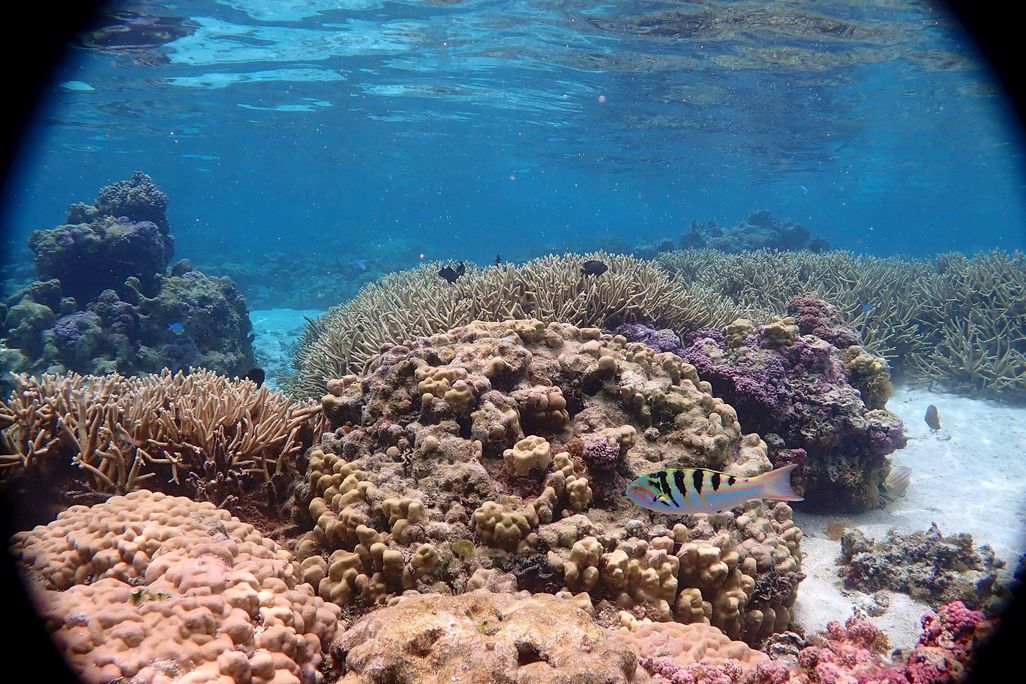
The world’s shallow-water coral reefs are in trouble: If climate change continues unchecked, most of these vital ecosystems could collapse within the next 50 years, experts predict.
On October 22, the International Union for Conservation of Nature’s Red List of Ecosystems released its first global assessment of shallow-water reefs. The findings paint a grim picture. Coral reefs in 122 of the 127 tropical and subtropical ecoregions they looked at—96 percent—are critically endangered, meaning they’re at extremely high risk of collapse by 2075.
The list of critically endangered ecoregions includes the Great Barrier Reef off Australia, the Coral Triangle in the western Pacific Ocean and the Mesoamerican Barrier Reef System in the Caribbean, just to name a few. Four of the analyzed ecoregions had too little reef data for researchers to determine their statuses.
Even if some coral species manage to survive a broader ecosystem collapse, they could end up being too far apart from one another to reproduce, preventing them from rebuilding their populations.
“If the population size gets so small that you don’t have another coral to mate with nearby, then reproductive failure will happen,” James Guest, a marine ecologist at Newcastle University in England, tells New Scientist’s Alec Luhn. “That species is in what’s called an extinction vortex.”
Coral reefs are built by tiny coral animals called polyps, which produce hard limestone skeletons that accumulate over time to form reef structures. Most reef-building corals live in partnership with colorful, microscopic algae that reside in their tissues and use sunlight to make food, providing the corals with much of the energy they need to survive.
When corals get stressed, particularly when ocean temperatures get too hot, they can expel their algae partners. This process, known as bleaching, turns the corals bone-white and leaves them without a primary food source. If the stressful conditions persist, the corals can eventually starve to death.
Quick fact: Healing touch
Earlier this month, researchers reported that a sick coral fragment can heal with the help of a ‘magic touch’ from a healthy, genetically identical piece. Most individual corals are colonies of cloned polyps.
The assessment found that heat stress resulting from climate change is the primary threat to coral reef ecosystems around the world. Rising ocean temperatures and marine heat waves are causing mass bleaching events, turning once-vibrant communities into barren underwater wastelands. Overfishing and pollution also threaten the world’s reefs, which support roughly a quarter of all marine species and help provide food, jobs and protection for people in coastal communities.
So far, just one of the world’s shallow-water coral reef ecosystems has collapsed, according to the IUCN: the one near the western Galápagos Islands. Those reefs lost more than 95 percent of their coral after the devastating 1982-83 El Niño event, which caused dramatic warming in the eastern Pacific, among other problems.
Still, bleaching events seem to be becoming more frequent and intense because of climate change—and scientists worry they’re now occurring so frequently that reef ecosystems don’t have time to recover between them.
“Reefs are like Picasso paintings under water,” Ben Fitzpatrick, a marine scientist with the University of Western Australia Oceans Institute who led the assessment on Australia’s coral reef ecosystems, tells the Guardian’s Graham Readfearn. “They have all these wonderful inhabitants in their millions. You can spend a lifetime trying to understand how all these weird critters go about their daily lives. To think we might lose that is devastating.”
Though the outlook is bleak, the scientists behind the new report emphasized that all hope is not lost. Their findings are based on the current “middle-of-the-road” warming projections—but if the world curbs greenhouse gas emissions, the situation could improve. Without the effects of future climate change, the researchers say just 24 percent of the reef ecosystems would be critically endangered, instead of nearly all.
“This must be a wake-up call rather than a cause for despair,” Mishal Gudka, a conservation biologist at the University of Melbourne in Australia who served as scientific lead for the assessment, says in a statement. “Coral reefs have shown a remarkable ability to bounce back from devastating bleaching events. Pockets of surviving, resilient coral reefs can still remain in the future, so we must do everything within our reach to set them up for success.”
Scientists are exploring innovative ways to help corals better withstand warming oceans, from cooling and shading reefs to breeding more heat-tolerant varieties. These methods may be helpful, but they likely won’t be enough to save the world’s coral reefs on their own.
“In the intervention and restoration community, I think we all recognize that it’s not going to matter unless climate change is addressed and greenhouse gas emissions are addressed,” John Parkinson, a marine ecologist at the University of South Florida, tells the New York Times’ Catrin Einhorn.
You Might Also Like
-
October 26, 2026
-
October 26, 2026
-
October 26, 2026
-
October 26, 2026
-
October 26, 2026