In October, Bazaar is celebrating our obsessions—how they delight us, connect us, and keep us going. Tune in each day for a new story, or go here to read them all.
In 1968, as the civil rights movement gripped the nation, The Studio Museum in Harlem began forging its own history, operating out of a small loft above a liquor store. The modest space would go on to become a sanctuary for Black artists, a space in New York City to correct the exclusion of artists of African descent across the city’s storied institutions. Over 58 years, the world changed drastically, and so did the museum, often adapting to find the best way to support Black artists, whether in local New York circles or on the global art stage.
“While the Museum has always been driven by its mission, it has maintained a willingness, an impulse even, to constantly transform and reimagine itself as its ambitions have grown, as a living institution that reflects the concerns of artists working today,” Thelma Golden, the museum’s director, tells Harper’s Bazaar.

The Studio Museum in Harlem, 2025.
The Studio Museum in Harlem now occupies seven stories on West 125th Street, a recent visionary expansion built to anchor its next generation of growth. The 82,000-square-foot building, designed by Adjaye Associates with Cooper Robertson as executive architect, opened in 2025 after seven years of construction, becoming the first space specifically tailored to carry out the museum’s mission after its humble loft and long-time residence in a historic bank. Its inaugural show, “From Now: A Collection in Context,” drew on the museum’s illustrious archives and featured about 200 works, offering a snapshot of the countless artistic voices the museum has championed for six decades. This same spirit is echoed in Studio Museum in Harlem: A History, a new book that traces the institution’s history through firsthand oral histories, archival photographs and documents, and critical essays, releasing on October 27.
“It only felt appropriate that we mark our momentous new building with the first-ever record of the people, ideas, events, dialogues, and, of course, artworks that have enabled and defined this Museum’s existence,” Golden says. “This chronicle tells a story of an institution that has navigated decades of complex social, political, and cultural paradigm shifts, and is a testament to the Museum’s predisposition to reenvision, reinvent, and transform itself alongside those in its orbit.”
Studio Museum in Harlem: A History is divided into five sections, meticulously edited by Chicago-based professor Romi Crawford. Section one compiles five essays that overview its influence and history, followed by firsthand accounts from long-time trustees and community members in section two. The third section comprises rare archival material, including letters and artwork. In the fourth section, Crawford curates essays from various art-world figures, including former Studio Museum curator Christine Y. Kim and photographer Deborah Willis. It is rounded out by a comprehensive list of exhibitions and prize winners. With this compilation, Golden and Crawford aim to capture the museum’s multi-vocal spirit.
The museum’s six-decade history is rooted in collective action. In 1968, a small group of activists and philanthropists, including politician Carter Burden, psychotherapist Frank Donnelly, the museum’s inaugural director Charles E. Inniss, and artist Mahler B. Ryder, came together to carve out space for Black artists. This founding cohort first envisioned the museum as a creative nexus, a place to champion Black artists and a space for these artists to create new work.

From Studio Museum in Harlem: A History (Studio Museum in Harlem, 2026; Yale University Press)

From Studio Museum in Harlem: A History (Studio Museum in Harlem, 2026; Yale University Press)
“It was a history that demanded multiple takes,” Crawford explains. “Thelma and I both didn’t think that it was a book that should have a single author. I definitely didn’t want to be an authoritative voice…. There are a lot of institutions that have a founder. This museum did not have that…It’s a history that really defies a single author because there was not a single founder of the museum, and its origins are complex and fascinating for that reason.”
One way the book frames this history is through Bridget R. Cook’s essay, titled “Black Galactic,” which traces the last six decades through the museum’s exhibitions. It begins with Tom Lloyd’s exhibition “Electronic Refractions II,” which featured light-based sculptures, then moves through shows by artists like Melvin Edwards (1978), Sam Gilliam (1982), Jack Whitten (1983–84), and Kara Walker (2003), among many others. This essay contextualizes the museum’s profound influence on Black art in the United States. It also details, perhaps above all, the breadth of the museum’s community.

Former Studio Museum Director Edward S. Spriggs and art handlers, c. 1971.
Even as the museum evolved as an institution and built a permanent collection, it retained the word “Studio” in its name as a nod to its founding principle: nurturing the work of living artists. It directly alludes to the Artist-in-Residence program, which William T. Williams founded in 1969. In archival material featured in the book, Williams writes, “It is the aim of the Artists In Residence program to help crystallize this community as well as teach young prospective artists to recognize their talent and to use it in a constructive manner.” Since then, the program has supported artists from Willie Cole and Candace Hill-Montgomery to Kerry James Marshall and Mickalene Thomas.
A distinguished roster of curators stands behind these exhibitions. By prioritizing collective history, Crawford and Golden sought to champion not only Black artists and the museum’s support for them, but the wider network of Black creatives orbiting the museum. “What the Studio Museum has done is spawn this extraordinary opening for Black artists, and not only Black artists, but Black curators, Black writers, Black historians,” the late Gordon J. Davis, a Trustee, writes in his featured essay. This network is the ultimate result of the founder’s mission, whose aspirations, as Crawford says, meant to “embolden a community that did not yet exist in 1968 in America.” One can safely say that community exists now.

Cover of The Studio Museum in Harlem 1968–69 Annual Report, 1969, Studio Museum in Harlem archives.
“It is a community of makers, curators, scholars, leaders, artists,” Crawford says. “That’s one of the other reasons the book really demanded a community or collective approach, a chorus.”
Studio Museum in Harlem: A History details the institution’s six decades as a cultural touchstone for Black art and an incubator for artists and the network that surrounds them. Crawford ensures its unique conception and trailblazing legacy are reflected in a mosaic-style compilation of letters and voices from those who have been touched by, or have touched, the museum.
“[The] collective spirit has served as a blueprint for the Museum’s fifty-eight years in operation and informs our approach to space-making today,” Golden says. “What readers will find is that our mission’s essence has remained the same: that the Studio Museum in Harlem is unequivocal in its necessity as a metaphorical home for artists of African descent and their practices.”
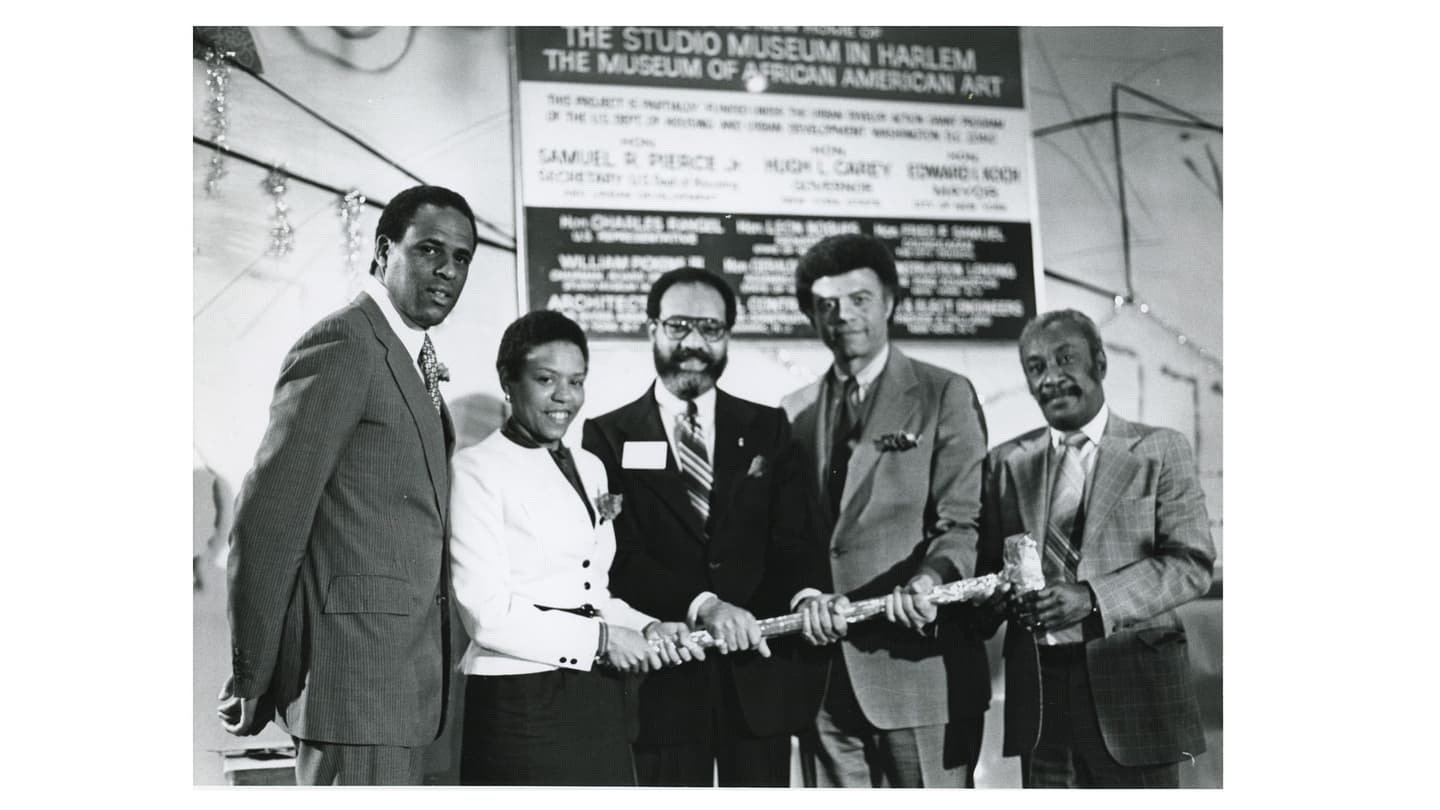
Opening image: Groundbreaking for the Studio Museum in Harlem at 144 West 125th St. (L to R) Carl McCall, Mary Schmidt Campbell, Arthur Barnes, Robert Carroll, and Fred Samuel, 1981. Courtesy Studio Museum in Harlem.

From Studio Museum in Harlem: A History (Studio Museum in Harlem, 2026; Yale University Press)