
ⓘ Adafruit
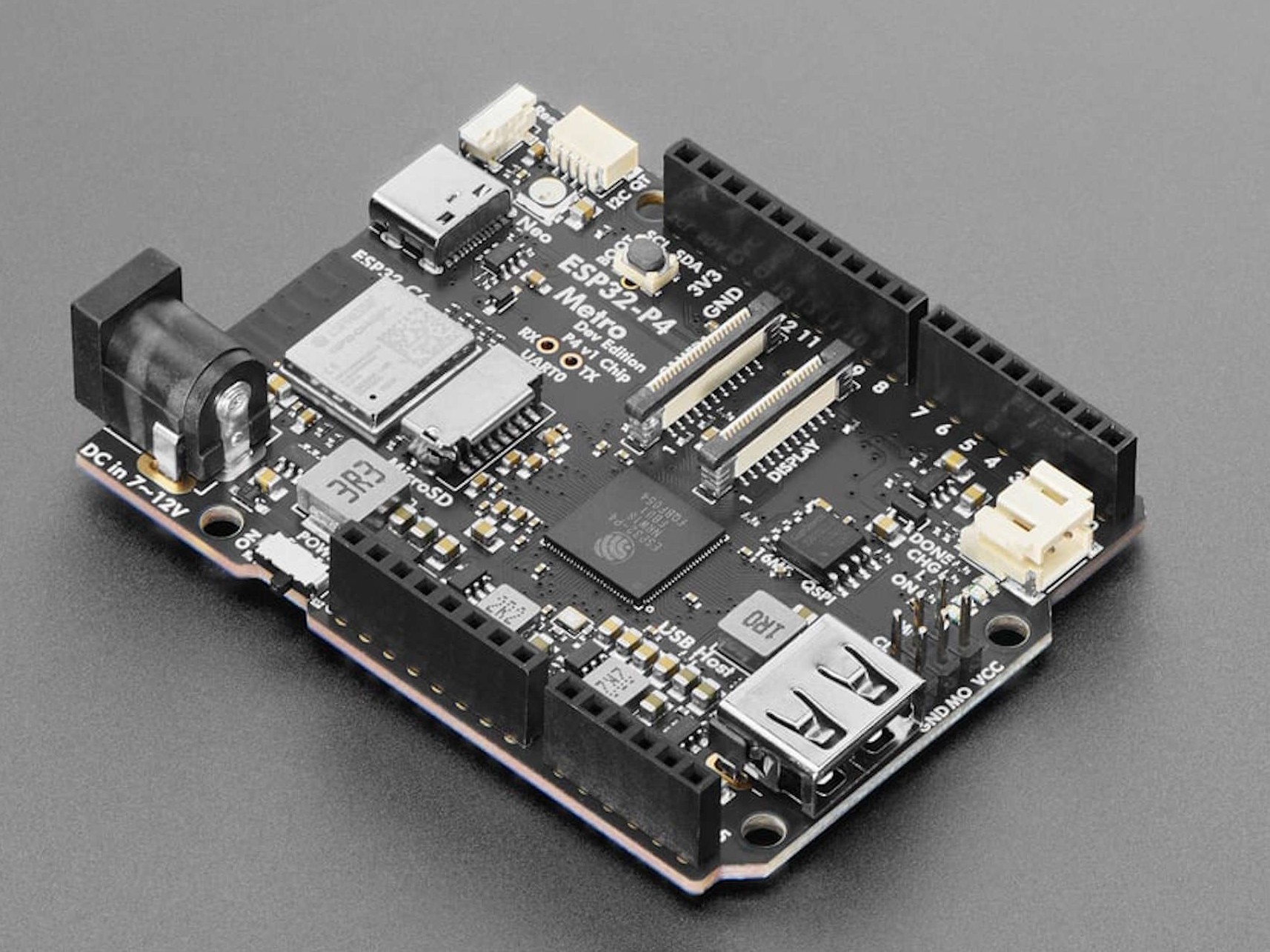
Offering broad versatility, relatively high processing power, and a compact footprint, Adafruit's latest development board supports both display output and camera connections. The Metro ESP32-P4 Hydra is also competitively priced at under $40.
Silvio Werner (translated by Silvio Werner), Published 🇩🇪
Adafruit is a well-known name among makers. Having previously covered several of the manufacturer's products, including an RP2040-powered Metro board, the company has now introduced the Adafruit Metro ESP32-P4 Hydra. As the name suggests, the board is powered by the ESP32-P4 chip, which operates at clock speeds of up to 360 MHz. While this offers high performance for a development board, it is primarily tailored toward processing sensor data rather than demanding 3D graphics rendering.
Measuring 72.3 x 53.3 x 14.7 mm, the board includes standard development interfaces such as I2C and SPI for connecting sensors and actuators. Notably, it also features MIPI DSI for displays and MIPI CSI for cameras, enabling compatibility with displays originally designed for the Raspberry Pi ecosystem. Adafruit’s integrated STEMMA QT connector simplifies peripheral hookups without requiring complex wiring.
A built-in microSD card slot allows for expanded storage, which is useful for logging large datasets or storing graphical assets for user interfaces. Wireless connectivity is handled by an onboard ESP32-C6 coprocessor, enabling Bluetooth 5.3 LE alongside support for Thread and Zigbee protocols. This opens up integration options for smart home environments. Additional features include integrated status LEDs and a programmable NeoPixel RGB LED. The Adafruit Metro ESP32-P4 Hydra is currently available directly from Adafruit's online store for $35.

Editor of the original article: Silvio Werner - Senior Tech Writer - 18203 articles published on Notebookcheck since 2017
I have been active as a journalist for over 10 years, most of it in the field of technology. I worked for Tom’s Hardware and ComputerBase, among others, and have been working for Notebookcheck since 2017. My current focus is particularly on mini PCs and single-board computers such as the Raspberry Pi – so in other words, compact systems with a lot of potential. In addition, I have a soft spot for all kinds of wearables, especially smartwatches. My main profession is as a laboratory engineer, which is why neither scientific contexts nor the interpretation of complex measurements are foreign to me.
Silvio Werner, 2026-10-27 (Update: 2026-10-27)