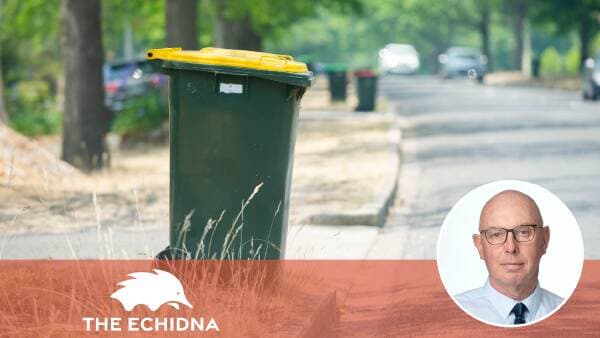
Bins, like fences, are great sources of discord.
Subscribe now for unlimited access.
or signup to continue reading
SAVE $100
All articles from our website
& app
The digital version of
Today's
Paper
Crosswords, Sudoku and Trivia
All other
in your area
I still can't forgive my neighbours who objected to me putting my recycling in "their" yellow top bin. I got into the habit of placing the odd can and bottle into "their" bin when it was out on the kerb early on Mondays. If "their" bin wasn't full, I reasoned, why put two bins out?
But one evening, the two women who live behind me knocked on my door and told me that they had spotted me doing so. And it just wasn't on. Not on.
I pointed out that it wasn't actually their bin but the council's. All the same, my reasonableness cut no ice. It buttered no parsnips.
Since then, lots of people have told me their bin horror stories - or so they perceive these matters of utter triviality to be.
The management committee of an apartment block in which a friend lives has just put in cameras to spot people putting items in the wrong recycling bin. The penalty has not yet been disclosed but presumably the transgressor will be forced to sit in the stocks and get pelted with rotten tomatoes, organic of course.
Some councils say that "dog poo and other pet waste can be bagged and disposed of in the red general waste bin". But there are instances of people objecting when they spot a dog owner putting the waste into "their" bin.
And don't get anyone going on those lads who go round yellow top bins at night to get the cans which earn 10 cents in the excellent recycling centres in NSW.
To my mind, if people want to work really hard to earn ten cents, more power to their elbows. Such enterprise should be encouraged. They are strivers who deserve to get ahead.
My local one in the Woolies car parks gets 34,000 cans a day. On a Saturday morning, streams of enterprising people queue to push the cans and bottles in.
Every time I see them, I admire their energy. It also makes me reflect on how 10 cents is significant money for some people.
But putting your waste in "their" bin is the big issue of our times. The Nine news organisation actually did a poll on it and found that "Australia divided over whether it's OK to put stuff in other people's bins on bin night".
Divided is the right word: 49 per cent said it was OK and 51 per cent said no way.
There is etiquette on this big issue apparently. "The polite thing to do is ask first. If a neighbours bin isn't full and you aren't about to fill it with smelly, inappropriate items, then it is most likely that they wont mind, but you should never assume," according to the Australian Seniors organisation, quoting the director of the Australian School of Etiquette (there is such a thing).
But some people just don't know this etiquette.
In June, the Nine network reported that "what started as a petty dispute over rubbish bins with her neighbours escalated into all-out war, with the mum-of-three flying into a rage". Escalation is the right word: "Danielle's pretty handy with a chainsaw. Even when she's dressed in heels."
Nine's A Current Affair also covered "neighbours at war over wheelie bin placement".
There are wars on this planet but I don't feel that "wheelie bin placement" is one of the more serious ones.
What is the correct etiquette when it comes to bin night? Picture by Dion Georgopoulos
IN CASE YOU MISSED IT:
- Injured federal politician Helen Haines' condition has improved following an alleged attack that has raised disturbing questions over the safety of women in Australian public life.
- A project envisioned to save Australians money on energy bills could now cost up to 12 times more than originally planned, the government has revealed.
THEY SAID IT: "I change my mind every five minutes. I'm very brutal with my own process. I throw everything away very quickly, and then I have to go out and rummage through the rubbish in the middle of the night to try to find a bit I'd written a week ago," actress and writer Phoebe Waller-Bridge.
"Looking at the internet through my own lens, reveals a tremendous boon for my curiosity. I've always liked learning new things, and this innovation gave me just the tools I needed via information sites and YouTube videos. I taught myself philosophy through a series of vids gradually building on what I already knew! I'm grateful," writes Anita. "It's unfortunate that we're not all the same seekers of truth. Malevolent actors use this means of communication to amplify their vile message. We'll never put the genie back in the bottle but we need to be discerning. Parents and teachers have a mammoth task in front of them because we need good information to supplant the bad."
Susan writes: "Calls for forced identification online are misguided IMHO. As a female early adopter I was careful to never disclose my gender or anything other than a vague 'Australia' location online when gaming, especially when I saw how females were routinely derided and chased off platforms. Continued that policy when I moved to a country town 20 years later and was horrified to see a thug with a profile picture of himself, kids, dogs and guns complain that I hadn't identified myself, although the local FB group is members only and you have to be vetted to comment. Only FB page I look at. The tragedy is that no one competed with FB in the early days and people were compelled to join by their peers, schools, sports clubs etc. There's no such thing as a free lunch..."
"How true," writes Arthur. "The social filters that removed the hateful and divisive comments on the internet have been ignored and destroyed by the cowards who choose to hide behind anonymity."
Jim writes: "The internet has certainly made information more readily available though at the cost of having to be much more selective because truth can be elusive. My trip to the library involved 60km of driving. I was lucky - the specialised library would have involved 160km in the opposite direction."
Another John writes: "Power is an unavoidable part of human life. It shapes our relationships, institutions, economy, politics and engagement with the natural environment. It determines whose voices are heard, which interests are advanced, how resources are distributed and what possibilities are opened or closed to others. Power can be exercised to control, dominate, exclude and exploit. It can also protect, enable, connect, heal and create. The question is not simply how effectively we exercise power, but what purposes it serves, how it is exercised, and what consequences it creates for people, communities and the Earth."
"In 98-99, I worked in Silicon Valley for two listed dot-com start-ups, so I know the internet was built by complex humans for democratising knowledge and connecting to far-flung friends," writes Merissa. "I worked for a series of entrepreneurs through the 00s and 10s and saw websites I designed change from 'brochures' to e-commerce, and we all slowly trusted a little padlock to take our credit card details, and trusted the company to deliver us the thing or service we'd paid for in advance. Now in the 20's we have lost this trust due to (among other things) global wars on 'terror', AI, nefarious bots and mind warping algorithms, and have lost the idea that 'debates' used to be for both standing (mouth) and sitting (ears). RESPECT for both sides."
Peter writes: "John, lots of positive things in your article today but ... why are you playing war games? For goodness sake, stop it and go and listen to some bird calls or smell some roses."
Broelman's view ...
Let's bin the silly arguments over bins

As it happens
Breaking news alert
Be the first to know when news breaks.