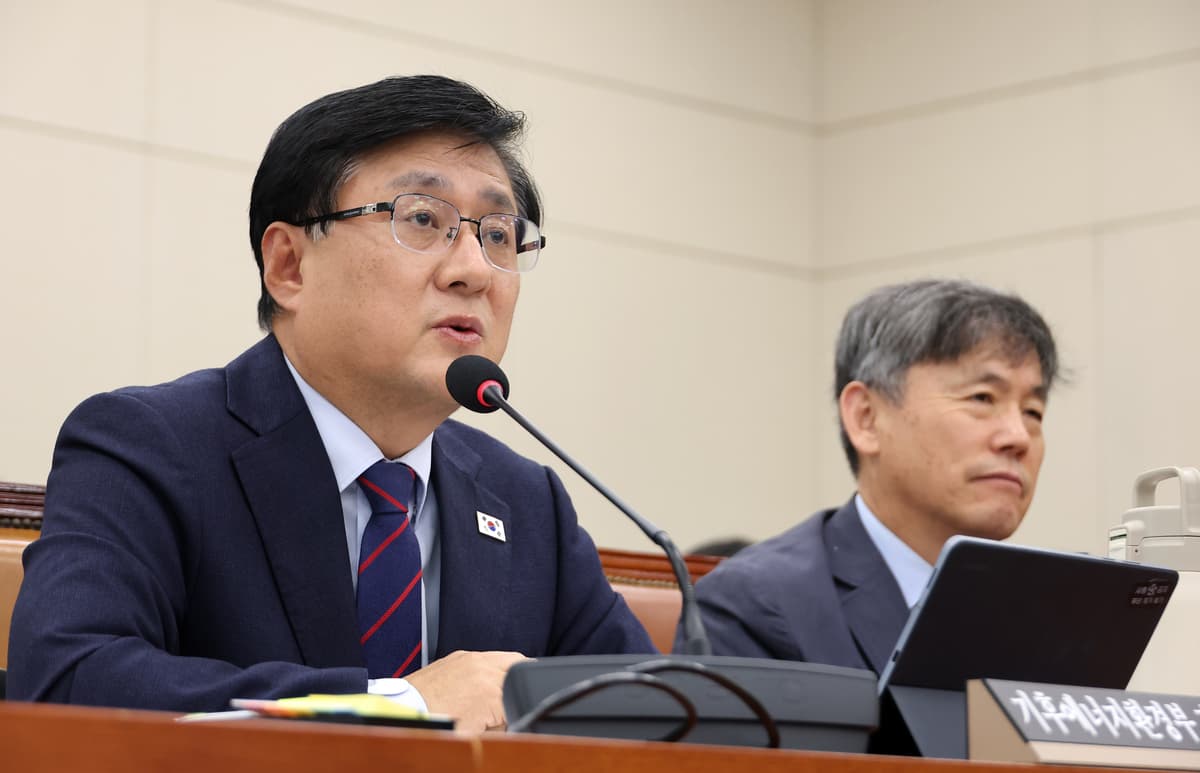
Climate, Energy and Environment Minister Kim Sung-hwan said it will be difficult to scale back Korea Electric Power Corp.'s bond issuance ceiling as planned.
Speaking on the 26th at a parliamentary audit of his ministry by the National Assembly's Climate, Energy, Environment and Labor Committee, Kim said the ceiling could have been lowered to within twice the sum of KEPCO's capital and reserves by next year had the Middle East war not broken out this year. "Right now, with the Middle East war and other factors shrinking KEPCO's earnings, it is expected to be difficult," he said.
The current Korea Electric Power Corporation Act caps the utility's bond issuance at twice the combined total of its capital and reserves, a limit designed to prevent a surge in borrowing.
The ceiling was raised to five times that amount through a legal amendment at the end of 2022, after a spike in oil prices following the outbreak of the Russia-Ukraine war pushed KEPCO into heavy losses and raised concerns that its bond issuance capacity would be exhausted. The temporary exception is set to expire on Dec. 31, 2027. If it is not extended, the ceiling will revert to twice capital and reserves.
With KEPCO's profitability expected to deteriorate again in the wake of the Middle East war, and with concerns that a reduced ceiling would disrupt funding for three megaprojects and power grid construction, the minister's remarks were read as signaling that the exception could be extended further.
KEPCO President Kim Dong-cheol said at a parliamentary audit by the National Assembly's Trade, Industry, Energy, SMEs and Startups Committee on the 12th that if the bond issuance ceiling is reduced, the utility will no longer be able to issue bonds, and that at a minimum an electricity rate increase is needed alongside self-rescue efforts.