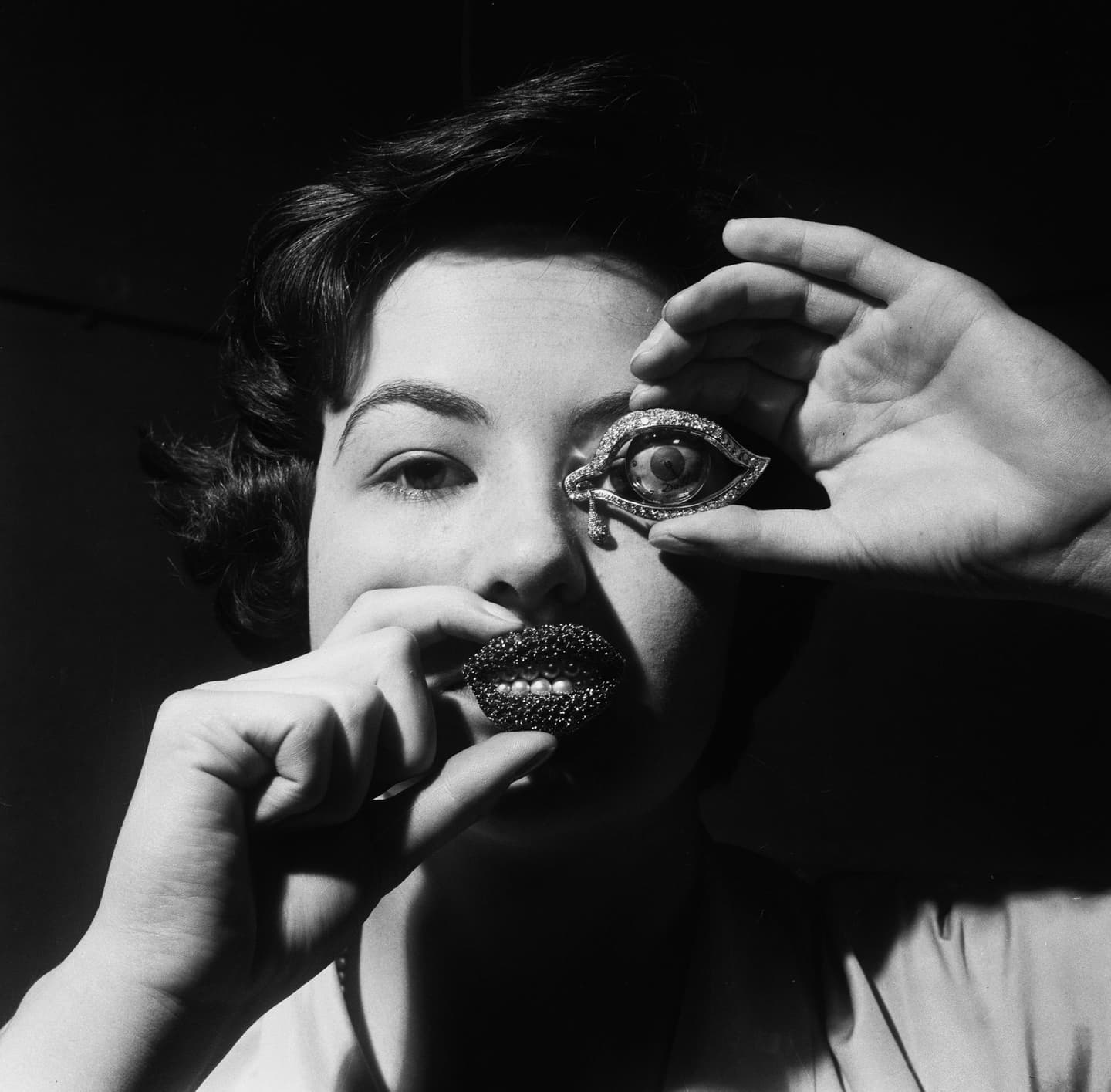
If you haven’t yet visited the Schiaparelli exhibition at the V&A Museum, I urge you do so before it closes next month, for it displays that rarest of qualities in fashion: wit. This feature is far more unusual than you might expect, given that a certain lightness of touch is, at least in theory, intrinsic to the business of style. Yet, watching endless catwalk shows during my career at Vogue and Harper’s Bazaar, I was struck by how often the designers were deadly serious in their intentions.
Such solemnity is understandable, given the fact that the industry has grown to become a vast, global trade, owned by billionaires and driven by the rapacious demands of commerce. Even so, one wishes for just a hint of Elsa Schiaparelli’s sense of humour, which she brought with such deftness to her creations.
One of my favourites is worth seeking out at the V&A: an ensemble worn by Jane Clark (wife of the National Gallery director at the time, Kenneth Clark) to the coronation of George VI in May 1937. It looks irreproachably discreet at first sight: an elegant, cream-coloured, floor-length gown, adorned only with a pattern of woven silver fronds and worn with an ivory silk velvet coat. Examine it more closely, however, and you will see a single button on the coat, featuring a buoyant, bare-breasted mermaid (who was thereby smuggled into Westminster Abbey).
Schiaparelli’s mischievous streak was also evident only a few days before the coronation, in the form of Wallis Simpson’s wedding trousseau. The twice-divorced woman who might have become queen, were it not for the abdication of her lover, Edward VIII, only five months previously, had ordered 18 outfits from Schiaparelli’s Paris couture house, in which she was photographed by Cecil Beaton to mark her impending marriage.
The shoot was staged at the Château de Candé in France (where the nuptials would take place on June 3), and Simpson chose to wear one of the most iconoclastic dresses of the epoch. Embellished with a larger-than-life scarlet lobster painted by Salvador Dalí, Schiaparelli’s friend and collaborator, which dangled between her legs beneath a crimson waistband, the provocative gown is arguably more brazen than blithe.
Certainly, Dalí’s insistence on the erotic symbolism of the crustacean reflected his well-known artwork Lobster Telephone, where the supposedly phallic tail is placed over the mouthpiece.
Even so, the startling effect of seeing the soon-to-be Duchess of Windsor dressed with such surreal irreverence makes for a remarkably memorable form of visual iconography, which still retains its subversive power almost 90 years later.
If Schiaparelli remains, at least in my view, unrivalled in her talent for wit, how might we incorporate a playful element in our own wardrobes, without looking facetious? The late Andrew Cavendish, 11th Duke of Devonshire, was able to carry off that trickiest of sartorial looks, the slogan-embellished sweater, with one of his design: a navy jumper emblazoned with the phrase ‘Never Marry a Mitford’.
This worked for him because his wife was, of course, the youngest of the fabled Mitford sisters (Debo, whose equally eclectic flair for fashion included her cherished Elvis slippers), but when the Duke’s in-joke was reproduced in a high-profile Gucci collection in 2017, it didn’t achieve quite the same result.
My own favourite jumper is a contemporary copy of the garment that brought Schiaparelli to fame in 1927, featuring a white trompe-l’oeil bow around the neck of a simple black knit top. It’s certainly not laugh-out-loud funny, but I like its quiet allusion to the past, which seems to me preferable to trying too hard with heavy-handed visual puns.
Needless to say, I am not a great fan of ‘amusing’ ties or novelty Christmas jumpers, but, if they have a place in your family traditions, then I’m all for continuing the good cheer. Just don’t do as Dalí did, who nearly ruined the lobster dress when he tried to smear mayonnaise over it; fortunately, Schiaparelli stepped in to prevent him, by pointing out that it was already festooned with prettily painted parsley.
This feature originally appeared in the October 21, 2026, issue of Country Life. Click here for more information on how to subscribe