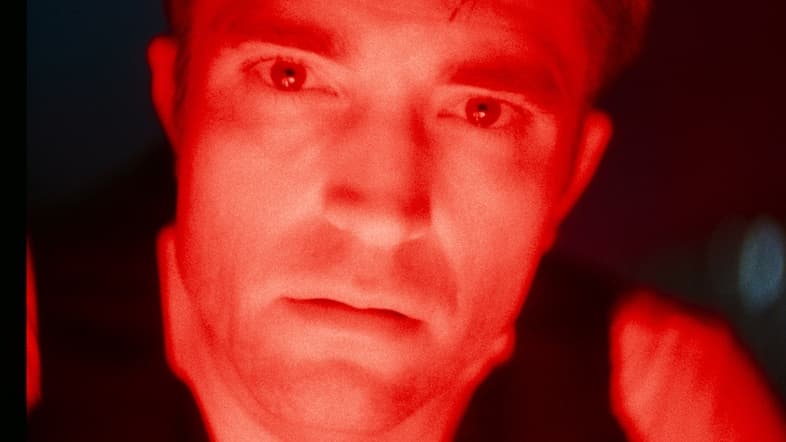
It’s late September, the day Primetime comes out in US cinemas, and its 30-year-old director, Lance Oppenheim, has received some major news. “Chris Hansen just watched the film,” Oppenheim excitedly tells me over a video call from LA. “He’s doing a live stream at 4pm on his social media. I’m so curious about what he’s going to say.”
Hansen, the subject of Primetime, had previously turned down A24’s offer to watch a preview at their office, calling the film “an insult” and “a complete work of fiction attached to a real name”. “I wouldn’t have been as interested if it had had his direct involvement,” says Oppenheim. “I wanted to make something that felt closer to a fever dream than any conventional biopic. I wanted to deal with the mythology. It’s like creating a superhero movie where I have the guy who plays Batman playing Chris Hansen.”
From 2004 to 2007, Hansen hosted To Catch a Predator, an American reality show that hunted down paedophiles and ruined their reputation for entertainment. Pretending to be children with access to the internet, Hansen and his team arranged dates with men who were trying to sleep with kids. Arriving at an agreed address, the paedophile is met by a “decoy” (an adult actor with youthful looks) before being ambushed by a slick, suited Hansen with his camera crew. The predator not only realises his life is over, but that his humiliation will air on NBC.
Written by Ajon Singh, Primetime stars Robert Pattinson as Hansen, an extrovert whose crazed, maniacal energy as a TV presenter might also exist when the camera’s not rolling. Inspired by a 2009 Esquire article, the film details the show’s conception (Hansen is challenged by NBC’s Jeff Zucker, playing himself, to defeat Lost in the ratings), the power battle with Hansen’s producer Andie (Merritt Wever), and why it was cancelled: in November 2006, Bill Conradt, an assistant district attorney, killed himself when the police and Hansen’s camera crew approached his home.
At the time, To Catch a Predator was enough of a mainstream hit that Hansen guested on talk shows (Jimmy Kimmel told him it was “Punk’d for paedophiles”) and he played himself on 30 Rock. If you find the premise queasy from a 2026 lens, that might continue with Primetime. Like the show it’s depicting, Primetime is lurid, over-the-top, and horribly compelling. Skyler Gisondo and Phoebe Bridgers, who sings over the end credits, are comically believable as the decoys hired to mimic 13-year-olds; Bridgers only needs to put on a baseball cap and lower her register to convince a middle-aged man she’s an adolescent boy. Pattinson, too, draws laughter from his sliminess and desperation. Oppenheim recalls, “I remember telling Rob in the second week of shooting, ‘You’ve got the mannerisms and voice down, but you’re also doing Dracula and Jerry Maguire.’”
It thus raises the same ethical question: is it OK to find so much amusement in a story that culminates in a real person’s suicide? “If there’s comedy to be found in the movie, it’s located in how this group were catching predators like Pokémon,” says the director. “I never wanted the film to come off as glib. To me, it’s mimicking how the show felt. I wanted to depict the suicide in a way that wasn’t gratuitous, but so we could experience the emotional toll on the people who created it.”
To this day, Hansen is still unapologetic about Conradt’s death. “He’s on record saying he slept very well that night. But I think seeing any event like that – and doing the work he does on a daily basis – would have a psychological effect on you. This movie’s attempting to decipher what happens when you spend more time with potential predators across a kitchen island than you do with your own family.”
Before Primetime, Oppenheim directed esoteric documentaries like Spermworld, Ren Faire, and Some Kind of Heaven. After the release of Spermworld, Oppenheim’s wife paid Hansen to film a Cameo video congratulating her husband. When Oppenheim showed the video to Pattinson (they were discussing a different project), he was subsequently sent the Primetime script. “I saw a path to creating something phantasmagorical, almost honouring the spirit of movies like Body Double or JFK.”
Chris Hansen knew how to create iconic moments. He’s like Tony Montana in Scarface
On Primetime, Oppenheim deploys key figures from his docs, including cinematographer David Bolen, who lenses the hotel rooms of Spermworld with a murky blue similar to what haunts Hansen’s world. (Oppenheim compares the colours of Primetime to “being lost inside a CRT monitor”.) As a filmmaker from a non-fiction background, does Oppenheim have a begrudging respect for Hansen, a journalist who carved out a niche for himself?
“Absolutely. I came into this as a fan of Chris Hansen, and I remain a fan of Chris Hansen, even if he publicly says he isn’t a fan of mine. I see Chris Hansen as a journalist and entertainer – but also an artist. He created this manufactured reality that’s so odd and particular. Transitioning into narrative films, I thought: how would Chris Hansen make this movie? I wanted to capture this state of mind of moving 1,000 miles a minute, and you’ve been handed everything you ever dreamed, and it slowly turns into a nightmare. The movie operates in this register that’s almost pure id.”
Is he a fan of the show itself, or just Hansen? “I watched it as a guilty pleasure. When we were shooting Spermworld, Ren Faire, and You Can See Everything – I remember because Nathan Fielder is a fan of To Catch a Predator as well – I would throw it on to relax after a long day. These moments capture the darkest parts of humanity, but they’re mixed with levity, because Chris Hansen is very aware of the camera and the power he has in the situation. He knew how to create iconic moments. He’s like Tony Montana in Scarface.”


In the credits, Oppenheim thanks David Osit, a director whose incisive 2025 documentary Predators covers Conradt’s suicide (it includes the raw footage of camera crews waiting to enter his house), the show’s methodology (it interviews decoy actors and Hansen himself), and Hansen imitators who post their ambushes on YouTube. “Before the Primetime script got in my hands, I heard David was making a documentary about Chris Hansen. I was a little bummed, because I thought, ‘David’s going to absolutely body that thing. He’s such a great filmmaker. He got there first.’”
In Primetime’s postproduction, Oppenheim watched Predators. “It was a powerful take, but from a different vantage point, which is the unknowability of Chris Hansen; the Chris Hansen who’s seemingly not self-reflective about the darker parts that he’s buried deep inside.” Osit provided feedback on an early cut. “I appreciate him as a friend and filmmaker.”
24 hours after Primetime premiered at Venice, a surprise screening at Telluride turned out to be You Can See Everything, a three-hour documentary about Elizabeth Holmes that Oppenheim co-directed with Nathan Fielder. Should UK viewers research Holmes or watch The Dropout while they wait for its theatrical release? “Go in completely cold if you can. If anyone talks about what happens in it, please tell them to stop. So much of the movie is about deciphering moments we couldn’t agree on. Nathan became this amateur detective of ordinary, everyday things. He was never intending to be on camera. He was pulled into it. We thought the audience could help us decipher what each moment means.”
How does this point in time feel for him? “I feel like I’m floating. I’m also anxious, generally. I overthink everything.”
A few hours after the interview, I look up what Hansen has to say about Primetime. On his YouTube channel, Hansen refers to Oppenheim calling the film “a love letter to Chris Hansen”, and concludes, “If that’s a love letter, I’d hate to get a poisoned pen letter from this director.” Rating Pattinson with a “D”, Hansen notes, “Tough grade, but I’m kind of the only guy that counts.”
Primetime opens in UK cinemas on October 30.