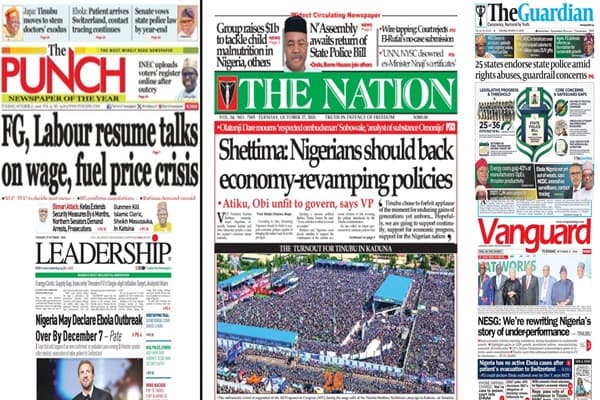
Nigeria’s economic reforms, renewed negotiations between the Federal Government and organised labour, concerns over state police safeguards, and the country’s Ebola response dominate today’s newspaper headlines. The Nation reports that Vice President Kashim Shettima has urged Nigerians to support economic policies aimed at revamping the economy, warning against reversing ongoing…...
Nigeria’s economic reforms, renewed negotiations between the Federal Government and organised labour, concerns over state police safeguards, and the country’s Ebola response dominate today’s newspaper headlines.
The Nation reports that Vice President Kashim Shettima has urged Nigerians to support economic policies aimed at revamping the economy, warning against reversing ongoing reforms. Punch focuses on the resumption of talks between the Federal Government and labour unions over petrol prices, wage demands and workers’ welfare. Vanguard highlights President Bola Tinubu’s pledge to rewrite Nigeria’s history of economic under-performance through reforms aimed at creating jobs and shared prosperity.
The Guardian examines concerns over political interference and human rights abuses despite 25 state assemblies endorsing the proposed state police amendment. Leadership reports that Nigeria could declare the Ebola outbreak over by December 7 if no new cases emerge and the required conditions are met.
1. THE NATION
Shettima: Nigerians should back economy-revamping policies
Vice President Kashim Shettima has urged Nigerians, particularly business leaders and influential citizens, to support economic policies aimed at improving the country’s fortunes.

Speaking at the Nigerian Economic Summit in Abuja, where he represented President Bola Tinubu, Shettima said Nigerians must decide whether to sustain the current administration’s economic reforms or risk reversing the policies.
Quoting political thinker Frantz Fanon, he said, “Every onlooker is either a coward or a traitor.”
The vice president also called on future administrations to maintain policies that promote economic growth, irrespective of the political party in power. He defended the removal of fuel subsidy, saying the former arrangement placed a heavy burden on government finances.
Read More in The Nation.
2. PUNCH
FG, Labour resume talks on wage, fuel price crisis
The Federal Government and organised labour are set to resume negotiations over petrol prices, wage demands and other unresolved workers’ welfare issues amid the threat of nationwide industrial action.

The Nigeria Labour Congress and Trade Union Congress are demanding a reduction in petrol prices to 2024 levels, tax relief for workers, immediate wage awards and the commencement of negotiations for a new minimum wage ahead of the government’s proposed June 2027 review.
The meeting follows an earlier round of talks that ended without an agreement. Labour is expected to determine its next course of action based on the government’s response before the unions’ ultimatum expires.
Meanwhile, the Federal Parastatals and Private Sector Pensioners Association of Nigeria has called for the payment of three months’ outstanding fuel-subsidy palliatives totalling N75,000 to eligible retirees, alongside improved access to healthcare benefits.
Read More in Punch.
3. VANGUARD
NESG: We’re rewriting Nigeria’s story of under-performance — Tinubu
President Bola Tinubu says his administration is working to reverse Nigeria’s longstanding economic under-performance through reforms designed to remove structural barriers, attract investment and create jobs.

Read Also
Tinubu, represented by Vice President Kashim Shettima, made the declaration while formally opening the 32nd Nigerian Economic Summit Group summit in Abuja.
“We came to rewrite the story of a nation that has performed below its potential for far too long. But there is no shortcut to economic growth. This is why we began with a difficult reset. For us, rescuing the economy means rescuing livelihoods and transforming the fortunes of young job seekers, farmers, manufacturers, entrepreneurs and innovators,” he said.
The president said the reforms were intended to restore confidence, strengthen the economy and create conditions for public and private sector investment, productivity and sustainable growth.
Read More in Vanguard.
4. THE GUARDIAN
25 states endorse state police amid rights abuses, guardrail concerns
The Guardian examines concerns about political interference, human rights violations and weak accountability as 25 State Houses of Assembly endorse the proposed state police constitutional amendment.

Although the endorsements have met the required two-thirds threshold for the amendment to advance, critics warn that decentralising policing could transfer existing accountability problems to state governments without resolving them.
Senate Leader Opeyemi Bamidele has defended the proposal as a necessary response to worsening insecurity, maintaining that safeguards have been incorporated into the legislative framework.
Human rights advocates, however, have questioned whether independent commissions would have sufficient financial autonomy and institutional independence to investigate alleged misconduct involving governors and other powerful officials.
Further legislative consideration, consultations and proposed policing legislation are expected to shape relations between federal and state police services and determine the effectiveness of accountability mechanisms.
Read More in The Guardian.
5. LEADERSHIP
Nigeria May Declare Ebola Outbreak Over By December 7 – Pate
The Coordinating Minister of Health and Social Welfare, Prof. Muhammad Ali Pate, says Nigeria could declare the Ebola outbreak over by December 7, 2026, provided no new confirmed or probable cases emerge and the required 42-day countdown is validated by the Nigeria Centre for Disease Control and Prevention and the World Health Organisation.

Pate disclosed this following the medical evacuation of Nigeria’s imported Ebola index patient and her husband to Switzerland on Monday.
Although no additional cases have been recorded since the index case was confirmed, surveillance and contact-tracing activities are continuing, with 52 contacts still being monitored in the country.
The minister said the proposed date remains provisional and would be subject to validation by the NCDC and WHO. Any new confirmed or probable case would require a fresh countdown.
Nigeria confirmed its first imported case of Ebola virus disease caused by the Bundibugyo virus on October 20, 2026, after laboratory tests detected the infection in a woman who had travelled from Uganda.
Read More in Leadership.