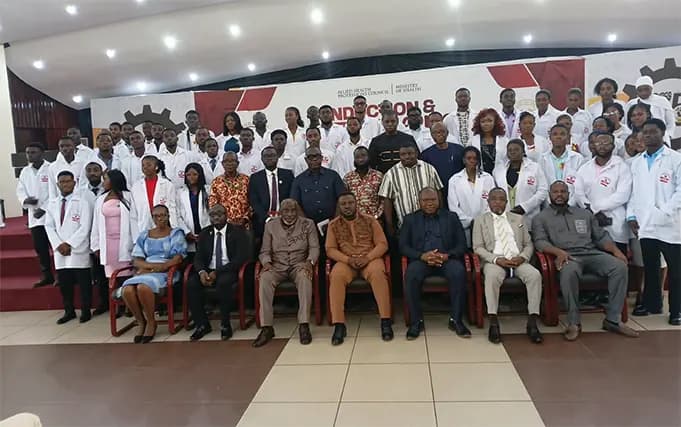
Prof. Yaw Amo Wiafe (seated 2nd from left) with other dignitaries and some graduates
Newly qualified allied health professionals have been warned to prioritise patient safety, uphold professional ethics and continuously upgrade their knowledge and skills to avoid medical negligence and possible legal battles.
Prof. Yaw Amo Wiafe, Associate Professor of Clinical Ultrasound and Echocardiography and Dean of the Faculty of Allied Health Sciences at the Kwame Nkrumah University of Science and Technology (KNUST), gave the warning at the induction and oath-swearing ceremony for newly qualified allied health graduates in Kumasi.
He said the rapidly changing nature of medical knowledge, diagnostic technologies and treatment methods required healthcare professionals to embrace lifelong learning to remain competent and deliver quality services.
Speaking on the theme, “Setting the Standard: Regulating Service, Safety and Excellence Across Universal Health Coverage,” Prof. Wiafe reminded the graduates that their university education was only the foundation of their professional careers.
He urged medical laboratory scientists, sonographers, radiographers, radiotherapists and other allied health practitioners to continuously update their knowledge, refine their skills and adapt to emerging technologies.
He, however, cautioned that the desire to pursue further studies and accumulate continuing professional development (CPD) points should not be the principal motivation for professional development.
“The greatest motivation should be to serve your patients better,” he stressed.
According to him, every new skill acquired, scientific paper read and professional training programme attended must translate into better clinical decisions, improved patient safety and positive health outcomes.
Council Warns Interns
Meanwhile, the Registrar of the Allied Health Professions Council (AHPC), Prof. Shirazu Issahaku, has cautioned the newly inducted graduates against practising beyond their competence during their one-year internship.
He said more than 15,000 professionals across 12 allied health disciplines in the 16 regions of Ghana were being inducted as part of efforts to strengthen professional standards and improve healthcare delivery.
Prof. Issahaku explained that the internship was designed to equip the graduates with the practical knowledge and experience required before they could obtain their full professional licences.
He directed the interns to comply strictly with the prescribed dress code and report to their assigned healthcare facilities with the necessary documents, including their posting letters, code of ethics and relevant professional regulations.
He disclosed that the council would visit the facilities where the graduates had been posted to monitor their activities and ensure compliance with the internship requirements.
The Registrar stressed that the interns were expected to learn under the guidance of their supervisors rather than undertake procedures they did not understand.
He said the interns would be required to sit a council examination at the end of their training, with questions focusing on the practical knowledge and experience acquired during the internship.
Patient-Centred Care
The Chairperson of the AHPC, Prof. Eric Desmond Kotei Addison, said universal health coverage should not be limited to providing access to hospitals but must also guarantee quality healthcare regardless of patients’ financial circumstances, geographical location or social background.
He said the council was committed to regulating professional practice, establishing standards for service delivery and ensuring accountability among healthcare practitioners and facilities.
Prof. Addison stressed that patient-centred care must remain the focus of healthcare delivery, with respect for patients’ rights, effective communication, professional integrity, timely diagnosis and appropriate treatment serving as key indicators of excellence.
He said the success of the healthcare system should not be measured solely by the number of hospitals constructed, professionals trained or patients treated.
Rather, he said, attention must be given to improved patient outcomes, reduced preventable harm and consistent standards of care across healthcare institutions and geographical areas.
He urged the newly inducted professionals to uphold the highest standards of service, safety and professional conduct to support Ghana’s universal health coverage agenda.
The ceremony marked the beginning of the graduates’ one-year internship and their commitment to ethical and competent practice in the allied health professions.
FROM David Afum, Kumasi
The post Allied Health Graduates Warned Against Negligence appeared first on DailyGuide Network.