
Synopsis
An integrated tax framework for India's textile sector is being developed to improve competitiveness in global markets. This framework will potentially encompass various duties affecting production stages from raw materials to finished products. The government's focus is on enhancing textile manufacturing, especially in technical textiles and traditional clusters. Industry representatives are advocating for duty exemptions on specific raw materials to support domestic manufacturing viability.
 etimes.in
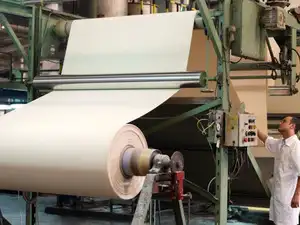
New Delhi: The Centre is working on an integrated tax framework for India's textile sector to provide greater tax certainty and wider duty relief on raw materials and machinery costs to compete in global markets, according to people privy to the discussions.
The proposed framework could encompass goods and services tax on textile products and inputs, basic customs duties on raw materials and imported textile machinery, and anti-dumping duties on select man-made fibre and yarn imports.
Also read: India's textile industry targets $350 billion by 2030 as exports rebound, costs rise: Report
The objective is to address tax and duty-related cost pressures across different stages of production, from fibre and yarn to fabric and finished products, while improving predictability for manufacturers.
The exercise comes as the government sharpens its focus on expanding textile manufacturing, prioritising technical textile, modernising traditional clusters and improving India's share in global markets.
"This is a priority sector for the government, and we are looking at an integrated tax frame to make it competitive rather than a tweak here and there," a senior official told ET on condition of anonymity.
The government has already been preparing to implement the ₹40,000-crore Textile Expansion and Employment Scheme, announced in the budget for 2026-27, to support machinery upgrades, technology adoption and common testing facilities in traditional textile clusters.
"Industry representatives have argued that investment support alone may not be enough if manufacturers continue to face high or uneven duties on raw materials, intermediate products and machinery," the official added.
 ET Bureau
Unified Tax Framework in Works for Textiles
The Department of Revenue is working with the textiles ministry and is looking into the request from industry representatives.
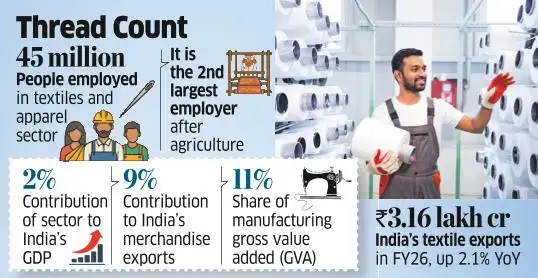
The textile sector contributes about 9% of India's merchandise exports and supports more than 45 million jobs. Industry players suggest that India is facing intense competition in man-made fibre textiles and apparel from China, Bangladesh and Vietnam.
The textiles ministry has taken up customs duty removal on caprolactam, nylon chips, rayon-grade wood pulp and cotton with the Department of Revenue. It has also recommended removing or deferring anti-dumping duties on elastomeric filament yarn and viscose rayon filament yarn, citing their impact on downstream manufacturers, micro, small and medium enterprises, and employment.
Also read: Gap apparel supplier Gokaldas eyes doubling Europe exports share to cut US reliance
Separately, industry representatives have sought a six-month basic customs duty waiver on five polyester-chain products-monoethylene glycol (MEG), purified terephthalic acid (PTA), partially oriented yarn (POY), fully drawn yarn (FDY) and drawn textured yarn (DTY).
Temporary duty exemptions on MEG and PTA were withdrawn in July, prompting renewed appeals from the sector to protect domestic manufacturing viability.
The textile ministry has also requested the department to look again at machinery costs.
Read More News on
...moreless