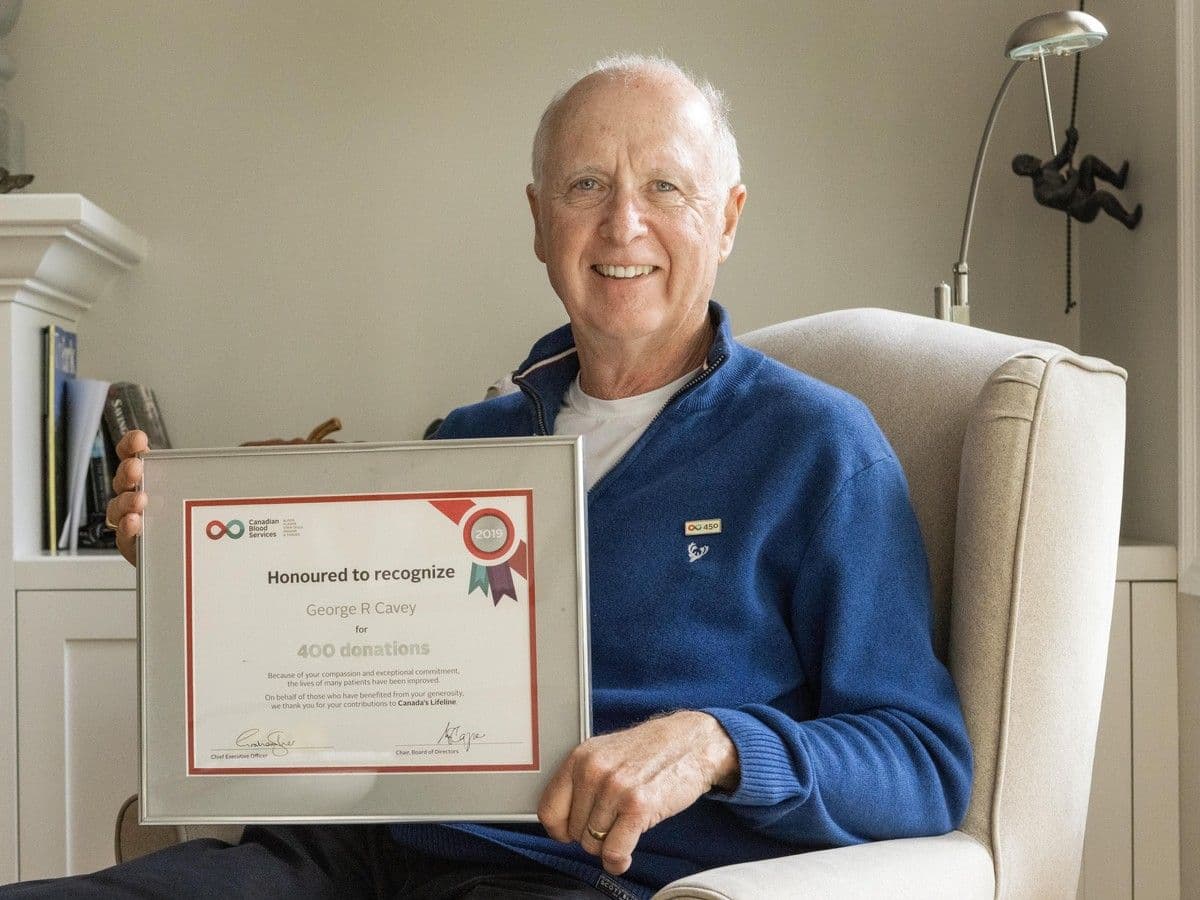
On Monday, Oct. 26, 73-year-old George Cavey will make his 500th blood donation. He’s not expecting any prizes, other than the usual Oreos and salty snacks provided to bump up blood sugar and replenish lost sodium.

Subscribe now to read the latest news in your city and across Canada.
- Unlimited online access to articles from across Canada with one account.
- Get exclusive access to the Vancouver Sun ePaper, an electronic replica of the print edition that you can share, download and comment on.
- Enjoy insights and behind-the-scenes analysis from our award-winning journalists.
- Support local journalists and the next generation of journalists.
- Daily puzzles including the New York Times Crossword.
Create an account or sign in to continue with your reading experience.
- Access articles from across Canada with one account.
- Share your thoughts and join the conversation in the comments.
- Enjoy additional articles per month.
- Get email updates from your favourite authors.
Create an account or sign in to continue with your reading experience.
- Access articles from across Canada with one account
- Share your thoughts and join the conversation in the comments
- Enjoy additional articles per month
- Get email updates from your favourite authors
Sign In or Create an Account
“He does this for no acknowledgment,” said his daughter Lisa Cavey, 38, a New Westminster mental-health councillor, who thinks the milestone deserves at least some attention, not just for her dad, but also to encourage others to donate. “He has saved so many lives.”
Even George Cavey’s two grandchildren, ages six and three, have tagged along, making it a family affair, although grandpa is by far the most prolific donor in the family.

Start your day with a roundup of B.C.-focused news and opinion.
By signing up you consent to receive the above newsletter from Postmedia Network Inc.
A welcome email is on its way. If you don't see it, please check your junk folder.
The next issue of Sunrise will soon be in your inbox.
We encountered an issue signing you up. Please try again
“The kids are mostly interested in the cookies,” said Lisa Cavey, but he wanted them to see, and feel comfortable, with the process. His mom was the first to encourage him to donate, when she took him along to a donation clinic when he was 17 or 18 years old. Since that first visit he began a regular schedule of donating every three months.
“I have massive, big veins,” said George Cavey. “That makes it easier.”
His veins are so accessible that when he was at university he was popular among the nursing students who used him to practise their skills on.
George Cavey is O-positive, one of the most common blood types.
“In case of accidents there is a statistically higher need for that type. So I kept doing it,” he said.
Over the years, George Cavey said, when the subject of donating has come up among friends, he has heard that a “mom, sister, friend or son” had benefited from platelets or other blood products due to an accident or illness.
“That makes me feel good to know that I may have helped them or others like them in similar situations,” he said.
He began with donating blood, which takes about 10 to 15 minutes, then switched to plasma, which takes 60 to 90 minutes. At the request of the Canadian Blood Services, he also began donating platelets, which are vital for cancer patients, every couple of weeks. The platelet donation process takes 2½ to three hours on average.
There have been a couple of hiccups and interruptions to the schedule over the years. When he started donating, there was no questionnaire or health assessment before donation. Canada’s contaminated blood crisis in the 1980s brought about changes, including donor health screenings and stricter regulations to ensure the safety of Canada’s blood supply. George Cavey had to pause his donations when he was working in Africa, because he was taking malaria medication.
Another pause came when one of the early screenings of George Cavey’s blood showed a false-positive for hepatitis C virus antibodies, something that isn’t unusual and can be the result of test interference or blood proteins.
After the result was determined to be false, the O-positive geologist continued to donate blood, plasma and platelets until a second false-positive in 2023. Donors with two false positives, even decades apart, are no longer eligible to donate blood for Canada’s public supply. That’s when George Cavey learned that there was a need to donate for research purposes, and that’s what he does now.
“A lot of people don’t know about it or don’t want to donate for research,” he said.
Since switching to research donations, he has hopped on his bike and made the almost 31-kilometre ride out to the University of B.C. 31 times to donate plasma and platelets at the Canadian Blood Service’s netCAD Blood4Research Facility, which does research that improves technology and blood services.
“I rarely get sick. I’m very healthy so I attribute part of that to my donations,” said George Cavey.
Although there is no scientific evidence that donating blood improves immune response, one of the benefits of losing blood is that the bone marrow is stimulated to produce fresh blood cells and platelets, he points out.
But that’s not the real reason, nor is it the cookies, Cheezies and chips.
“We need blood,” he said. “When you are in an accident, or have burns, or cancer, someone has to supply the blood. There are a lot of reasons people can’t. I can.”
For more health news and content around diseases, conditions, wellness, healthy living, drugs, treatments and more, head to Healthing.ca – a member of the Postmedia Network.
Join the Conversation
This website uses cookies to personalize your content (including ads), and allows us to analyze our traffic. Read more about cookies here. By continuing to use our site, you agree to our Terms of Use and Privacy Policy.