
CFA, MBA
Chief Investment Officer
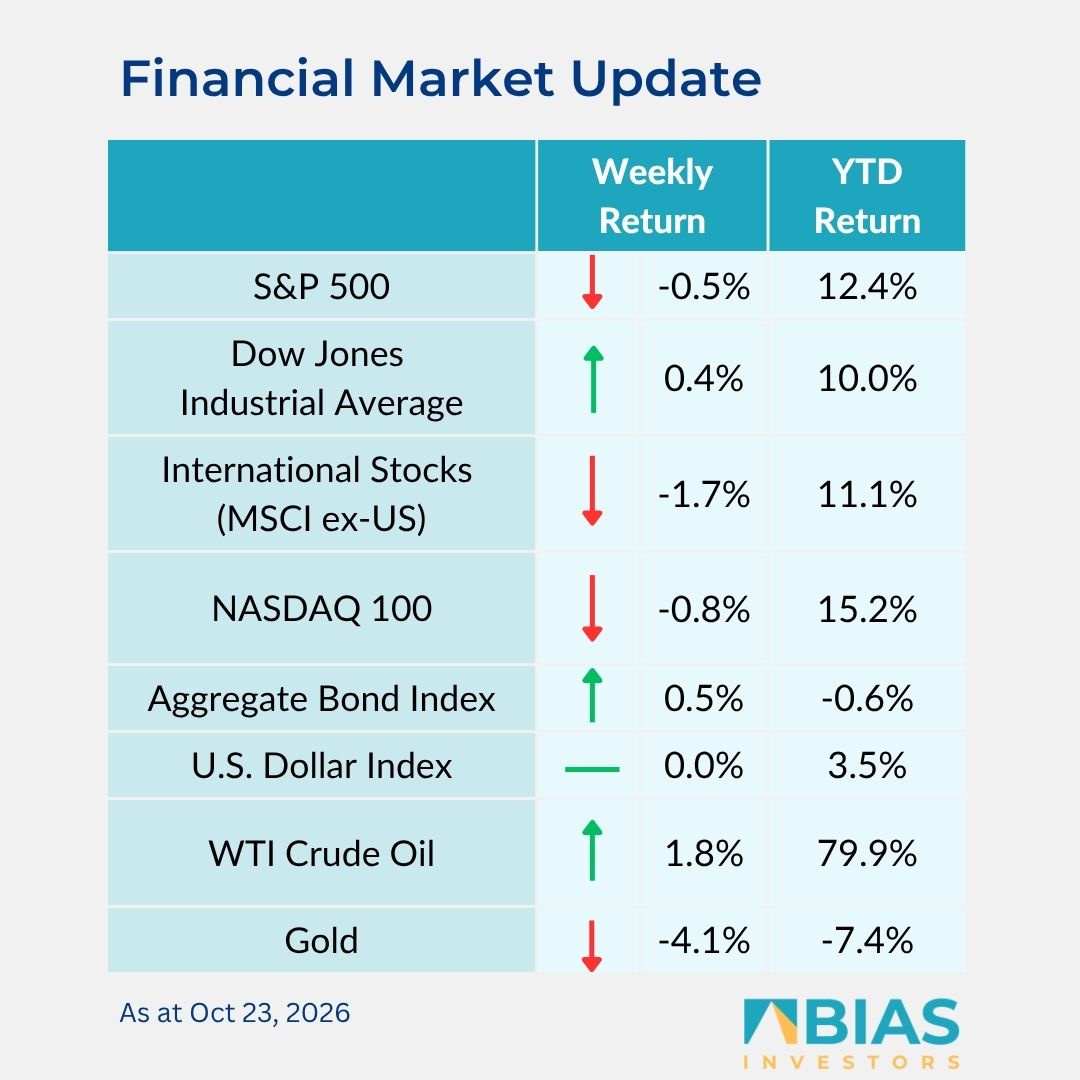
Stocks were mixed last week against a backdrop of higher oil prices and declining bond yields.
For the week, the S&P 500 Index declined 0.5%, the Dow Jones Industrial Average rose 0.4%, and the NASDAQ 100 fell 0.8%. Small-cap stocks also outperformed, with the Russell 2000 gaining 2% for the week.
The energy, healthcare, and real estate sectors led the S&P 500 Index for the week, while communication services, industrials, and technology lagged. The 10-year U.S. Treasury note yield ended Friday at 4.998%, down from 5.083% the previous week.
Consumer sentiment remained subdued in October. The University of Michigan’s final Consumer Sentiment Index reading was 48.0, little changed from September’s 48.1, but 10.4% below its year-earlier reading of 53.6. Consumers cited higher interest rates and affordability as reasons for less favourable buying conditions for credit-financed durable goods including vehicles, appliances, and furniture.
- Advertisement -
CME fed funds futures indicate that investors expect the Federal Reserve to hold rates steady at its October policy meeting this Wednesday, followed by a 25-basis point increase in the federal funds target range at its December meeting.
This week’s economic calendar includes the advance estimate of third-quarter GDP and the September PCE Price Index, both scheduled for Thursday.
Earnings season moves into its busiest stretch this week, with 179 companies in the S&P 500 Index scheduled to report third-quarter results. Third-quarter earnings are expected to grow 29.7% year-over-year, with revenue growth of 12.7%. For full-year 2026, earnings are expected to grow 33.1%, with revenue growth of 12.8%.
In our ‘Dissecting headlines’ section, we look at consumer spending on Halloween.
Dissecting headlines: Halloween spending
According to a National Retail Federation survey, Halloween spending for 2026 is expected to reach a record $13.5 billion, an increase of $400 million (+3%) from last year. Consumers expect to spend approximately $4.4 billion on costumes, $4.3 billion on decorations, $4.1 billion on candy, and $800 million on greeting cards. Spending is well above pre-pandemic levels.
Forty-seven percent of consumers said they are using artificial intelligence to support their Halloween shopping. Uses include generating costume and decorating ideas, planning, and product research. Key shopping destinations include discount stores at 39% of consumers surveyed, specialty Halloween and costume stores at 32%, and online at 27%.
While spending is higher, consumers are seeking to maximise value. Thirty-one percent of respondents say they comparison shop, 26% look for coupons or sales, and 34% prefer items that can be reused in future years or repurposed after the holiday.
Record Halloween spending suggests consumers remain willing to spend money for holiday celebrations, despite higher gasoline prices squeezing household budgets. With Christmas just 60 days away, the upcoming holiday shopping season should provide a broader gauge of consumer health in the current economic environment.

BIAS Investors (Cayman) Ltd.
Grand Pavilion (Hibiscus Way)
802 West Bay Road
Grand Cayman, Cayman Islands
W: biasinvestors.com
E: info@biasinvestors.com
T: 345-943-0003