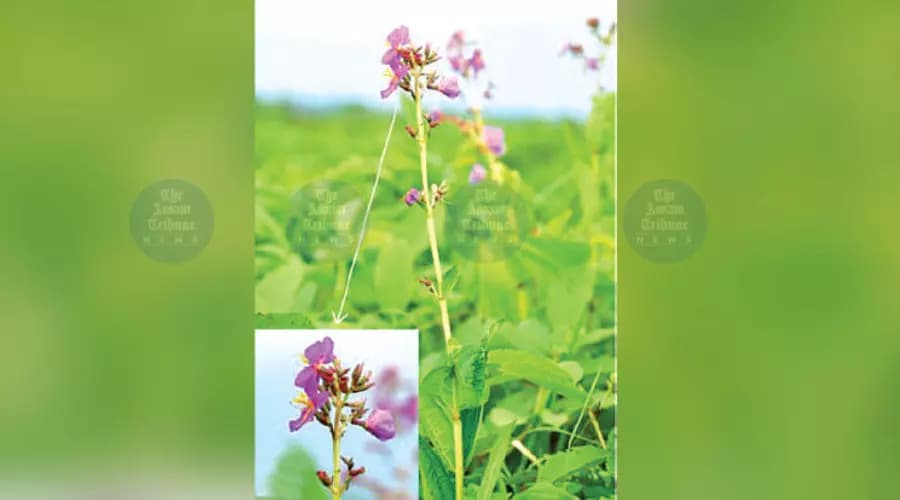
Guwahati, Oct 26: In another validation to the State’s remarkable floral wealth, a new species of Melastomataceae, Osbeckia assamensis, was recently documented by two researchers in Manas National Park.
The new species is morphologically allied to Osbeckia nayarii GS Giri but differs in branching pattern, strigose stem, foliar features, inflorescence with 30-35 flowers, hairy calyx margin, presence of intersepalar emergences on the hypanthium, etc. The new species is quite distinct from other Osbeckia species having tetramerous flowers.
The researchers – Prof Namita Nath from Gauhati University and Barnali Das, assistant professor from Pragjyotish College – did a detailed taxonomic description, photographic illustration, and comparison with allied taxa, which has been published in the peer-reviewed international journal Phytotaxa.
With 45 accepted species and six varieties, Osbeckia Linnaeus is distributed mostly in the southeastern part of the Asian continent (IPNI 2026, POWO 2026). The genus comes under the tribe Melastomateae Bartl. (Veranso-Libalah et al. 2017), which is pantropical in distribution covering 44 genera. South America has the highest number of members of the tribe, containing over 60% of species (Guimaraes et al 2019). Melastomateae members are characterized by staminal pedoconnectives with paired appendages on the ventral side, an ovary apex with a crown of appendages or hairs and cochleate seeds with tubercles (Michelangeli et al 2013). The Asian members of the tribe Melastomateae are found in Southeast Asia, Australia and the Pacific islands. Hansen (1977) considered India to be the centre of origin for the genus Osbeckia.
“We came across the species during the ongoing floristic work on the Melastomataceae family found in Assam. The species was found to grow in large populations sporadically over the grasslands of Manas National Park, Assam. The species shows similarities to the closely allied species O nayarii, having a quadrangular stem with winged angles, tetramerous flowers, isomerous stamens and glabrous and urceolate hypanthia. After consulting relevant taxonomic literature and analyzing detailed morphological features, it was found to be a new taxon. This new taxon is established to be a new species, Osbeckia assamensis,” the authors noted in the study.
Osbeckia is distinguishable from other Melastome members by the presence of different types of hairs, bristles and emergences over hypanthia surface; isomorphic stamens; and ribbed capsules with apical pore dehiscence (Prashob and Thomas 2019).
Prof Nath said that floristic exploration through extensive field survey from 2021 to 2025 helped the authors to collect the specimen resembling one of the members of Osbeckia genus. The collected specimen was compared with similar species found in India as well as in the neighbouring countries.
“By following the standard herbarium protocol by Jain and Rao (1977), voucher specimens were prepared and deposited at GUBH (abbreviations follow Thiers 2025). Voucher specimens under the genus Osbeckia as well as allied genera deposited at ASSAM and GUBH (abbreviations follow Thiers 2026) were examined physically, and voucher specimens at CAL (Thiers 2026) were examined digitally. Fresh samples were considered to measure the morphological features. The type specimens were submitted in the GUBH (abbreviations follow Thiers 2026),” she added.