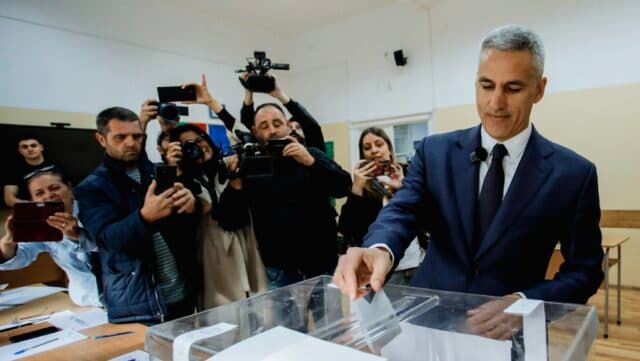

The two main candidates in Bulgaria’s presidential elections on Sunday will face off against each other in a second round on November 1 after an unexpectedly close first round in which neither won an outright majority and voter turnout was extremely low.
Acting President Iliana Iotova, who ran with the support of Prime Minister Rumen Radev, won 34.8 per cent of the vote, coming in ahead of the reformist candidate and former interim Prime Minister Andrey Gyurov, who won 31.9 per cent, according to the Central Election Committee after 99.94 per cent of ballots were processed.
Polls had Iotova and Gyurov as the two top candidates, but the final results strayed widely from some predictions that Iotova could win with a landslide.
On Sunday evening Iotova said her campaign was focused on “promoting peace” and, returning to a common theme across her campaign, added that she would “not let foreign flags be waved on our streets, I want to see only Bulgarian flags.”
Gyurov again challenged Iotova to an “honest and civilised” TV debate. Iotova has declined previous challenges to TV debates. “We owe it to all the citizens who voted for us but most importantly, those who decided to stay at home, still unconvinced,” Gyurov said.
The elections were notable for a record low turnout. According to Alpha Research, only 22.5 per cent of eligible voters cast their ballots. Voter turnout in elections in 2021 was 40.5 per cent, and in 2016, 56.28 per cent.
Low turnout appears linked to the fact that some major parties did not field candidates and so did not activate their core electorates.
According to Alpha Research, only around 30 per cent of the people regularly voting for GERB, the dominant party for much of the period from 2008 to 2025, voted on Sunday.
The political party Movement for Rights and Freedom – New Beginning, which is tied to the sanctioned tycoon Delyan Peevski and favoured by many Bulgarian Turks, also did not participate in the elections. Local media noted record low turnout in the regions where Bulgarian Turks live as well as fewer diaspora votes coming from Turkey.
One of the major campaign issues was increasing security concerns over the shaky government response to drone attacks in the Black Sea amid the ongoing Russian war against Ukraine – an issue that highlighted an East-West divide between candidates.
On Monday, Prime Minister Radev raised the topic again, saying that in the runoff, people will have to choose between “peace and war” – suggesting Iotova will be able to ease the situation with Russia while comparing Gyurov’s pro-EU and pro-Ukraine positions to warmongering.