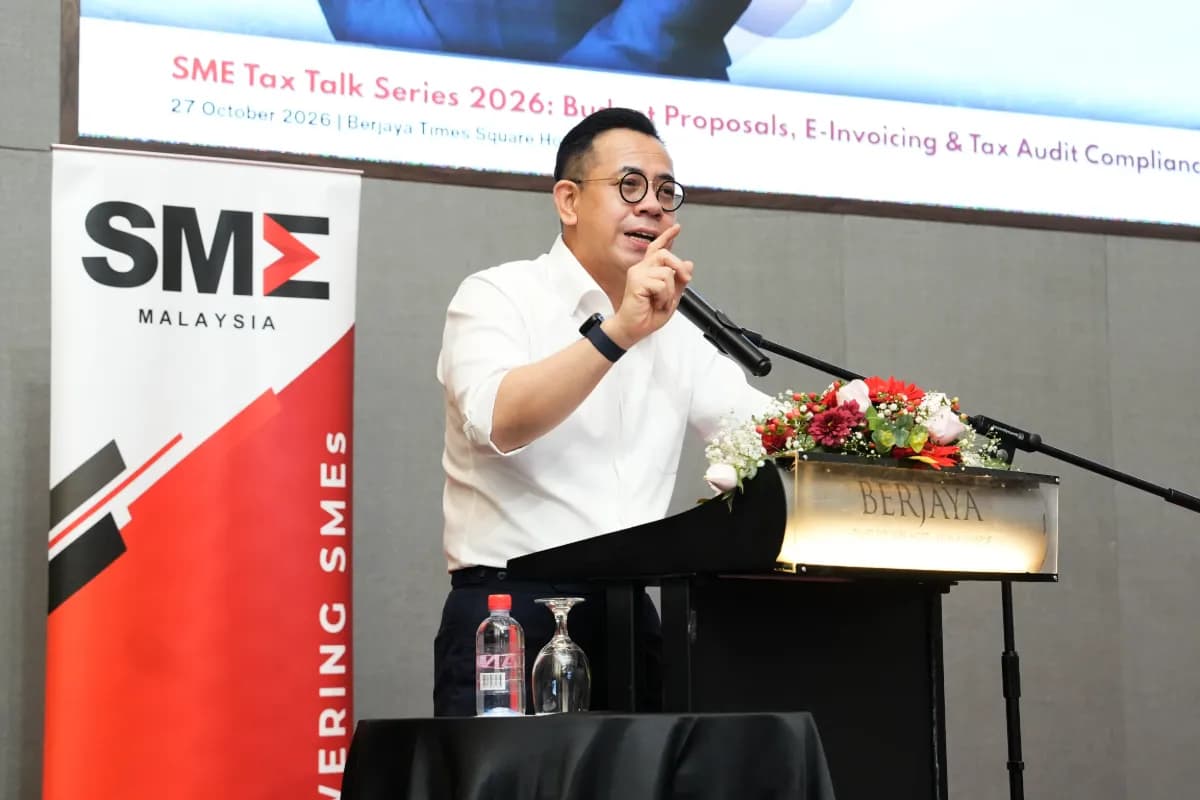
KUALA LUMPUR: Entrepreneur and Cooperatives Development Minister Steven Sim has urged SMEs to position themselves to capture business opportunities arising from Budget 2027, saying household assistance, tax savings and domestic investments could stimulate demand across the economy.
He said businesses should look beyond direct government grants and financing, as measures that put more money into households’ pockets could translate into higher spending at restaurants, retail outlets, neighbourhood shops and service providers.
“Businesses in restaurants, retail and services should prepare to capture this spending,” Sim said at SME Tax Talk 2026 at Berjaya Times Square today.
Among the measures the minister highlighted was the government’s plan to provide RM200 to every school-going child from Standard One to Form Five next year, involving more than RM1 billion in expenditure. Form Six students will receive an annual allowance of RM2,500.
Sim said the assistance could spur spending on school books, bags, clothing and other necessities, benefiting businesses supplying these goods and services.
He also pointed to the RM16 billion allocation for cash assistance under the Sumbangan Tunai Rahmah and Sumbangan Asas Rahmah programmes that would put more money into the hands of lower and lower- middle income households.
The additional disposable income could support a wider range of businesses, including those that do not receive government assistance directly. Up to five million Malaysians could also save as much as RM1,600 in personal income tax, potentially providing a further boost to consumer spending.
Sim said the impact of the measures would extend beyond the initial recipients as money circulated through the domestic economy.
He cited the example of households spending at local eateries and shops, whose owners could then use the additional income to buy equipment, renovate their premises or purchase furniture, generating further business for other suppliers.
Sim urged SMEs to prepare for the anticipated increase in demand rather than rely solely on direct government support. “Prepare your businesses to attract this new money that will be injected into the economy.”
He also highlighted the increase in the allocation for small government contracts reserved for G1 to G4 Bumiputera contractors to RM7.5 billion in 2027, from RM4 billion this year.
The higher allocation is expected to expand opportunities for smaller contractors undertaking government projects.
Government-linked investment corporations have been instructed to invest RM25 billion domestically next year, in a move intended to channel more investment into Malaysia.
Sim said the measures showed that the impact of Budget 2027 should not be assessed solely by the amount of financing or assistance received by individual SMEs. Businesses could also benefit indirectly when their customers, suppliers and vendors gained from government spending and investment.
He added the ministry’s budget proposals had been shaped by feedback from business owners, SME associations and non-governmental organisations, with priorities including increasing support for SMEs, lowering the cost of doing business and improving government efficiency.
“Next year, I want to support the SME sector not just to survive, but to charge forward, fight and win this economic race,” Sim said.
He acknowledged that government grants and financing remained out of reach for some SMEs because of eligibility requirements and limited funds amid competition from about one million businesses nationwide.
While encouraging business owners to scrutinise reports by the Auditor-General, Sim said financing decisions should be based on established rules, laws and guidelines rather than ministerial discretion.
To speed up access to financing, Sim has instructed providers to decide on complete applications for amounts below RM1 million within 14 days.
Applications below RM100,000 should receive approval or rejection within seven days, while an initiative in Terengganu targets decisions within 24 hours for financing of RM20,000 and below.
He said unsuccessful applicants could seek assistance from the ministry and reapply, although approval was not guaranteed.
Beyond immediate financial assistance, Sim said the government would pursue longer-term reforms under the SCALE action plan, covering SME redefinition, cash flow protection, artificial intelligence (AI) adoption, local content requirements and easier access to financing.
On cash flow protection, he criticised the practice of larger companies using SMEs as an “interest-free credit line”, saying delayed payments could leave smaller businesses struggling to meet operating expenses.
“Enough of treating SMEs as an interest-free credit line,” Sim said.
He cited research indicating that payment delays could extend beyond 120 days, or more than three months, and said the government wanted to address delayed payments and excessive retention sums to free up cash for businesses to operate and expand.
Sim also called on SMEs to accelerate AI adoption, saying early movers could gain greater productivity benefits over time.