
South African industry scores better on electrification than its counterparts in Germany, the US and the UK, according to a new 16-country index. On electric vehicles, however, the country trails far behind Ethiopia, and its grid is among the index’s weakest performers.
The first edition of the Electrification Competitiveness Index (ECI), developed by the We Mean Business Coalition (WMBC), a coalition of business climate groups, with support from US non-profit RMI, gives South Africa 13 out of 20 for industrial deployment. That puts it joint fifth with the Philippines, behind South Korea (18) and China, France and Spain (15 each), but ahead of Germany, Italy and Brazil (10 each), the UK (8) and the US (6). On industrial policy, though, South Africa’s 12/20 trails Germany’s 20/20.
Across the index, South Africa’s policies run ahead of delivery. It scores 38% for deployment – what is happening on the ground – and 53% for enablers, the policies meant to drive progress. That places it in the index’s “early-stage adoption” group with Indonesia and the Philippines. Its deployment score matches the UK’s, and its enablers score beats America’s 50%.
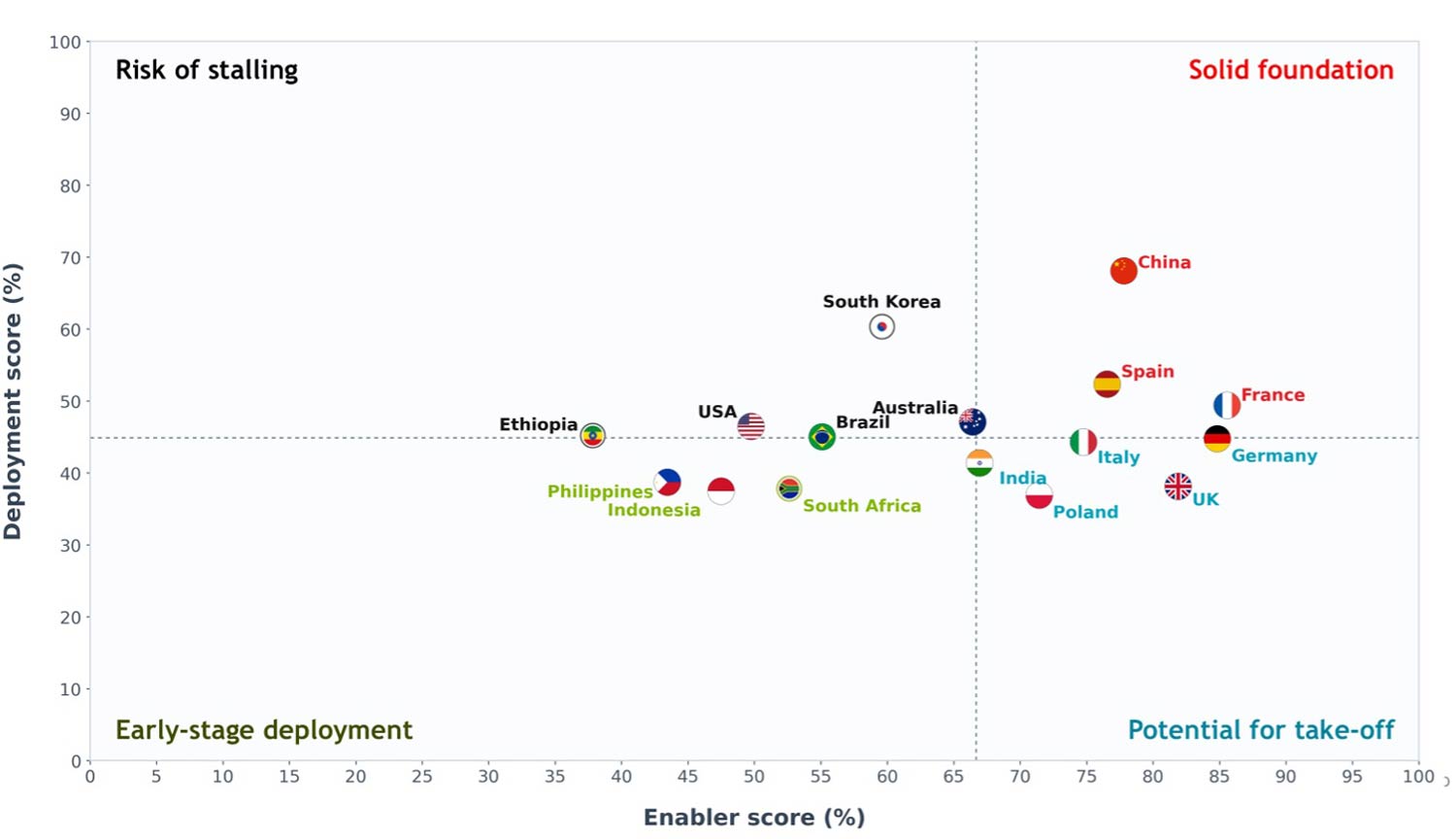
The report points to the Industrial Energy Efficiency Programme (IEEP), concessional loans through the Green Energy Efficiency Fund (GEEF) and tax incentives as strengths. It adds that private renewables, wheeling and power purchase agreements increasingly let industrial users decarbonise ahead of the national grid.
The catch is coal, which still generated 83% of South Africa’s electricity in 2024, according to Stats SA, and the report warns that coal-intensive grid electricity, low reliability, rising costs and slow transmission build-out “limit the competitiveness and emissions benefits of industrial electrification”.
Ethiopia’s lesson
Transport lags badly, with 3/20 for deployment, joint second-lowest with Indonesia and ahead only of Brazil (1/20). The report puts EVs at under 3% of vehicle sales, blaming underdeveloped policies, limited charging infrastructure and import tariffs.
Fully electric cars made up less than 0.2% of 2025 sales among brands that report to the National Association of Automobile Manufacturers of South Africa (Naamsa), Cars.co.za reported. This year looks little different: in June, only one in 123 new vehicles sold was fully electric, TechCentral reported. EVs attract 25% import duty, more than petrol and diesel cars from the EU, which qualify for a preferential 18%.
Ethiopia shows what a policy package can do, albeit in a far smaller car market. Its 2024 ban on imports of petrol and diesel cars, plus duty breaks for EVs, pushed EVs to 60% of new car sales that year, according to the report. The International Energy Agency (IEA), citing Ethiopia’s vehicle licensing authority, puts the figure at about half and notes that estimates vary widely. Yet EVs still make up just under 6% of vehicles on the road, according to government figures cited in a Bloomberg report.
The index recommends EV import duties at or below those on combustion vehicles, something car makers have long demanded.
On grids and power markets, South Africa scores 20/30 for enablers but only 10/30 for deployment, joint lowest with the UK and the Philippines. Grid investment is below 0.4% of GDP, against a sample average of 0.65%.
Still, the report holds up the scrapping of the licensing threshold for embedded generation, announced in 2022, as an example of best practice. Distributed resources now make up about 15% of installed generation capacity, the report notes.
Its prescription: keep unbundling Eskom, meet transmission targets and use the Credit Guarantee Vehicle, a guarantee facility the national treasury is establishing with the World Bank Group, to de-risk private investment in independent transmission projects.
The next priority
In a statement published on 25 September, government said the independent transmission programme reinforces its commitment to mobilising private investment. The final request for proposals is targeted for the second quarter of 2027. Business Leadership South Africa CEO Busi Mavuso has warned that “on the current trajectory, the new grid infrastructure is unlikely to be operating by the end of the decade”.
Skills are another drag: the report calls the workforce “a specific and significant bottleneck”.
“South Africa has taken important steps to reform its electricity sector, opening up opportunities for private investment and allowing more businesses to secure their own power supplies,” said Molly Walton, director of energy at WMBC. “The next priority is translating these reforms into greater transmission capacity, reliable electricity and the skilled workforce needed to support growing demand.”
The report flags “medium” data-quality concerns for South Africa, and notes that its deployment data may lag policy by several years. – © 2026 NewsCentral Media


