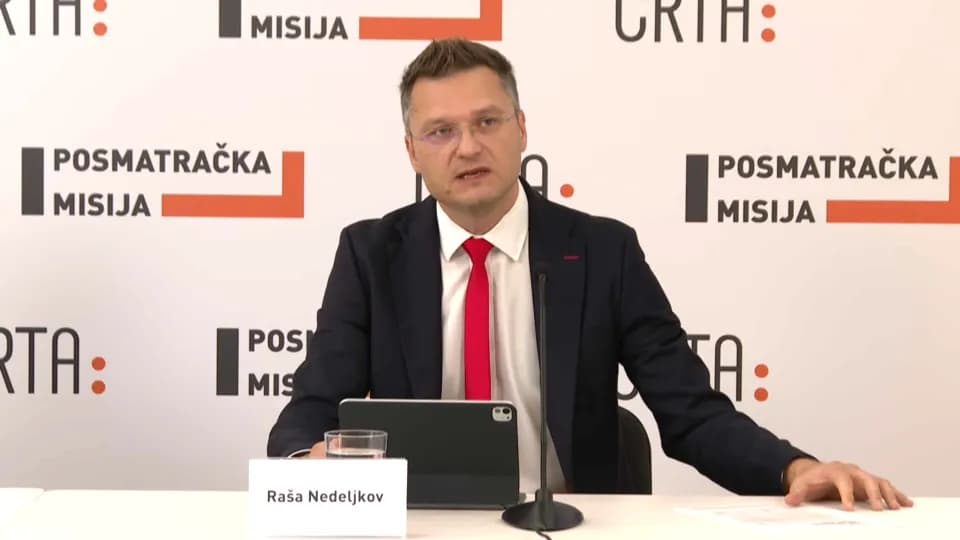

The highest voter turnout in Sunday’s snap parliamentary elections was recorded in Western Serbia, while the largest percentage gap between the “Student List” and “United Serbia” electoral list was achieved in Belgrade, said Rasa Nedeljkov, the Program Director of the Center for Research, Transparency and Accountability (CRTA).
Oglas
Sunday’s results confirmed that the government in Serbia can indeed be unseated through democratic elections despite an uneven playing field, Nedeljkov said, attributing the breakthrough primarily to the massive surge in voter participation.
“Turnout reached 69 percent of the electorate, meaning more than 4.4 million citizens cast their ballots. The highest turnout was recorded in Western Serbia at 70.5 percent, followed closely by Vojvodina at 70.2 percent. Turnout in Belgrade stood at 70 percent. It was slightly lower in Central Serbia at 67.2 percent, and 66.9 percent in the south, while the lowest turnout was in Eastern Serbia at 64.1 percent,” he noted.
This impressive wave of engagement was driven by widespread citizen mobilization and a shifting socio-political climate over the past two years, he added.
According to data available to CRTA, the “Student List – Students Win” won at least half a million more votes than the runner-up coalition, which stagnated at its December 2023 election levels.
“The Student List won 52.45 percent of the vote and will hold between 136 and 140 seats in the Parliament, which is enough to form a government independently. The Aleksandar Vucic - United Serbia list won 39.2 percent of the vote and will have between 101 and 105 seats,” he said.
How election day unfolded
Systemic manipulation at polling stations was largely kept in check because an unprecedented number of citizens trained themselves to monitor and secure the voting process directly on the ground.
“For the first time, polling boards were staffed with well-prepared representatives, which effectively choked off many potential irregularities. Because of this, our observers noted constant friction and tension between board members, primarily debating procedural rules. The most widespread violation this time involved voters photographing their ballots - occurring practically at every other polling station,” Nedeljkov said.
He also cited issues with verifying voter identities, inconsistent use of UV lamps and sprays, discrepancies in the voter registry, and direct pressure exerted on polling boards.
“Restoring electoral integrity must be a top priority for the incoming legislative and executive authorities. Serbia must never again hold an election marred - even to a lesser extent - by the blatant abuse of public resources and institutional dysfunction,” Nedeljkov warned, adding that presidential elections must be called no later than November 27 of this year.
Nedeljkov appealed to political figures still serving as acting officials to immediately announce their plans to the public, warning them not to again hold the country hostage again “as another tactic in election engineering.”
“These elections were still fought using a highly contested voter register because a comprehensive audit was systematically blocked by captured and deeply compromised institutions. Although widespread systemic manipulations of the register were not recorded on election day itself - as seen in the 2023 parliamentary and Belgrade races - CRTA received multiple reports of voters who were unlawfully transferred to vote in Bosnia and Herzegovina, North Macedonia, Montenegro, and Austria without their consent. We also encountered numerous unexplained cases of people whose names had vanished from the voter rolls entirely,” he explained.
More signatures than votes - “pure Corruption”
The fact that more than half of the competing electoral lists won fewer total votes than the number of verified support signatures required to get on the ballot reveals the normalization of systemic electoral engineering across recent cycles, he pointed out.
“If I may take the liberty to translate this euphemism into a language we can all understand: this is pure corruption. Pure corruption and the manipulation of the electorate, involving fake candidate lists and, in some cases, phantom voters, all designed to manufacture an artificial advantage for a single political structure,” Nedeljkov said.
He concluded by extending his gratitude to all independent observers, NGOs, journalists, and free media outlets.
Teme