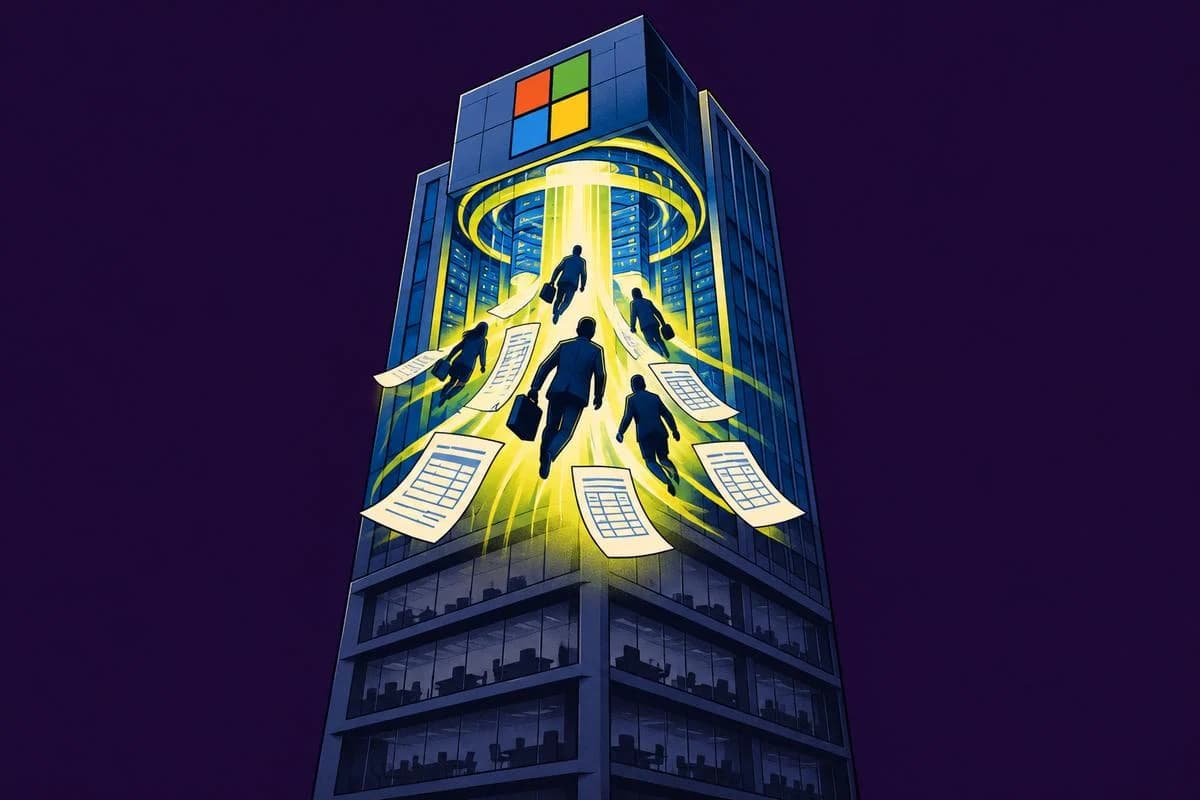
Microsoft is offering voluntary buyouts to approximately 60,000 employees worldwide as it redirects capital toward artificial intelligence. The offer reaches a group equivalent to about 27% of its workforce, but it is not a confirmed tally of departures. Microsoft’s AI investment strategy also draws a line around teams it wants to protect, including data center and AI infrastructure staff.
Key takeaways
- Buyout eligibility covers selected teams in four countries.
- Some data center, sales and marketing employees are excluded.
- Microsoft is directing resources toward Azure and enterprise Copilot.
- Shares gained 1.1% following the announcement.
Who qualifies for Microsoft’s voluntary buyouts?
The offer applies to selected employees at vice president level and below in the U.S., Canada, India and the UK, a Microsoft spokesperson said. The approximately 60,000 eligible workers represent about 27% of the company’s 223,000-person workforce recorded in June.
Eligibility is selective rather than company-wide. The spokesperson said certain employee groups, including some working in data centers, sales and marketing, are excluded from the program.
Microsoft is reducing headcount elsewhere while protecting data center and AI infrastructure teams. The voluntary offer’s scope should therefore be distinguished from the number of employees who ultimately leave.
Microsoft’s AI investment prioritizes infrastructure and products
Microsoft is positioning the workforce reduction as capital reallocation toward AI rather than a defensive cost-cutting exercise. Lower payroll spending is intended to free resources for artificial intelligence infrastructure and products.
The investment focus includes Azure cloud services and enterprise Copilot applications, including dedicated AI instances in Azure and enterprise Copilot seats. Microsoft’s strategy places greater weight on specialized AI talent and infrastructure than on general headcount.
The financial objective is operating-margin expansion through lower costs and growth in AI-driven revenue. That outcome is conditional on execution: reducing payroll alone is distinct from generating additional revenue through Azure, Copilot and enterprise applications.
Shares rise as attention turns to margins
Microsoft shares rose 1.1% to $530.38 following the announcement on October 26, 2026, compared with a 0.8% increase in the S&P 500.
The financial questions surrounding Microsoft’s AI investment include the cost of severance, the capital released for AI spending and the trajectory of operating margins. The January 30 earnings call is identified as the next checkpoint for those figures and management’s margin guidance.
Article produced with the assistance of artificial intelligence and reviewed by the editorial team.