
Watching Québec solidaire’s swearing-in ceremony at the national assembly last week, one could easily have believed that the party had just achieved the best electoral result in its history.

Enjoy the latest local, national and international news.
- Exclusive articles by Conrad Black, Barbara Kay and others. Plus, special edition NP Platformed and First Reading newsletters and virtual events.
- Unlimited online access to National Post.
- National Post ePaper, an electronic replica of the print edition to view on any device, share and comment on.
- Daily puzzles including the New York Times Crossword.
- Support local journalism.
Create an account or sign in to continue with your reading experience.
- Access articles from across Canada with one account.
- Share your thoughts and join the conversation in the comments.
- Enjoy additional articles per month.
- Get email updates from your favourite authors.
Create an account or sign in to continue with your reading experience.
- Access articles from across Canada with one account
- Share your thoughts and join the conversation in the comments
- Enjoy additional articles per month
- Get email updates from your favourite authors
Sign In or Create an Account
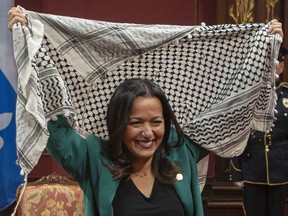
The atmosphere was festive. Its supporters were celebrating as if they were only a couple of seats away from forming a government. At one point, Québec solidaire Co-Leader Ruba Ghazal grabbed a keffiyeh from her former colleague, Manon Massé, and proudly waved it in front of the cameras in a weird celebratory pose.
Yet, looking at the results of the Oct. 5 election, we can wonder what exactly there was to celebrate for Québec solidaire (QS). It’s the second consecutive election in which QS has lost popular support. It also lost two seats, leaving the party with nine MNAs.

Columnist Jesse Kline keeps you up to date with what’s happening in Israel and the effects of antisemitism on life here in Canada. Friday mornings.
By signing up you consent to receive the above newsletter from Postmedia Network Inc.
A welcome email is on its way. If you don't see it, please check your junk folder.
The next issue of Channel Israel will soon be in your inbox.
We encountered an issue signing you up. Please try again
The reality is that Québec solidaire remains a party with an extremely limited electoral reach. Outside of Montreal, downtown Quebec City and some university campuses, the party has no realistic chance of winning any middle-class, predominantly francophone riding. And a lot of it has to do with the fact that QS seems far more interested in remaining an activist movement than becoming a serious political party that can seriously aspire to govern Quebec.
The keffiyeh incident is a good example. Ghazal defended her behaviour by saying that she has Palestinian origins and that it was a way to show her love for Quebec, a society that welcomed her family, and many others, as refugees. But was the swearing-in ceremony really the appropriate moment to take a stand on a foreign cause that is far from the top of most Quebecers’ daily concerns?
This it is not the first time that Québec solidaire’s tendency to favour ideological activism over political judgment has surfaced. In November 2024, Haroun Bouazzi, then a QS MNA, created a major controversy when he suggested that, every day at the national assembly, he was witnessing racism towards Muslims, Black people, Indigenous people and North Africans.
And last week, Ghazal gave us another example of this political mindset: speaking about the violent riots that are taking place in France, she argued that the anger of young protesters was understandable and that to prevent this from happening in Quebec, we have to spend more on public services.
Once again, Québec solidaire seemed more concerned about defending an ideological narrative than improving the lives of Quebecers. And this problem seems to go well beyond QS. Progressive parties throughout the western world seem to be following the same ideological script, regardless of the country they are supposed to represent and the issues they face at home.
We see them chant the same slogans, defend the same international causes and engage in the same ideological battles. It has become somewhat predictable. Whenever a new controversy emerges somewhere in the world, you can expect them to take up the cause and try to turn it into a political battle at home, even if it has nothing to do with them.
I’m not saying we shouldn’t be concerned about international affairs. Geopolitics reshapes the world we live in and impacts us all. But we can wonder whether these political movements are still capable of understanding the concerns of the ordinary people they claim to represent, as it’s clear that the average Quebecer is not spending his days debating the latest intersectional controversy coming out of an American university or the latest protest movement getting traction somewhere in the world.
Instead, he wants to know why, despite paying some of the highest taxes in North America, he still struggles to get decent public services. He wants to keep more of his hard-earned money. He wants to be able to buy a home, to raise his family peacefully and hopefully leave his children a better life than the one he inherited. Those are the kind of concerns that ordinary people want their politicians to care about.
To be fair, Québec solidaire has proposals on housing, affordability and public services. But it’s one thing to discuss these issues in an election platform, it’s more difficult to convince Quebecers that you embody their down-to-earth priorities when you so often appear more interested in ideological purity and international activism.
Former QS co-leader Gabriel Nadeau-Dubois seemed to understand this reality. Before leaving politics, he attempted a pragmatic shift within Québec solidaire, arguing that the party needed to broaden its base to become a credible governing alternative. Unfortunately for him, activists within the party resisted, which helped lead to his resignation.
In her leadership race, Ghazal openly advocated a return to the party’s progressive roots. Judging by the results of the last election, that decision has done very little to convince Quebecers outside of the party’s traditional electoral base.
At some point, Québec solidaire will have to decide whether it wants to become more than a political movement that speaks exclusively to its own activists. Otherwise, it will continue to struggle to escape its role as a permanent third party. Yet judging by last week’s celebrations, that does not seem to bother its supporters very much.
National Post
Join the Conversation
This website uses cookies to personalize your content (including ads), and allows us to analyze our traffic. Read more about cookies here. By continuing to use our site, you agree to our Terms of Use and Privacy Policy.