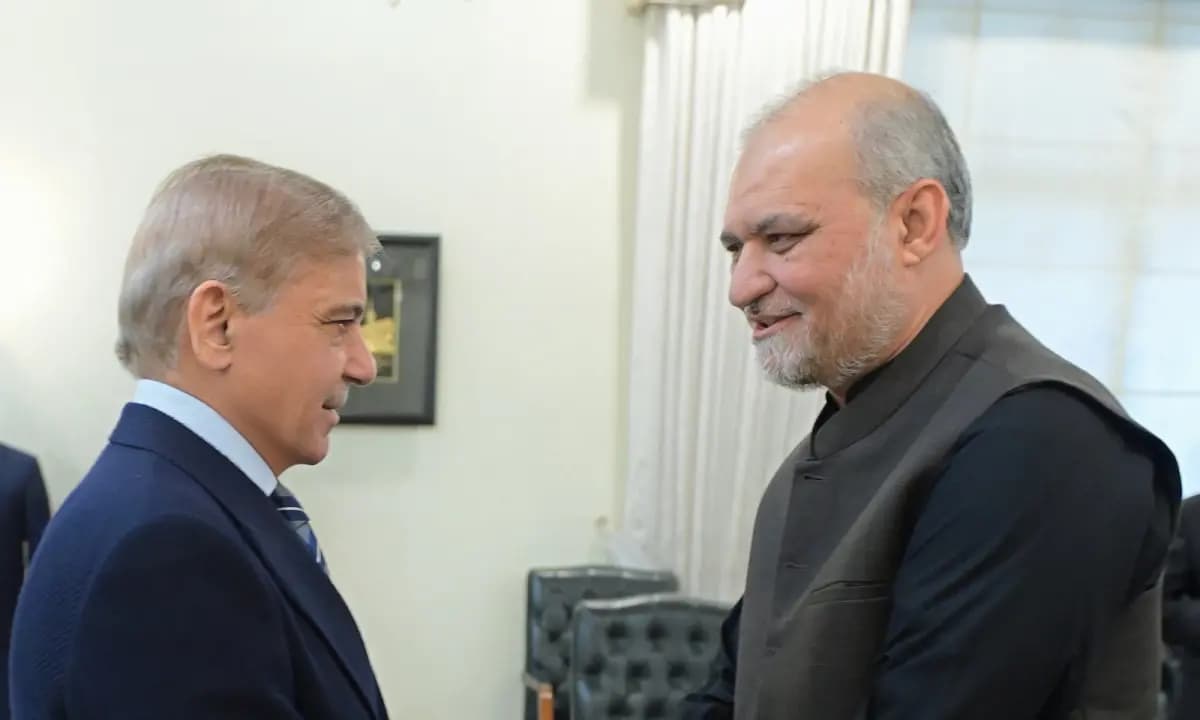
The government and Jamaat-i-Islami (JI) on Tuesday decided to form a joint committee to recommend proposals for expanding the ongoing fuel relief scheme, while JI warned of marching to Islamabad next month if no relief “package” was announced by then.
The decision was made during a high-level meeting between Prime Minister Shehbaz Sharif and JI chief Hafiz Naeemur Rehman at the PM House, according to a press release issued by the PM Office (PMO).
The meeting was offered by PM Shehbaz last month when urging JI to postpone its Islamabad march, which it had accepted. JI has been demanding the abolition of the petroleum levy to reduce the burden of heightened fuel prices on the public.
Tuesday’s meeting decided that a committee, comprising three members each from the government and JI, will present final recommendations on the following two measures:
- Expansion of the scope of the ongoing relief scheme on petrol for the public so that the maximum number of deserving people can benefit from it
- Preparation of feasible proposals for the budget for a phased reduction in the petroleum levy
Deputy Prime Minister and Foreign Minister Ishaq Dar, Planning Minister Ahsan Iqbal and the PM’s political adviser Rana Sanaullah will represent the government in the joint committee, PMO stated.
The premier informed the JI delegation in detail about the relief provided so far by the government in the petroleum products quota for the low-income segment, noting that 12.7 million people have registered in the subsidy scheme so far.
The relief scheme for owners of motorcycles, rickshaws and vehicles of up to 800cc was rolled out across the country on Sept 17. PM Shehbaz had announced the subsidies to ease the public’s burden amid rising fuel prices due to the Middle East situation.
During the meeting, the prime minister conveyed to JI that he “fully understands the burden on the public due to the increase in prices of petroleum products”, PMO said.
He highlighted the government’s effort to provide relief through the subsidy scheme and asserted that Islamabad was “making all-out diplomatic efforts to resolve the regional crisis so that the situation can return to normal”.
“The current crisis is not related to government policies but to the increase in oil prices in view of regional and international situations. However, according to financial capacity, the government is providing relief to the public and will continue to do so,” he was quoted as saying.
The prime minister thanked JI for adopting the path of negotiations regarding the prices of petroleum products. PMO noted that the JI delegation “expressed its stance on the abolition of the petroleum levy and relief for the public”.
JI Deputy Emir Liaquat Baloch, Deputy Secretary General Syed Farasat Shah, Islamabad Emir Nasrullah Randhawa and Inayatullah were also part of the party delegation.
From the government, Dar, Iqbal, Sanaullah, Economic Affairs Minister Ahad Khan Cheema, Finance Minister Muhammad Aurangzeb, Petroleum Minister Ali Pervaiz Malik, and Minister of State for Finance and Railways Bilal Azhar Kiani were also present.
‘Cannot simply accept peanuts’
In his press conference in Islamabad, the JI chief affirmed that his party will not postpone its march any further.
He stated: “It will now take place in mid-November, and it certainly will take place. Let them announce this package, provide this relief, and devise a mechanism to abolish this extortionate levy before that, [but] if they do not do so, we might have to sit on the road to talk.
“We are prepared for anything,” Rehman declared.
Asked about the outcome of his meeting with PM Shehbaz, the JI emir refrained from terming it “inconclusive”.
He noted that two sides had consensus on expanding the scope of relief, but there were disagreements over the “modalities” and “procedure”.
“We say eliminate the levy; they say we can move towards it phase by phase,” Rehman elaborated.
Rehman, apparently referring to the new joint committee, said Baloch, Shah and Randhawa would be part of it.
“We cannot simply accept peanuts,” the JI chief said when asked about a reported government offer to reduce the levies by Rs20-30. He stressed that his party stood firm on its stance.
He maintained that JI would continue its preparations and would begin nationwide mobilisation for its planned march to the federal capital, while negotiations would also continue at the same time.
“Our preparations are already complete; we will prepare further [and] we will talk to them (the government) further. However, we will also hold the Islamabad march in mid-November,” Rehman said.
Asked whether JI had presented any alternative to abolishing the levy, he responded in the affirmative, asserting that his party had comprehensive preparations.
Rehman highlighted that all past governments vowed not to take loans from the International Monetary Fund (IMF) but then entered into programmes with it after coming into power.
He said his party pointed this out, adding, “Give relief to the people; do not take retribution for your incompetence from the nation.”
Providing details of his party’s demands, the JI chief said it had also raised the issue of refineries’ margins increasing as well when oil prices rose in the international market.
“That should have decreased, people should have gotten relief,” he said.
Rehman acknowledged that JI was aware of the fluctuations in international oil prices due to the ongoing conflicts in the Middle East, but “we want relief to be provided to the people in this regard as well, and this levy should also be abolished alongside”.
He went on to claim credit for the relief scheme launched by the government in mid-September. “If Jamaat-i-Islami was not protesting, do you think this relief package would have come?”
Rehman further said, “We have restrained them a little by continuing to push, by taking a stand, stepping onto the field and protesting; otherwise, it is easy money that you just take advantage of this opportunity.”
The JI emir recalled that in April, the government had hiked the levy on petrol to Rs160 per litre from Rs105, but widespread criticism prompted it to reduce the levy by Rs80.
“It is JI that has raised awareness, protested, and built pressure,” he claimed.
Iqbal calls for ‘durable, sustainable path’
After attending the meeting, Iqbal and Sanaullah addressed a press conference and assured the public that the government wanted to ease the burden of the fuel prices.
“The prime minister and JI emir agreed that they share one purpose and intent: they want to reduce the difficulties of the public,” Iqbal said.
“However, for this, we will have to adopt a path that is durable, sustainable, and the cost of which we can afford.”
The planning minister expressed hope that the committee would be able to work together on the topics to find a solution to these issues.
Simultaneously, while acknowledging that every political party had a right to protest, he stressed that the regional conditions warranted that everyone maintain peace and internal stability in the country.
Iqbal assured the public that the government was aware that the increase in international oil prices, and the consequent fuel price hikes, affected ordinary citizens.
He emphasised that PM Shehbaz was “continuously concerned about how to reduce the difficulties of the most affected and vulnerable classes” and said the soaring costs were a result of a global crisis that was not in the government’s control.
The minister stressed that Pakistan was playing its diplomatic role in resolving the Middle East crisis, including facilitating negotiations between the US and Iran, so that reduced regional tensions could lower global oil prices and the relief could be passed on to the public.
The PML-N leader went on to take a jibe at the previous PTI government, saying it reduced fuel prices for “cheap popularity” even as international oil prices rose, bringing the country to the brink of fiscal default.
He contended that if a government made decisions merely to hype its popularity among the masses, that irresponsibility could come back to it as a “nightmare”.
Therefore, he added, the government, including the prime minister, wanted to help people as much as possible “while staying within our resources”.
Addressing the media alongside Iqbal, Sanaullah said, “The government, to whatever extent possible, is providing relief to the common man, the poor man, and is trying to advance it further.”
He said the number of people benefitting from the fuel subsidy scheme was likely to reach 20m in the coming days.
He appreciated the JI’s efforts and its belief that the common man should be provided relief, stressing that this relief should be taken forward “in such a manner that it is targeted, and that maximum relief be given to those people who deserve it more”.
At the same time, Sanaullah urged all political parties to strengthen the position of Pakistan’s military and political leadership, and to create an environment that lent strength to the efforts made by PM Shehbaz and Chief of Defence Forces and Chief of the Army Staff Field Marshal Asim Munir to end the US-Iran conflict, as well as to maintain good relations within the Muslim world.
He called for “complete solidarity and complete unity” in the country “so that Pakistan can succeed in playing an effective role in the world”.
“It is our hope, and indeed our belief, that the Jamaat-i-Islami leadership, keeping in view these delicate and sensitive matters, will certainly play their role,” he said.
The PML-N leader emphasised that the government had listened to the JI’s suggestions “very carefully” and held the talks with “complete sincerity of intention and good faith” so that the current relief could be made more effective.
JI protests so far
The JI has been demanding for over two months that the Centre abolish petroleum levies, as fuel prices have skyrocketed due to conflicts in the Middle East since March.
The Centre and JI had agreed to form committees in early September — when the latter had planned a nationwide strike — to recommend measures to reduce the levy.
Rehman on Monday warned that the party would march to Islamabad in mid-November if the premier did not abolish the petroleum levy.
On Aug 16, the JI announced sit-ins in all the provincial capitals of Pakistan against the petroleum levy and had called for a nationwide strike on Sept 3.
On Sept 20, the party launched a protest march towards Islamabad, warning that if the government failed to abolish the petroleum levy, the protest could turn into one to oust the government.
On Sept 22, the JI emir said his party, whose convoy had reached Multan, was postponing its long march at the request of PM Shehbaz, who had assured the other side of a meeting to discuss the matters.
However, in a press release issued last week, the party alleged that the government had made no further contact regarding the planned meeting.