
By: Steven Grattan, The Associated Press Posted:
TUTUBUKA, Suriname (AP) — Deep in Suriname’s rainforest, a group of Saamaka men hacking their way up a forested mountain discovered an abandoned excavator and logging camps in an area they believed should have remained untouched.
Read this article for free:
To continue reading, please subscribe:
*Billed as $5.77 plus GST every four weeks. After 52 weeks, price increases to the regular rate of $19.95 plus GST every four weeks. Offer available to new and qualified returning subscribers only. Cancel any time.
TUTUBUKA, Suriname (AP) — Deep in Suriname’s rainforest, a group of Saamaka men hacking their way up a forested mountain discovered an abandoned excavator and logging camps in an area they believed should have remained untouched.
Read unlimited articles for free today:
TUTUBUKA, Suriname (AP) — Deep in Suriname’s rainforest, a group of Saamaka men hacking their way up a forested mountain discovered an abandoned excavator and logging camps in an area they believed should have remained untouched.
The discovery highlights growing threats to one of the world’s most heavily forested countries, where roads, logging and gold mining are pushing deeper into largely intact rainforest.
Saamaka communities are fighting back with satellite images, GPS mapping and forest patrols, documenting areas they have protected for generations in hopes of securing government recognition of their traditional forest management system.
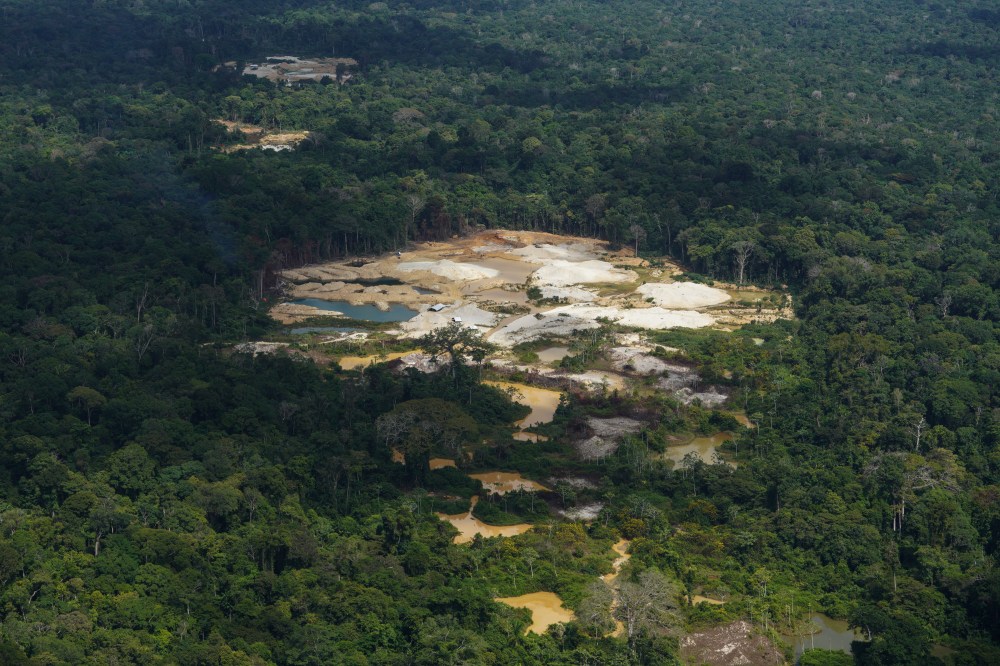
The Associated Press accompanied community patrols and a helicopter flyover to see how the Saamaka are responding to the incursions.
Here are takeaways from AP’s reporting:
Suriname’s largely intact forests face growing pressure
Suriname, a small South American country of about 650,000 people, remains roughly 93% forested. Its forests absorb more greenhouse gases than the country emits, making it one of the world’s few carbon-negative countries.
But expanding roads are opening previously inaccessible areas to logging and gold mining. Tribal territories have lost nearly 154,000 hectares (380,500 acres) of forest since 2001, roughly twice the size of New York City.
During a helicopter flyover, the AP witnessed new roads and clearings pushing into largely intact forest. The damage was less extensive than in parts of neighboring Amazon countries, but offered signs of expanding development in Suriname’s interior.
Saamaka communities combine traditional knowledge with modern technology
For generations, Saamaka clans have governed how their forests are used through traditional agreements, setting aside areas for farming while protecting others for their spiritual, cultural or historical importance.
Now, communities are mapping those traditionally protected areas under an initiative called Apaki, named after a container made from dried calabash fruit traditionally used to preserve food. Just as the container keeps food safe, the initiative aims to safeguard the forest for future generations and strengthen the case for government recognition of their traditional forest management system.
Satellite images help identify suspicious clearings and roads, while GPS mapping, forest patrols and helicopter flyovers allow communities to document incursions on the ground. Young people are also being trained to collect evidence that can support complaints and legal action.
The aim is to document a forest management system that has existed for generations and strengthen the case for its formal recognition by the government.
A landmark land rights ruling remains largely unfulfilled
In 2007, the Inter-American Court of Human Rights ordered Suriname to recognize the Saamaka’s collective land rights after ruling that the government had violated their property rights by granting logging and mining concessions on their traditional territory.
Nearly two decades later, Saamaka leaders say key parts of the ruling remain unimplemented, leaving communities without the legal authority to control development on their land.
John Goedschalk, an adviser to Suriname’s president, said the government is updating its legal framework to allow community-protected areas to be formally established. He also said the president had imposed a moratorium on new gold mining concessions and extensions.
But defending the forest carries risks. Hugo Jabini, managing director of the Association of Saamaka Communities, said he received a death threat earlier this year after communities challenged a mining concession near a protected forest area.
For Navaldo Vola, 31, who helped lead the forest patrol, the fight is about preserving the forest for future generations.
“This is our wealth and this is what we are fighting for,” he said. “Maybe a thousand generations from now, this must still be here like how our ancestors left it for us.” ___
Follow Steven Grattan on Instagram: @steven.grattan.
___
The Associated Press’ climate and environmental coverage receives financial support from multiple private foundations. AP is solely responsible for all content. Find AP’s standards for working with philanthropies, a list of supporters and funded coverage areas at AP.org.
- Read Later