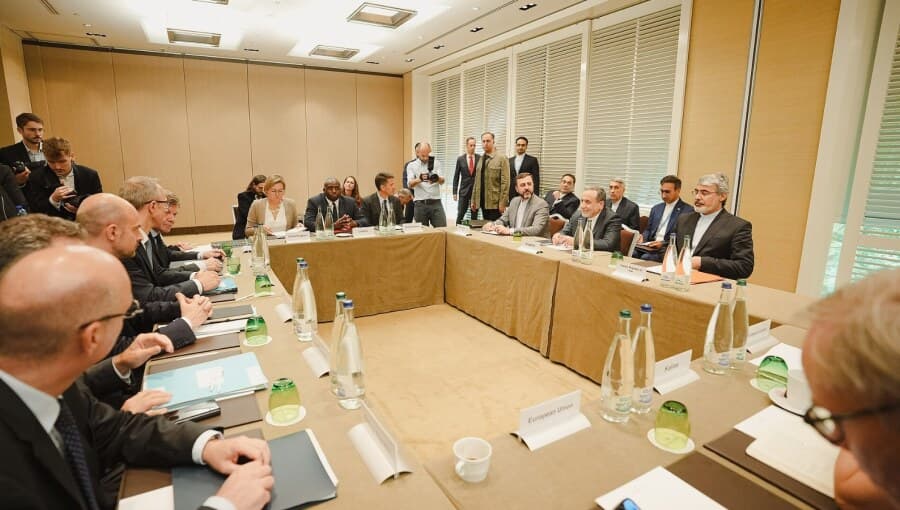
Germany, France and Britain are weighing a two-stage proposal for Tehran and Washington that would trade a deal on the Strait of Hormuz for talks on the nuclear programme, Iran's Borna news agency reported on October 25.
The first stage would aim to reopen the strait and lift some maritime restrictions, Borna said, citing published reports. The second would revive nuclear negotiations on the principles of the 2015 deal, which current American President Donald Trump walked away from in 2018, claiming he could get a better deal than his predecessor, Barack Obama.
If the European governments could clinch a deal, it would mean time-bound limits on uranium enrichment, International Atomic Energy Agency (IAEA) inspections, partial sanctions relief and a decision on Iran's frozen assets.
In return for Iran's steps, part of the sanctions would be lifted and the US blockade fully dismantled, under a mechanism modelled on the 2015 agreement. Trump pulled the US out of that deal in his first term.
Tehran was cool on the idea, according to local reports on officials commenting on the backchannel talks between the governments.
Deputy Foreign Minister Saeed Khatibzadeh told reporters on October 25 that European states had made "wrong choices" in recent months and were living with the consequences. He said Europe must distance itself from US and Israeli actions in the region before anyone could speak of a different Europe.
The three countries triggered the UN snapback mechanism last year, which still colours Tehran's view of their mediation. Living costs in Europe are pushing the other way.
UK Foreign Secretary Ed Miliband said on October 23 that Britain was "redoubling" diplomatic efforts because the war was driving up household bills.
Foreign ministers from Europe and the region met in Istanbul on October 23 and warned against a new strike on Iran.
Iran's foreign ministry spokesman Esmaeil Baghaei said US Secretary of State Marco Rubio had accused Iran of what Washington itself takes pride in, piracy, in a post on X late on October 25.
Rubio had accused Iran of attacking merchant ships, saying the world had seen nothing like it "since World War Two and the era of the Caribbean pirates", Baghaei wrote. Earlier in the week Rubio compared Iranian threats to shipping with Nazi Germany's submarine campaign.
Baghaei pointed to remarks by US President Donald Trump on May 1, when Trump described the seizure of a commercial ship and its oil cargo during the US naval blockade of Iranian ports. "We're like pirates. We're sort of like pirates but we are not playing games," Trump said at the time.
"The president may not be too pleased to learn that his secretary of state has so quickly forgotten that boast of being a pirate," Baghaei wrote.
Tehran has framed the seizures as theft from the start, denouncing two tanker seizures as piracy. It has also defended its own Hormuz blockade and tanker strikes as lawful self-defence, while strikes on tankers have put Iran's army on its highest alert.
The exchange came as Islamic Revolutionary Guard Corps (IRGC) spokesman Hossein Mohebbi answered the head of US Central Command, Admiral Brad Cooper, on X. "This is the reality on the ground," Mohebbi wrote, without giving further detail.
Cooper flew over the Strait of Hormuz on October 25. He said its main transit routes "remain free and clear of Iranian sea mines". Central Command said US forces had helped Gulf states export more than 1.5bn barrels of crude since the summer.