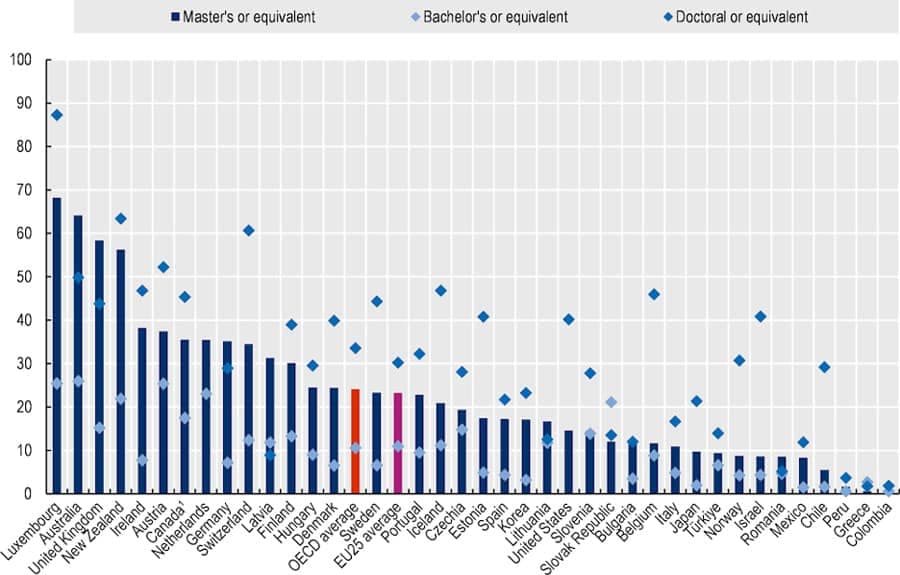
New indicators from the Organisation for Economic Co-operation and Development (OECD) highlight the risk to economies of curbing international student numbers through sweeping policies. The organisation’s “Education at a Glance 2026” report shows that international students are much more likely than in the past to be pursuing advanced degrees, and they are more likely than domestic students to enrol in STEM programmes. These trends are increasingly important, especially for host countries with ageing populations and declining domestic enrolments.
Proportions of foreign students in advanced degree programmes are very high in several countries
On average across OECD countries in 2024, international students represented 11% of all new entrants to tertiary studies at the bachelor’s level, 24% at the master’s level, and 34% at the doctoral level.
Luxembourg and New Zealand stand out for the huge proportion of international students in their master’s and doctoral programmes. Of new entrants at the master’s level, 68% and 56% are international in Luxembourg and New Zealand, respectively. At the doctoral level, the proportions are even higher: 87% and 63%, respectively. Switzerland is also notable: 6 in 10 international students in Swiss universities are studying at the doctoral level.
Otherwise, Australia, Canada, and the UK enrol more foreign students at the master’s level than the OECD average, as do Ireland, Austria, the Netherlands, Germany, and Switzerland. The US is below the all-country average for the proportion of master’s students in its overall international student population.
Joining Luxembourg, New Zealand, and Switzerland in above-average proportions of foreign doctoral-level students are Australia, Canada, Ireland, Austria, Finland, Denmark, Sweden, Iceland, Estonia, Belgium, and the US.
Foreign students are often more likely than domestic students to be in STEM programmes
On average across the OECD, 30% of international students graduated with a STEM degree, versus 23% of domestic students. This ratio intensifies in the US (53% foreign, 20% domestic), Denmark (46% vs 23% domestic), and Iceland (37% vs 15%).
The OECD notes: “As doctoral-level research is heavily concentrated in STEM disciplines, [international] students play a critical role in supporting long-term research and development capacity and mitigating the impact of ageing populations on the future supply of high-level skills.”
New trends since the 2023/24 OECD data
The OECD’s “Education at a Glance” series is an extremely comprehensive research exercise whose findings cannot help but be slightly dated given that they require (1) a common year of comparable data across 38 member countries and (2) in-depth analysis and reporting based on that data. The tracking over time is what is the most valuable about the series, especially since the initiative began as far back as 1992. Each year of publication, then, serves as a reference point against previous benchmarks.
The 2026 report is based on 2023/24 data. That reference year coincides with:
- Big Four governments beginning to retreat – through new policies – from a relatively open doors approach to welcoming international students;
- Other countries – including Germany, France, South Korea, and Japan – moving in the opposite direction, i.e., enacting new policies and initiatives to welcome more students.
As such, the latest OECD indicators reflect a point in time when foreign enrolments in the Big Four hadn’t yet begun to be affected by more restrictive policies. Since then, policies have prompted many top-tier international students – including at the master’s and postgraduate levels – to choose to study or work in other countries. This represents a loss, or potential loss, of advanced STEM talent in the four destinations.
US: Talent magnet is losing power
As noted earlier, the OECD’s Education at a Glance data shows that the US was a STEM talent magnet in 2023/24. Since then, this position has weakened.
In September 2026, there were -13.8% fewer active F-1 and M-1 visa records for master’s-level students in SEVIS than in September 2025, and -7.7% fewer records for international students in STEM fields. Active SEVIS records do not indicate trends in new visa holders – we can expect that data soon – but as F1Jobs.io notes: “The master’s-to-OPT-to-H-1B [study-to-work pipeline] is the main route for international STEM hiring and it is the segment that shrank the most.”
The Council of Graduate Schools’ flash survey (August 2026) of 99 research institutions found that international applications for both US master’s and doctoral programmes beginning in fall 2026 were down significantly. The survey also revealed a growing trend of accepted students declining offers of admission, with 43% of respondents stating that students declined offers because of concern about the current instability of funding of graduate education in the US. Further:
- 82.6% of graduate schools reported longer visa processing for their admitted students;
- 60% reported that current international graduate students expressed concern about OPT being removed;
- 75% said that both admitted and current international graduate students have expressed concerns about their US visa status or about deportation.
Separately, a survey of 55 US research institutions by the Association of American Universities Data Exchange (AAUDE) found that compared with fall 2025, -21% fewer international PhD students applied for the fall 2026 intake and 15% fewer were admitted.
At present, the US government is moving to restrict enrolments in the popular post-study work programme, Optional Practical Training (OPT). To understand how restricting OPT would disrupt the flow of foreign STEM talent into the US, consider that:
- More than half (57%) of all international students in the US were in STEM programmes in 2024/25 (64% at the graduate level), and more than half of those students go on to OPT;
- More than half (54%) of current international students surveyed by NAFSA and the Institute for Progress in 2025 said they would not have chosen the US if there had been no OPT option.
If it becomes too difficult for most STEM students to participate in OPT, those students will leave the US after their studies, taking with them their talent and skills. The implications of this are significant. A 2024 study by the Semiconductor Industry Association and Oxford Economics projects that by 2030, the US will be short about 1 million computer scientists, 270,000+ engineers, and 100,000+ technicians. A main reason for the predicted shortage is “a problem of insufficient numbers of US students pursuing science, technology, engineering, and mathematics (STEM) fields.” As the study notes, international STEM students are vital to filling STEM labour force gaps, and if they go home instead of remaining, “growing the domestic pipeline of US-citizen students pursuing advanced degrees in STEM fields will take years or decades to bear fruit.”
Canada: The cap that went too far
In 2024, Canada introduced a cap on new study permits that was primarily intended to affect international student recruitment at private colleges and some universities. But its design has resulted in much broader consequences. For example, in 2025, international master’s and PhD students were included in the cap. Not coincidentally, -46% fewer study permits were granted to master’s-level students for the period January-to-September 2025 (15,390) than in January-to-September 2024 (28,605) – whereas the government’s 2025 target for study permit issuances for graduate level students had been over 73,000.
Along with many other Canadian institutions, Canada’s top-ranked research universities lost talent at the graduate level at least in part because of the cap itself or the way it was perceived overseas. For example:
- The University of Toronto’s (U of T) graduate enrolments in fall 2025 were down -9% compared with fall 2024 and at their lowest level since 2021. Coincidentally or not, U of T’s position in the QS University World Rankings fell from #21 in the 2024 edition, to #25 in 2025, to #29 in 2026, and finally to #32 in 2027.
- The University of British Columbia’s graduate enrolments fell by -10% between 2023/24 and 2024/25. Relatedly or not, UBC’s QS ranking declined over four consecutive years from #34 in the 2024 edition to #45 in 2027.
- And McGill University’s international graduate enrolment fell by -17.5% in fall 2025 versus fall 2024. The university fell from #27 in the 2026 QS rankings to #30 in the 2027 edition.
Current Canadian Prime Minister Mark Carney was elected in April 2025. By November of that year, his government had recognised the danger posed by the cap’s inclusion of master’s and doctoral students and took action. As of January 2026:
- Master’s and doctoral students studying in public universities are exempted from the cap;
- The spouses of students pursuing master’s programmes of at least 16 months and students in doctoral programmes can receive an open work permit;
- Immigration, Refugees and Citizenship Canada (IRCC) has moved to streamline study permit processing for doctoral candidates, with a service standard to issue decisions within 14 working days.
The effect of the policy reversal was immediate: the number of study permits granted to master’s and PhD students doubled in Q2 2026 (6,455) over Q2 2025 (3,085). UBC reports that international graduate student applications have increased by +15% in 2026, with an accompanying +30% increase in applications for doctoral studies. Similarly, McGill increased its intake of international students in advanced degrees by +14%.
UK: Funding for research at risk
As of January 2024, international students in “taught master’s” programmes, a category which accounted for the bulk of graduate enrolments in the UK at the time, were prevented from bringing family members with them while studying in the UK. This rule is a main reason that international student numbers are falling in the UK, as shown in the chart below. Readers will note that it is the postgraduate taught master’s level where (1) most international students are concentrated and (2) commencements have fallen the most.

The decline in international taught master’s commencements (and enrolments) naturally means a reduction in international student tuition fees for those courses. This is having a major impact on UK universities’ research funding and capacity. In 2026, 31% of universities surveyed by Universities UK said they had cut academic research activity in the past three years. That is more than double the proportion reporting the same just two years earlier in 2024 (14%). In addition, the 2026 survey found that 46% of universities had reduced their course offering through consolidation, and 44% had closed courses entirely.
Australia: Commencement data holds warning signs
In the first half of 2026, international higher education commencements in Australian taught master’s courses fell by -10%. This category has for many years accounted for almost a quarter of all international enrolments in Australia. Unlike research master’s and PhDs, taught master’s programmes are not protected in Australian legislation aimed at limiting international student numbers in higher education. Despite this loss, Australia is building international enrolments in its research master’s and PhD programmes. The increase in volume in these two categories is relatively small, however, and cannot mitigate the decline in tuition revenue in the much larger category of taught master’s programmes.

International research talent in demand
In destinations including Australia, Canada, France, Germany, the Netherlands, the UK, the EU (covering its 27 member states), China, Japan, and South Korea, governments are working hard to attract top foreign researchers, PhD students, and postdoctoral students. They are doing so through significant funding packages and/or more generous study and work policies for students pursuing advanced degrees. This is a trend we expect to see continue into 2027, and beyond.
For additional background, please see:
- “What is happening with international student numbers in Canada so far this year?”
- “US: Climate of uncertainty continues for international students amid legal action on internships and a proposed $70,000 OPT fee”
- “UK: Study visa application withdrawals surge amidst new BCA compliance requirements”
- “Australia: New rules now in force for accompanying dependants and onshore student visa applications”
- “Foreign recruitment of American students and researchers is intensifying”
The post New OECD data underlines growing competition for graduate-level international students appeared first on ICEF Monitor - Market intelligence for international student recruitment.