Archaeologists uncovered something more than a hunting stopover just east of the Bering Land Bridge. Far more. An excavation team at Shég’ Xdaltth’í’—in what is now Alaska, roughly 34 miles southeast of Fairbanks—discovered the earliest known Nenana Complex occupation east of the Bering Land Bridge. It isn’t the oldest archaeological evidence of humans in the Western Hemisphere, but it may be the oldest spot where people actually settled in. It also delivered some intriguing news about domesticated dogs.
In a new study published in the journal Science Advances, the authors date the early base camp to 13,800 years ago, when it was inhabited by the Late Pleistocene people of Alaska.
While researchers believe human dispersal across the Bering Land Bridge helped populate the Americas, we still don’t fully understand the region’s archaeological record, in part because most known Beringian sites are scattered remains of small seasonal hunting camps. The Shég’ Xdaltth’í’ site in interior Alaska—a name that translates as “They Were There”—offers a rare focal point. The study’s authors wrote that the oldest array of cultural remains found there includes a “unique hafted-biface form, osseous tools, diverse fauna, and well-preserved activity areas, a record unparalleled for this age in Beringia.” The findings may all be a part of what is ultimately a historic discovery.
“The complex feature at Shég’ Xdaltth’í’ represents the earliest potential case of a habitation structure in North America,” the authors wrote. “Early Alaskans knew their surroundings well.”
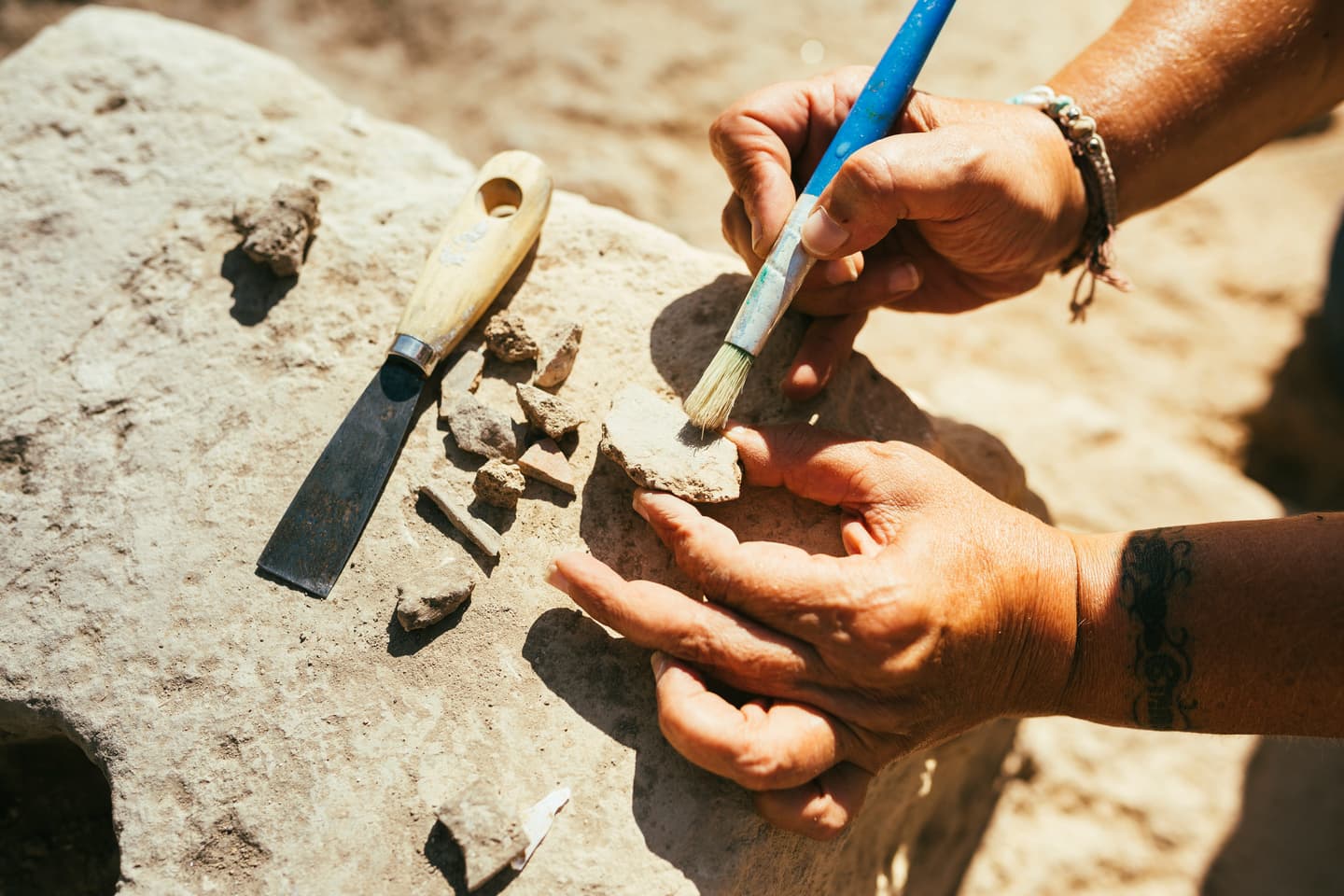
Even though Shég’ Xdaltth’í’ has been studied for more than a decade, the experts weren’t expecting to unearth tens of thousands of artifacts. But that’s exactly what they found, highlighted by stone tools, bone needles, and an antler pendant—along with a hearth, a small pit, and a soil stain marking where a wooden post once stood, likely the remains of a lean-to or early tent. Nearby, the team also uncovered an earth oven filled with charcoal and animal bones, probably used to slow-cook meat for a large family group.
Hunting camps aren’t uncommon in the region, but this is something far beyond that, instead showing people “settling in” to a location they returned to intermittently over roughly 1,000 years. “I expected we’d find hunting tools and knapping [stone tool making] debris surrounding a hearth or two, but I had no idea that we’d stumble into a base camp with tens of thousands of artifacts,” Kelly Graf, the study’s first author and an archaeologist at the University of Kansas, told Live Science. “It was a total surprise.”
The latest archaeological and genetic research has the ancestors of today’s Indigenous Americans entering the continent around 21,000 years ago, so finding an occupied site in eastern Beringia—the Alaskan half of the landmass that joined northeast Asia and northwest North America during the last ice age—with cultural links running both west and south fits the narrative.
Those westward links show up in the stone and the stone sources. The team said the obsidian artifacts match a geological fingerprint hundreds of miles to the northwest, meaning people carried the volcanic rock a long way to the site. The hafted bifaces, meanwhile, were knapped from rhyolite and basalt into a distinctive diamond shape unique to central Alaska, yet they closely resemble tools from sites far to the west in Beringia, in present-day northern Siberia.
Then there are the finds that point south instead. Eight bone needle fragments tie the camp to sites farther south in North America, where the only other eyed needles had previously been recovered, making the Shég’ Xdaltth’í’ needles the oldest discovered in the Western Hemisphere. The antler pendant, with a hole drilled at one end and a point at the other, resembles personal adornments found elsewhere in North America as well.
“The co-occurrence of these cultural features at the single site of Shég’ Xdaltth’í’ is truly notable,” the team wrote, adding that the finds “highlight the strong cultural connection between early Beringians and Americans.”
Whether the residents themselves made those journeys remains unclear. “It would be hard to pin down whether or not they were moving back and forth during a lifetime,” Graf said, “but at least we can say there is a connection.”
The research uncovered one additional surprise. While bones from more than a dozen wolf-like animals create additional links to Asia, an analysis of one animal’s jaw showed it came from neither a dire wolf nor a Pleistocene gray wolf, but from a population of wolf-like canids unique to central Alaska. Because current genetic evidence suggests early domesticated dogs in North America descended from Siberian wolves, the site’s timing and location offer circumstantial evidence that these people may have been dog owners.
Still, further work is needed, both at Shég’ Xdaltth’í’ and elsewhere, to understand the dispersal and timing of population shifts east of the land bridge. “Alaska is a big place and so remote,” Graf said, “so there are really just a few small areas that have been intensively investigated.”
Tim Newcomb is a journalist based in the Pacific Northwest. He covers stadiums, sneakers, gear, infrastructure, and more for a variety of publications, including Popular Mechanics. His favorite interviews have included sit-downs with Roger Federer in Switzerland, Kobe Bryant in Los Angeles, and Tinker Hatfield in Portland.