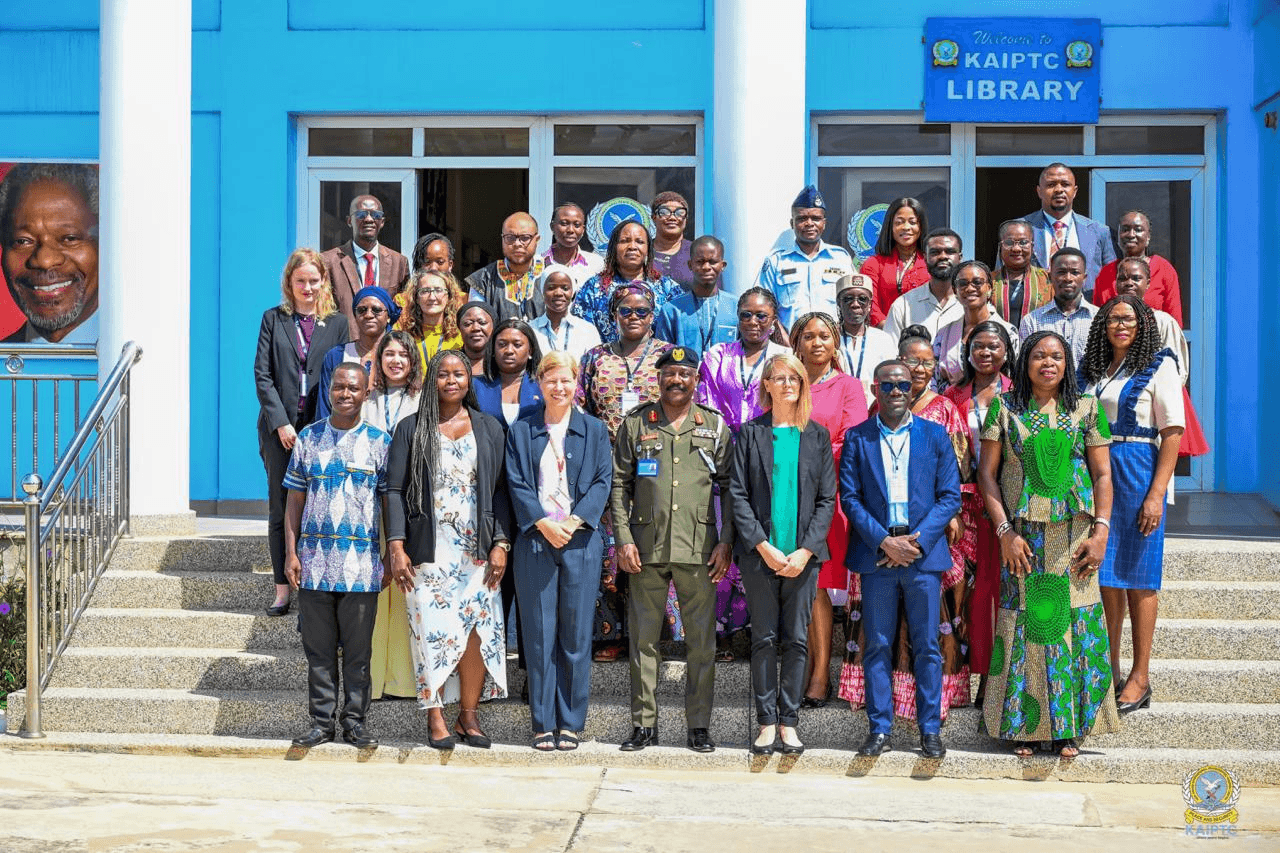
The Kofi Annan International Peacekeeping Training Centre (KAIPTC) has opened its 2026 Gender Advisers’ Course in Accra, aimed at strengthening the capacity of peace and security practitioners to integrate gender perspectives into institutional policies, programmes and operations across Africa.
The training, which brings together participants from across the continent, seeks to equip gender advisers and focal points with practical knowledge, analytical tools and strategic advisory skills to advance the implementation of the Women, Peace and Security (WPS) agenda.

The 2026 edition marks the fifth cohort of the programme, which has benefited more than 80 participants through previous training sessions held in 2021, 2022, 2023 and 2025.
The course was developed following an extensive needs assessment involving serving and former gender advisers to identify the competencies required to address gender-related challenges within peacekeeping and peacebuilding institutions.

Speaking at the opening ceremony, the Deputy Commandant of KAIPTC, Brigadier General Lawrence Deku, stressed that gender mainstreaming must be integrated into every stage of peace and security operations rather than treated as an additional responsibility.
“Gender mainstreaming, therefore, should not be treated as an additional responsibility to be considered only after key operational decisions have been made. Rather, it must be understood as an integral part of effective, inclusive, and sustainable approaches to peace and security,” he stated.

He acknowledged progress in developing international and regional gender policies, including United Nations Security Council Resolution 1325, but expressed concern about the persistent gap between policy commitments and practical implementation.
“The challenge before us is to bridge the gap between commitment and practice,” he emphasised.

Brig. Gen. Deku disclosed that an evaluation of previous editions, conducted in partnership with the Folke Bernadotte Academy (FBA), had revealed significant achievements, including stronger networks of gender experts across Africa, increased representation of women on peace councils and the establishment of gender-responsive institutional structures.
Other achievements included the development of gender-sensitive policies and the deployment of gender officers to peacekeeping missions.
However, the evaluation identified institutional resistance, cultural barriers and the need for stronger strategic advisory skills as continuing challenges.
Also addressing participants, the Head of Component of the ECOWAS Peace, Security and Governance (EPSG) Project, Ms Theresa Kraft, said the training comes at a critical time when Africa faces increasingly complex security challenges, including conflicts, displacement, inequality and weak institutions.

“Gender mainstreaming is therefore not an optional add-on to peace and security work. It is essential to understanding conflict dynamics, protecting civilians, strengthening participation and building sustainable peace,” she stated.
Ms Kraft explained that the course would strengthen participants’ ability to apply gender analysis tools, advise institutional leadership and translate gender-related policies into measurable outcomes.
“You help translate commitments into plans, plans into practice, and practice into measurable results,” she told participants.

She reaffirmed the commitment of Germany, the European Union and Denmark, through the EPSG Project, to supporting the programme alongside the Folke Bernadotte Academy.
The training is organised in collaboration with KAIPTC’s Women, Youth, Peace and Security Institute (WYPSI), with support from partners including the ECOWAS Gender and Development Centre.
Previous editions were funded by the Swedish International Development Cooperation Agency (Sida) through the Folke Bernadotte Academy.

Originally developed in Sandö, Sweden, the course has been adapted to the African context to expand access to specialised gender mainstreaming training for peace and security professionals.
Participants are expected to undertake practical exercises, discussions and simulations designed to strengthen their advisory competencies and improve gender-responsive decision-making within their institutions.
Brig. Gen. Deku urged participants to apply the knowledge acquired to promote institutional reforms and strengthen accountability in peace and security operations.

“The true value of this training, however, will not be measured solely by what you learn while you are at KAIPTC. It will ultimately be measured by what you do with that knowledge when you return to your institutions,” he said.
The programme forms part of ongoing efforts to bridge the gap between gender policy commitments and implementation while promoting inclusive and sustainable peacebuilding across Africa.