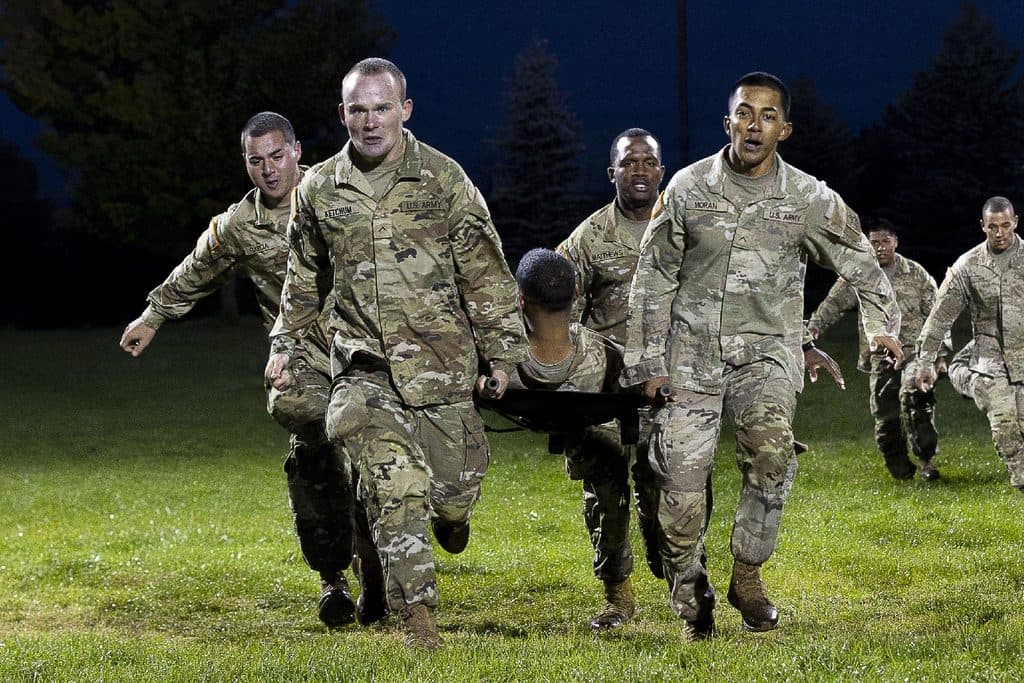
Less than two weeks after it became known, through information from The New York Times, that 600 U.S. soldiers would be deployed to Panama, and then to Honduras and Colombia, to conduct military exercises with troops from those nations, Colombia’s Ministry of Defense confirmed that 300 military personnel will arrive in the country this Tuesday, Oct. 27.
At the time, the U.S. Embassy in Panama denied The New York Times’ report and said it was “categorically false.” It explained that 120 U.S. military personnel from the 10th Mountain Division were participating in a two-week training course in the Panamanian jungle and would return to the United States upon completing their training on Oct. 25.
The presence of these U.S. Army light infantry personnel in Panama represents, in any case, one of the most significant movements of U.S. forces in Latin America in recent years.
Exercises as part of Trump’s regional strategy
But beyond a simple jungle warfare training program at the Jungle Operations Training Center, the deployment was part of a broader regional strategy promoted by the Donald Trump Administration, aimed at strengthening the fight against drug trafficking, transnational criminal organizations, and the protection of critical infrastructure in Latin America.
It is also in this context that the announcement by Colombia’s Ministry of Defense should be understood, stating that U.S. military personnel will begin arriving in the country at the Tolemaida Military Fort, located in the municipality of Nilo, Cundinamarca, for the multinational collective training exercise Southern Vanguard 2026 (VS27), which will run until November 11.
SV27 is a Command Post Exercise and Field Training Exercise held every year. It is fully part of the Joint Staff’s global military exercise strategy, which allows the Joint Force to train alongside allies and partners.
The training seeks to counter regional threats, strengthen partners’ capabilities, and increase readiness levels, the U.S. Embassy in Bogota reported in this regard. The scenarios will focus primarily on maritime interdiction, land security operations, cyber defense, and interagency cooperation.
“This year’s edition is one of the main bilateral training exercises and demonstrates the deep and lasting security alliance between the United States and Colombia,” the diplomatic mission explained. Soldiers from both nations will work shoulder to shoulder to share tactical knowledge, build lasting institutional trust, and strengthen their combined ability to respond to the region’s security challenges.
Aircraft and specialized medical equipment will be used
According to the Ministry of Defense, during the days when U.S. Army light infantry soldiers from the Mountain Battalion are in Colombia, units from the Colombian Army’s Counter-Narcotics Battalion No. 1 will exchange military tactics, techniques, and procedures with them.
The activity, which will bring together around 800 participants: approximately 350 U.S. military personnel and more than 400 soldiers from the Colombian National Army, will begin on Friday, October 30, with an aeromedical evacuation from Tolemaida Military Fort to the facilities of the Cavalry School in Bogota.
According to the Ministry of Defense, the objective will be to verify the medical care and first aid procedures used by the medical personnel of both armies to assist a person who would have been injured in a mined area.
Aircraft and specialized medical equipment will be used to carry out the simulation. The activity will conclude with the transfer of the simulated patient from the helipad at the military facility to a specialized medical care center.
Once this activity is completed, the multinational exercise will continue with a military ceremony marking the beginning of the other training sessions. This edition of the exercise will make it possible to strengthen the capabilities of the participating units through the exchange of experiences and the execution of combined procedures.
During the exercise, which is being held for the fourth time in Colombia, the level of interoperability between both armies will be assessed, as well as coordination in the execution of military maneuvers and operational decision-making processes.
Through these activities, the Colombian Army strengthens international cooperation, the exchange of knowledge, and the preparation of its units to counter the criminal activities of organized armed groups operating across the national territory.