

Fiamma Nirenstein is an Italian-Israeli journalist, author and senior research fellow at the Jerusalem Center for Security and Foreign Affairs (JCFA). An adviser on antisemitism to Israel’s Ministry of Foreign Affairs, she served in the Italian Parliament (2008-2013) as vice president of the Foreign Affairs Committee. A founding member of the Friends of Israel Initiative, she has written 15 books, including October 7, Antisemitism and the War on the West, and is a leading voice on Israel, the Middle East, Europe and the fight against antisemitism.
(Oct. 27, 2026 / JNS)
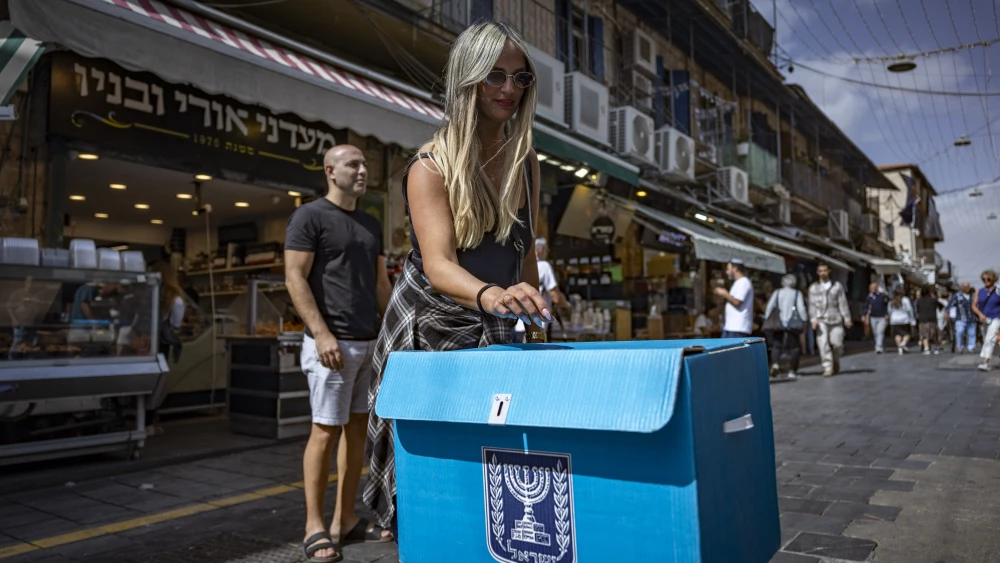
Today, Israel votes.
The meticulousness with which, television station by television station, radio station by radio station and polling place by polling place, the country goes to the polls is almost an ancestral ritual.
The Jewish people as a whole—7,331,981 eligible voters—do not simply cast their ballots today. They bring to the altar of democracy a 3,000-year-old culture in the heart of the Middle East, where democracy remains exceedingly rare.
It is a fundamental choice, one that connects Israel to the democratic West: democracy itself and the integrity of elections. The rules are emphasized almost to exhaustion. Since the days of David Ben-Gurion, Israel’s didactic instinct when it comes to democracy has been irrepressible.
And the precautions are immense.
There are 12,018 polling stations across the country. Some 700 million shekels have been spent on the election, 15,000 cameras have been deployed and tens of thousands of police officers are on guard.
The dangers are not few.
In a country plagued by terrorism, the threat could come from Judea and Samaria. The bitter confrontation between anti- and pro-Netanyahu camps could erupt and spoil the day. Parts of the haredi community, particularly in Jerusalem, remain fiercely at odds with the Jewish state over military conscription.
Hamas and Hezbollah growl from afar. Election Day, with the eyes of the international media fixed on Israel, presents an attractive opportunity for Israel’s enemies to seize the headlines.
And above all, there is Iran.
On Monday, Iranian Foreign Minister Abbas Araghchi met with senior Pakistani, Turkish and Saudi officials against the backdrop of growing regional tensions.
Meanwhile, U.S. President Donald Trump reiterated his support for Netanyahu while making clear that any American intervention against Iran would be postponed—a message also directed at Israel.
At the same time, Israeli public opinion was plunged into another fierce controversy.
Channel 12, one of the media outlets most hostile to Netanyahu, reported that IDF Chief of Staff Lt. Gen. Eyal Zamir had objected both to the government’s increasingly tough posture toward Iran—including flights over Iraqi airspace in exercises intended to send a message—and to Netanyahu’s repeated campaign references to the force Israel could unleash if Iran attacked.
A situation balanced on a knife’s edge could provoke an attack against Israel precisely on Election Day. Netanyahu’s opponents accuse him of playing with fire to win the election.
Neither Netanyahu nor Zamir has confirmed that there was any confrontation between them.
But Netanyahu’s opponents—Gadi Eisenkot, Naftali Bennett and Yair Golan—have repeated the familiar accusation that the prime minister uses security issues for political purposes.
Yet they, too, are playing politics with Israelis’ understandable desire to emerge from the long and bitter defensive war the country has been forced to wage since Oct. 7.
Netanyahu was also heavily criticized for an ugly video posted on X depicting an atomic bomb striking Tel Aviv. His opponents portrayed it as evidence of a prime minister resorting to fear because he is afraid of losing.
But the tension is everywhere. The polls show the two opposing blocs running neck and neck, at almost 60 seats each.
And the meaning is clear.
Despite the bitter confrontation among Israel’s political leaders, 68% of Jewish Israelis regard Oct. 7 as a fundamental factor in deciding how to vote. Security is a primary concern for 39%, while 38% want the cost of living reduced and 27% want the religious to be conscripted.
Among Arab Israelis, 53% want crime in their communities tackled, while 46% seek economic improvement.
Antisemitism and Israel’s international isolation are important to 26%.
For now, danger, terrorism and war remain paramount.
And all the candidates—not only Netanyahu—are seeking votes on these issues.
Even a victory by Eisenkot would not put Israel on the road to appeasement. The siege is real, and whoever governs Israel after today will face the same enemies and the same strategic reality.
Any Israeli government will be forced to seek peace through the deradicalization of the enemy, after defeating it.
That is the lesson today.
But there is another one.
Today, millions of Israelis are going to polling stations, casting secret ballots and deciding for themselves who should govern them, even as their country remains surrounded by threats and torn by profound internal disagreements.
For Israel, democracy is not a luxury reserved for peaceful times.
It is a ritual of national survival.